
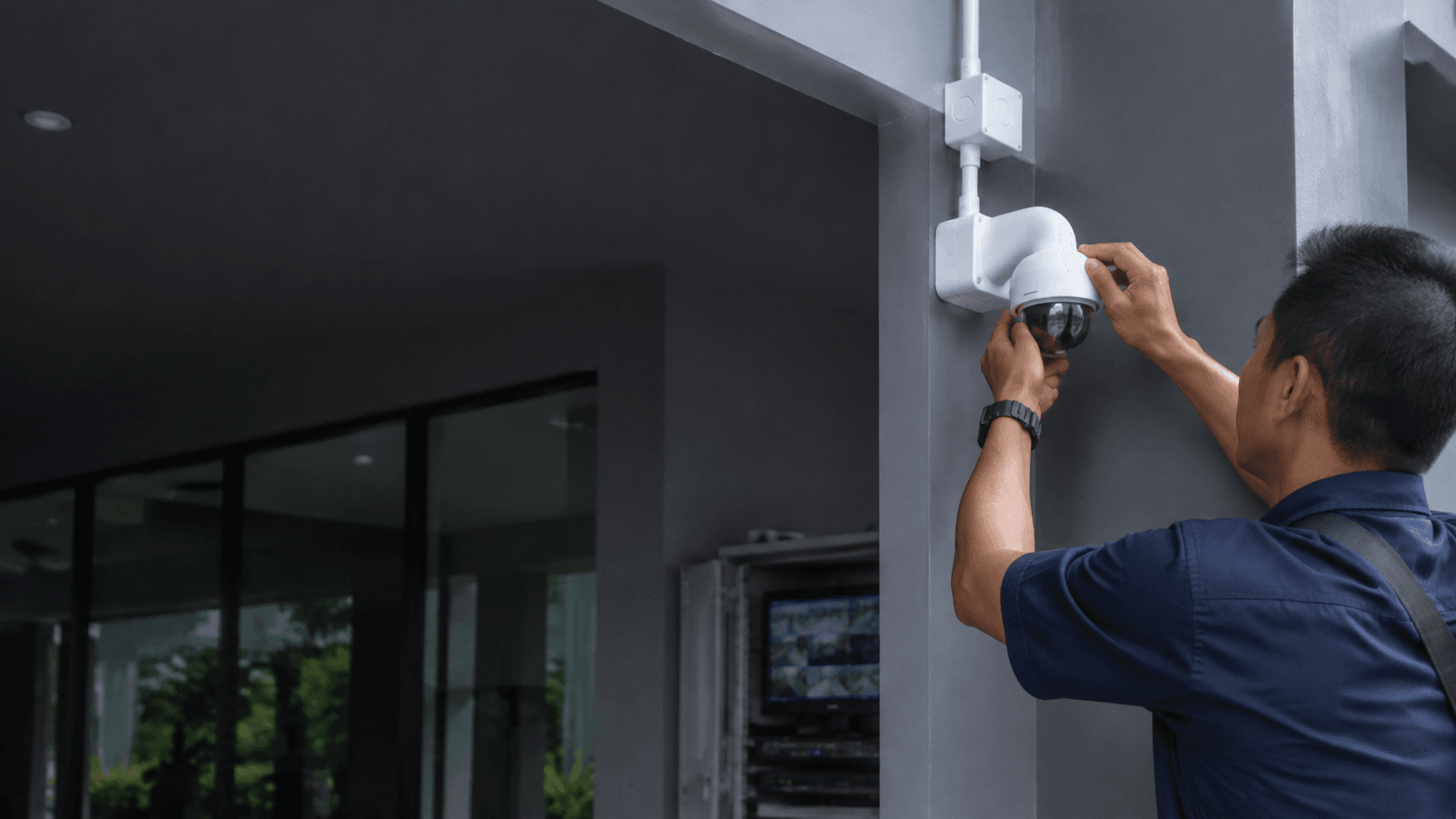
The phrase covers a practical arrangement rather than a product. A shop with four cameras, an office with two floors, or a company with branches in different towns can all end up looking at the same question: where does the picture actually land, and who can see it.
Cctv central in a working system
In a working system, cctv central means the recordings and live views from separate cameras are gathered so that one person can check them without walking to each device. That gathering point is usually a recorder on site, with remote viewing layered on top so the same footage can be opened from a phone or laptop elsewhere.
The value is not the number of cameras. It is whether the person responsible can answer a simple question quickly: what happened at this entrance, at this hour, on this day. A central view shortens that search. A pile of unconnected recorders does not.
Eyonic plans, supplies and installs monitoring systems with camera placement, recording and remote viewing for homes, offices, shops and industrial sites. Those four elements — placement, recording, viewing, and the network that carries them — are what decide whether a central setup feels simple or frustrating six months later.
What the phrase does not mean
Cctv central is sometimes confused with two unrelated things. One is China Central Television, a broadcaster that shares the same abbreviation. The other is closed-circuit television as a general technology category. Neither describes a monitoring arrangement for a property, and neither helps someone deciding how to view several camera feeds together.
It is also not the same as a control room. A control room is a physical space with consoles, displays and operators. A central view can exist without any dedicated room at all, which is the more common situation for shops, offices and homes in Sarawak.
How footage from several cameras reaches one viewing point
Cameras connect to a recorder, the recorder stores the footage, and the recorder is what a phone or computer connects to for remote viewing. The camera is the eye; the recorder is the memory and the meeting point.
Placement comes first because it determines what the system can prove later. A camera aimed at a doorway records faces and arrivals. A camera aimed at a corridor records movement but rarely identity. Eyonic recommends checking actual lighting conditions before confirming placement for ColorVu-style cameras, because a position that looks correct in daylight can behave differently after dark.
Recording configuration follows placement. The recorder needs to know which cameras record continuously, which record on motion, and how the stored footage is organised so a specific hour can be found without scrolling through days of video.
Remote viewing is the last layer, and it depends on the network rather than the camera. If the connection between the recorder and the outside world is weak or unstable, the central view exists on paper but not in practice.
Where a central setup usually breaks down
Three failures appear often. Cameras are placed for coverage rather than for the specific thing that needs to be seen. The recorder is sized for the cameras installed today with no room for one more. Remote viewing is handed over without checking that it works from outside the property's own network.
Each of these is cheaper to resolve before installation than after. A short site survey catches all three.
What changes when a site has more than one location
A single building is straightforward: one recorder, one viewing point. Multiple locations introduce a choice. Each site can keep its own recorder and be viewed separately, or the sites can be linked so footage is reachable through one interface.
The trade-off is between simplicity and convenience. Separate recorders are easier to install, easier to troubleshoot, and fail independently — one site going down does not affect the others. A linked arrangement is more convenient to check but depends on the network between sites staying healthy, and a problem in that link can make several sites look unavailable at once.
For most Sarawak businesses with two or three premises, the practical middle ground is separate recording at each site with remote viewing configured for all of them, so a manager can open any location from one device without the sites depending on each other to keep recording.
Eyonic's work for the Kuching Immigration Office focused on arrival flow, staff areas, visitor movement and dependable daily operation. That project shows the pattern clearly: the requirement was not more cameras, but coverage matched to how people actually move through a building, with reliability as the priority.
Questions worth settling early
Who needs to see the footage, and from where? If the answer is one manager on a phone, the design is simple. If the answer is several people across departments, the design needs to account for who can view what, and how access is removed when someone leaves.
What happens when the internet is down? Recording should continue locally even when remote viewing does not. A setup that depends entirely on an outside connection to record is a setup with a single point of failure.
How far back does footage need to go? Retention is a storage decision, and storage is a cost. The right answer depends on how quickly an incident is normally noticed, not on a round number.
Planning checks before committing to a central setup
The sequence below is the one Eyonic follows on CCTV installation work in Sarawak. It exists to prevent the common outcome where equipment is bought before the requirement is understood.
- Site survey — walk the property, check lighting at the times that matter, and confirm where cabling can realistically run.
- System proposal — set out camera positions, recording approach and viewing method against the actual requirement.
- Installation — mount, cable, configure recording, and confirm remote viewing works from outside the property's network.
- Handover — walk through live view, playback and mobile access so the system is usable without a manual.
Two checks belong inside that sequence rather than after it. Confirm that the recorder has capacity for at least one additional camera, because requirements grow. Confirm that remote viewing has been tested from a mobile network, not only from the property's own Wi-Fi, because those are different conditions.
Budget expectations vary with scope. Eyonic's published package pricing starts at RM 1,599 for a Hikvision CCTV package covering camera supply and setup, basic recording configuration and mobile viewing handover. Larger multi-area work sits in a different range: the Kuching Immigration Office project carried an approximate budget of RM 12,000 to RM 28,000, and the KTA Sarawak Sdn Bhd office project an approximate budget of RM 8,000 to RM 18,000. Those figures describe completed project scopes, not a quotation for any other property.
What cannot be confirmed in advance
Camera count, storage duration and network method all depend on the site. Anyone quoting those numbers before seeing the property is guessing. The honest position is that the survey produces the design, and the design produces the cost.
Where Eyonic fits for Sarawak properties
Eyonic Sdn Bhd is a security system supplier based in Sarawak, working on CCTV and ELV systems for homes, offices, shops and industrial sites. The company was founded by Eric Yong, who has more than ten years in the industry and works on technical installation of digital security solutions for commercial businesses in Sarawak.
The service scope covers site survey, camera placement, NVR setup and remote viewing — the four pieces that decide whether cctv central is genuinely useful or just a screen with pictures on it. Work is planned around how a property is actually used rather than around a standard package applied to every site.
For a property in Kuching or elsewhere in Sarawak, the practical next step is a survey. Share the location, the property type and the required system with Eyonic on WhatsApp at +60 11-5111 7959, and the survey will establish what the site needs before any equipment is specified.