
The exact model, code capacity and battery figures for a Yale Touchpad Lock are not published in the material behind this page, so the guidance below stays on what can be checked at the door, how code entry behaves in daily use, and what to settle before any unit is ordered.
Yale Touchpad Lock. what the touchpad does at the door
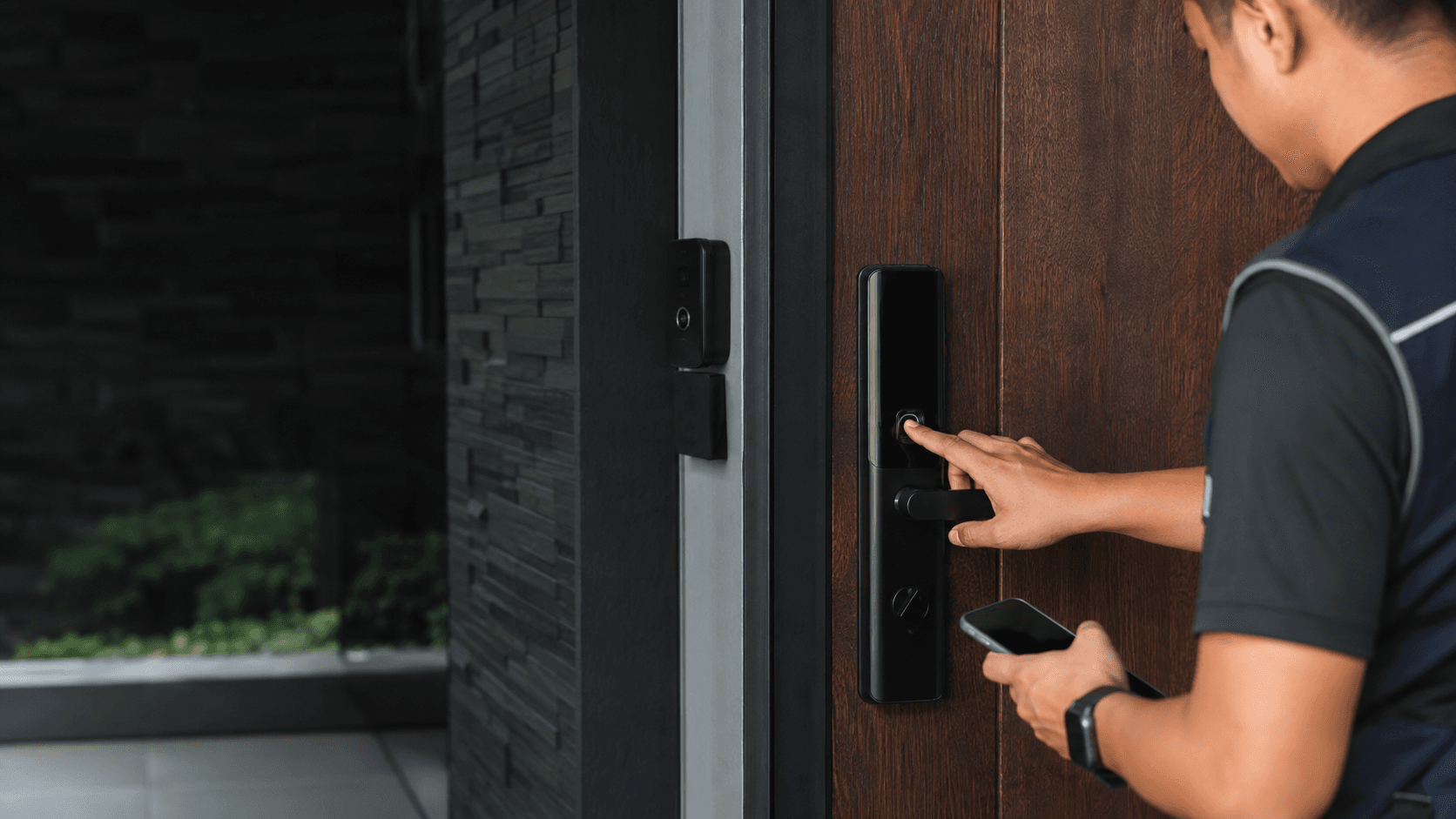
The touchpad replaces the key turn. A person enters a code, the lock reads it, and the bolt retracts. There is no keyway to pick in the ordinary sense and no key to copy, which is the main reason a household or a small office considers one.
Two things sit behind that simple action. The first is the credential. the code itself, which is stored in the lock and can be changed. The second is the mechanism. a motor or solenoid that drives the bolt once the code is accepted. Both matter, because a lock with a good pad and a weak bolt is still a weak door.
Yale builds touchpad entry into more than one product family, and the families differ. Some are complete deadbolt replacements. Others are add-on keypads that pair with a separate smart lock. The add-on route keeps an existing lock and adds a pad beside it; the replacement route removes the old deadbolt entirely. That distinction changes the cost, the installation and the number of parts that can fail.
Eyonic's own product review guidance treats smart lock door access as suitable for controlled convenience when user permissions and backup entry are planned properly. That wording is deliberate. The lock is not sold as a substitute for a monitored alarm or a camera system. It controls who can open one door, and it records nothing about what happens after the door opens.
How code entry works in daily use
Daily use is where the difference between a good installation and a frustrating one shows up. The pad is touched, the code is entered, the bolt moves. Everything else is about what happens around that moment.
Codes are usually split into roles. One code acts as the administrator or management code and is used to add or remove the others. The remaining codes belong to household members, staff or regular visitors. When someone leaves, their code is deleted rather than the lock being rekeyed, which is the practical advantage over a mechanical key.
Batteries are the second daily factor. A touchpad lock runs on its own power supply, and low battery is the most common reason a working lock stops responding. A lock that warns before it fails is manageable. A lock that fails silently is not, which is why the backup method matters more than the pad itself.
Backup entry is the part most buyers under-plan. Options include a mechanical key override, a temporary code issued to a trusted person, or a second entrance that is not electronically locked. Whichever is chosen, it should be tested before it is needed, not during the first failure.
Weather and door movement also shape daily behaviour. A door that swells in the wet season can bind against the bolt even when the code is accepted, and the user reads that as a lock fault. Aligning the strike and checking the door's swing is part of making the lock work, not an optional extra.
What to check before choosing a Yale Touchpad Lock
The checks below are ordered because each one can rule out the next. Skipping ahead usually means buying a lock that does not fit the door.
- Confirm the door condition and the existing hardware, including whether the current lock is a deadbolt, a mortise set or a lever, and whether the door closes and latches cleanly without force.
- Define who needs entry and at what level, separating permanent users from occasional visitors so the code list stays short and reviewable.
- Decide the backup entry method before installation, and confirm it works independently of the touchpad.
- Confirm power expectations, including what type of battery the lock uses and who will replace it on a schedule.
- Confirm installer and handover support, so the code setup, user testing and a walkthrough of the backup method happen at the door rather than over the phone.
Door condition is the first check for a reason. A touchpad lock needs a door that already closes and latches properly. If the door drags, the frame is out of square, or the existing cut-outs do not match the new hardware, the lock will be blamed for a door problem. Fixing the door first is cheaper than replacing a lock twice.
The second check is about people, not hardware. A home with four residents needs four codes and one administrator. A shop with rotating staff needs a way to add and remove codes without disturbing the others. A small office with a shared entrance may find that a standalone lock is the wrong tool and that an access control panel with a reader and a door controller fits better, because it can be managed centrally and tied to a record of entries.
Eyonic's review guidance makes that same split explicit: for business use, the question is whether a standalone smart lock or an access-control panel is more appropriate. The deciding factors are the number of users, whether entry needs to be logged, and whether the door is one of several that should be managed together.
Door, user and backup entry planning
Three variables decide whether a Yale Touchpad Lock is the right answer for a specific door: the door, the users, and the fallback.
On the door, the relevant questions are the door material, its thickness, whether it is an entrance or an internal door, and whether it is exposed to direct rain. An internal office door and an exposed gate post present very different conditions, and a lock suited to one is not automatically suited to the other.
On users, the useful distinction is between people who need permanent access and people who need access for a defined period. Contractors, cleaners and short-stay guests fall into the second group. A code that can be issued and withdrawn is the reason to choose a touchpad over a key, and it only delivers that benefit if someone actually withdraws the code when the period ends.
On backup, the honest position is that every electronic lock has a failure mode. Power runs out. A pad can be damaged. A code can be forgotten. The plan should name what happens in each case and who holds the override. In a household, that is usually one trusted person. In a business, it should be a documented role rather than an individual's memory.
There is also a scale threshold worth naming. A single door with a handful of users is a good fit for a standalone touchpad lock. Several doors, dozens of users, or a requirement to review who entered and when points toward an access control panel instead. Choosing the wrong one of those two is the most expensive mistake in this category, because it is discovered after installation.
Installation and support in Sarawak and Malaysia
Installation quality decides how the lock behaves for the next several years. A touchpad lock is fitted to an existing door, so the installer works with whatever the door already has: the bore holes, the backset, the strike position and the frame alignment.
Eyonic's installation process runs through site survey, system proposal, installation and handover. Applied to a door lock, that sequence means the door is inspected before anything is ordered, the proposed hardware is matched to what the door can accept, the fitting is done on site, and the handover covers code setup, user testing and the backup method.
That order matters in Sarawak and across Malaysia because door stock varies. Imported doors, local solid timber doors and metal grille doors do not present the same cut-outs, and a lock chosen from a photograph may not match the door in front of the installer. A survey removes that guesswork.
Eyonic's project record includes the Kuching Immigration Office, where the work focused on arrival flow, staff areas, visitor movement and dependable daily operation. That is a public-office environment with a mix of staff and visitors, which is exactly the setting where user roles and backup entry have to be settled before installation rather than after. A separate project for KTA Sarawak Sdn Bhd covered a practical office setup in Kuching supporting staff movement, visitor handling, tidy cabling and clearer daily site control.
Support after installation is the part that cannot be judged from a product page. What can be confirmed is who attends when the lock stops responding, whether spare parts are held locally, and whether the original installer is reachable. Those questions belong in the conversation before the order, not after the first fault.
Costs, packages and the next practical step
No verified price for a Yale Touchpad Lock in Malaysia is available in the material behind this page, so no figure is quoted here. What is documented is Eyonic's package pricing for other security systems: the Hikvision CCTV Package at RM 1,599, the Hikvision Alarm System at RM 1,599, and the Autogate Package at RM 1,599. Each package covers supply, setup and handover rather than hardware alone.
Those figures are useful as a shape, not as a quote for a lock. They show that a supplied-and-installed package includes configuration and a handover walkthrough, which is the part a buyer often forgets to budget for when comparing a lock bought online against one installed on site.
For a door lock specifically, the cost drivers are the lock itself, whether the door needs preparation or repair before fitting, and whether the site needs a survey visit. A door that is already square and already has a suitable cut-out is the cheapest case. A door that needs adjustment before the lock goes on is not.
Where a property needs more than one door managed together, the budget conversation shifts from a lock to a small access control scope. Eyonic's documented project budgets for office work in Kuching sit in the RM 8,000 to RM 18,000 range for a practical office setup, and RM 12,000 to RM 28,000 for a public-office scope covering arrival flow, staff areas and visitor movement. Those are project figures, not lock prices, and they are included only to show the scale at which a single-door lock stops being the right answer.
Share your location, property type and required system with Eyonic on WhatsApp at +60 11-5111 7959 for the next practical step.