
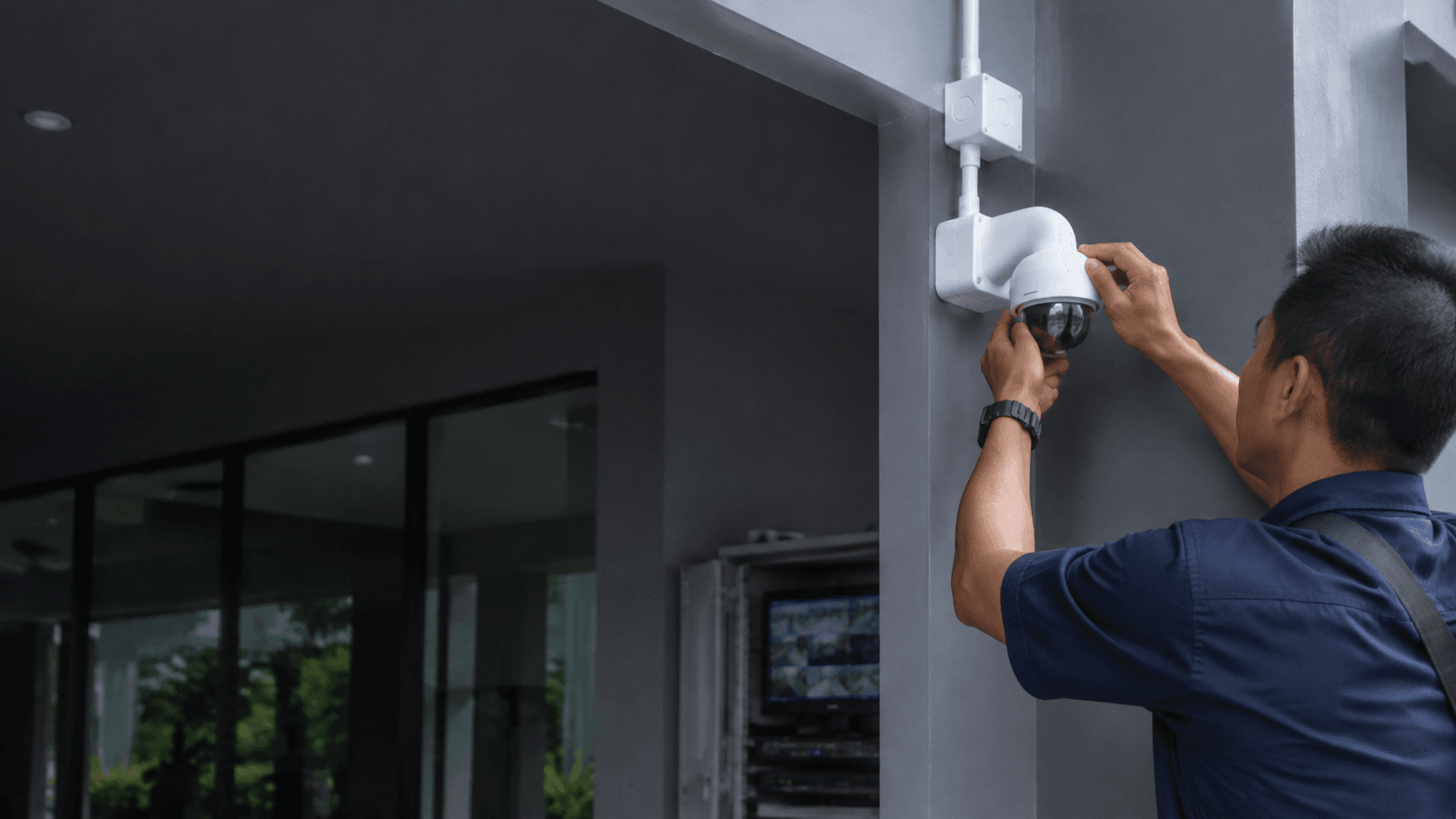
Infrared is the part of a CCTV system that most people only notice when it fails. A camera that looks sharp at noon can turn soft, grainy, or half-lit at 9pm, and the cause is usually the interaction between the camera's infrared illuminator and the surfaces, distances, and light sources around it. In Malaysia, that interaction is shaped by long dark hours, reflective finishes, street lighting, and the way a building is actually used after closing time.
Eyonic Sdn Bhd plans, supplies, and installs monitoring systems with camera placement, recording, and remote viewing for homes, offices, shops, and industrial sites in Sarawak. The company's documented installation process runs through site survey, system proposal, installation, and handover, which is the sequence that decides whether cctv infrared coverage holds up in practice.
Cctv infrared after dark. what the camera is actually doing
A standard CCTV camera sensor needs light to form an image. When ambient light drops below the level the sensor can use, the camera switches to its infrared mode: a ring of LEDs around the lens emits infrared light, the sensor captures what bounces back, and the image is rendered in black and white. The camera is not seeing heat, and it is not seeing through anything. It is lighting the scene with a wavelength the human eye cannot detect, then reading the reflection.
That mechanism explains most night-vision behaviour. Infrared light falls off with distance, so a subject at the far edge of a camera's reach returns less light and appears dimmer and noisier than a subject near the lens. Infrared also reflects strongly off some surfaces and absorbs into others, which is why a glossy car bonnet, a wet road, or a polished sign can flare white while a dark matte wall stays flat and detail-free.
Two practical consequences follow. First, infrared performance is a property of the whole scene, not just the camera. Second, the only reliable way to know how a specific camera will behave at a specific site is to look at that site under its real night-time conditions.
Why the image changes to black and white
Colour information depends on visible light reaching the sensor. Once the camera relies on its own infrared illumination, there is no usable colour data to record, so the image is delivered in monochrome. This is normal behaviour, not a fault, and it is the reason night-time footage is judged on clarity, contrast, and coverage rather than colour accuracy.
Where infrared stops being the right answer
Infrared is not the only low-light approach. Some cameras are built to hold colour in very low light by using a larger aperture and a more sensitive sensor, and Eyonic has published guidance that actual lighting conditions should be checked before confirming placement for ColorVu-style cameras. The trade-off is straightforward: infrared gives dependable monochrome coverage in near-total darkness, while low-light colour cameras can preserve colour and detail where some ambient light remains, but their usefulness depends on how much light is genuinely present at that spot after dark.
Lighting conditions decide placement, not the box
Camera placement is the decision that determines whether cctv infrared footage is usable. Two cameras of identical specification can produce very different results depending on where they are mounted, what they point at, and what sits between the lens and the area of interest.
Several conditions recur across real sites:
- Distance to the target. Infrared intensity drops with range, so a camera asked to cover a long driveway or a wide yard will return a dimmer image at the far end than a camera covering a doorway.
- Reflective surfaces in frame. Glass, chrome, wet asphalt, and painted metal bounce infrared back toward the lens and can wash out part of the image.
- Existing light sources. Street lamps, security lights, and shop signage create uneven pools of light that the camera must handle across a single frame.
- Obstructions. Foliage, pillars, parked vehicles, and roof overhangs block both the camera's view and its infrared output.
- Angle and height. A camera mounted too high or angled too steeply can lose facial detail at the point where identification matters most.
These are not abstract concerns. A camera covering an entrance needs enough infrared to render a face clearly at the door, while a camera covering a perimeter needs enough reach to show movement at the boundary. Those two jobs often call for different mounting positions, and sometimes different camera types, within the same property.
What a site survey is looking for
A survey is not a formality before installation. It is the step where the lighting conditions at each proposed camera position are observed, the distances to the areas of interest are measured, and the obstructions that will affect infrared performance are identified. It is also where the difference between what a property owner wants to see and what a camera can realistically deliver becomes clear.
Eyonic's documented process places the site survey first, before any system proposal is written. That ordering matters, because a proposal built without a survey tends to specify cameras by price or by brand rather than by the job each position has to do.
How Eyonic plans a cctv infrared installation
The installation sequence Eyonic follows is documented on its CCTV installation services page and runs in four stages.
- Site survey. The property is assessed on location, including the lighting conditions at each proposed camera position, the distances involved, and the obstructions that will affect coverage.
- System proposal. A proposal is prepared covering camera placement, recording, and remote viewing, matched to what the survey found rather than to a standard package.
- Installation. Cameras, cabling, and the recording unit are installed and configured, including NVR setup where a network video recorder is part of the system.
- Handover. The system is handed over with mobile viewing configured, so the property owner can check footage remotely after the installation team has left.
The sequence is deliberately front-loaded. Most night-vision problems that get blamed on equipment are actually placement problems, and placement is decided in the first two stages. Once cameras are mounted and cabling is run, correcting a coverage gap is far more disruptive than getting the position right at the proposal stage.
Eyonic's project record shows the same approach applied at scale. For the Kuching Immigration Office, the work focused on arrival flow, staff areas, visitor movement, and dependable daily operation. Those are coverage priorities rather than equipment specifications, and they are the kind of priorities that a survey establishes before any camera is chosen.
Remote viewing and recording
Infrared footage is only useful if it can be reviewed. Recording is handled by the NVR or recorder in the system, and remote viewing lets the property owner check live and recorded footage from a phone or computer. Both are configured during installation and confirmed at handover, which is the point at which the system is tested under the conditions it will actually operate in.
What a package includes in Malaysia
Eyonic's published Hikvision CCTV Package is priced at RM 1,599 and covers camera supply and setup, basic recording configuration, and mobile viewing handover. That is the package structure the company lists, and it is the appropriate starting point for a conversation about a specific property.
What the package does not do is fix a camera count, a camera type, or a placement plan in advance. Those depend on the survey. A single shop lot with one entrance and a small back area has different requirements from a two-storey office with a car park, a loading bay, and a reception desk. The package price covers the supply, setup, recording configuration, and handover work; the scope of what gets installed is determined by what the site needs.
For larger or more complex sites, project budgets are scoped individually. Eyonic's published project records show approximate budget ranges of RM 8,000 to RM 18,000 for an office setup and RM 12,000 to RM 28,000 for a public office project, which gives a sense of how scope scales beyond a basic package.
What to confirm before committing
Before confirming a cctv infrared installation, it is worth establishing a few things in writing:
- Which positions were surveyed, and what lighting conditions were observed at each one.
- What each camera is expected to cover, and at what distance.
- Whether the system records continuously or on motion, and how long footage is retained.
- How remote viewing is configured and who has access to it.
- What happens if a camera position turns out to underperform after dark.
These questions are answerable from the survey and proposal, and they are the difference between a system that was specified for a property and one that was simply installed at it.
Questions before confirming placement
Will infrared work in heavy rain or haze
Infrared light is scattered and absorbed by particles in the air, including rain, mist, and smoke, and the effect increases with distance. The supplied evidence does not include measured performance data for Malaysian weather conditions, so the honest position is that performance varies with conditions and distance, and that a site survey is the appropriate way to judge a specific location rather than a general claim.
Does every camera need infrared
No. Cameras covering areas with reliable lighting may perform well without relying on infrared, and low-light colour cameras can be a better fit where some ambient light is present. The decision belongs to the survey, not to a default rule.
Can infrared be added to an existing system
Sometimes. Whether an existing recorder, cabling, and power arrangement can support additional or replacement cameras depends on what is already installed. That is a question for the survey stage, where the existing setup can be assessed alongside the coverage requirement.
How many cameras are needed
Camera count follows from coverage, not from property size alone. The useful starting point is a list of the areas that need to be seen after dark, the distance from a practical mounting point to each area, and whether identification or general awareness is the goal at each position.
What is the next practical step
Share the location, property type, and required system with Eyonic on WhatsApp at +60 11-5111 7959. A survey establishes the lighting conditions at each position, and the proposal that follows is built on what the site actually needs after dark.