
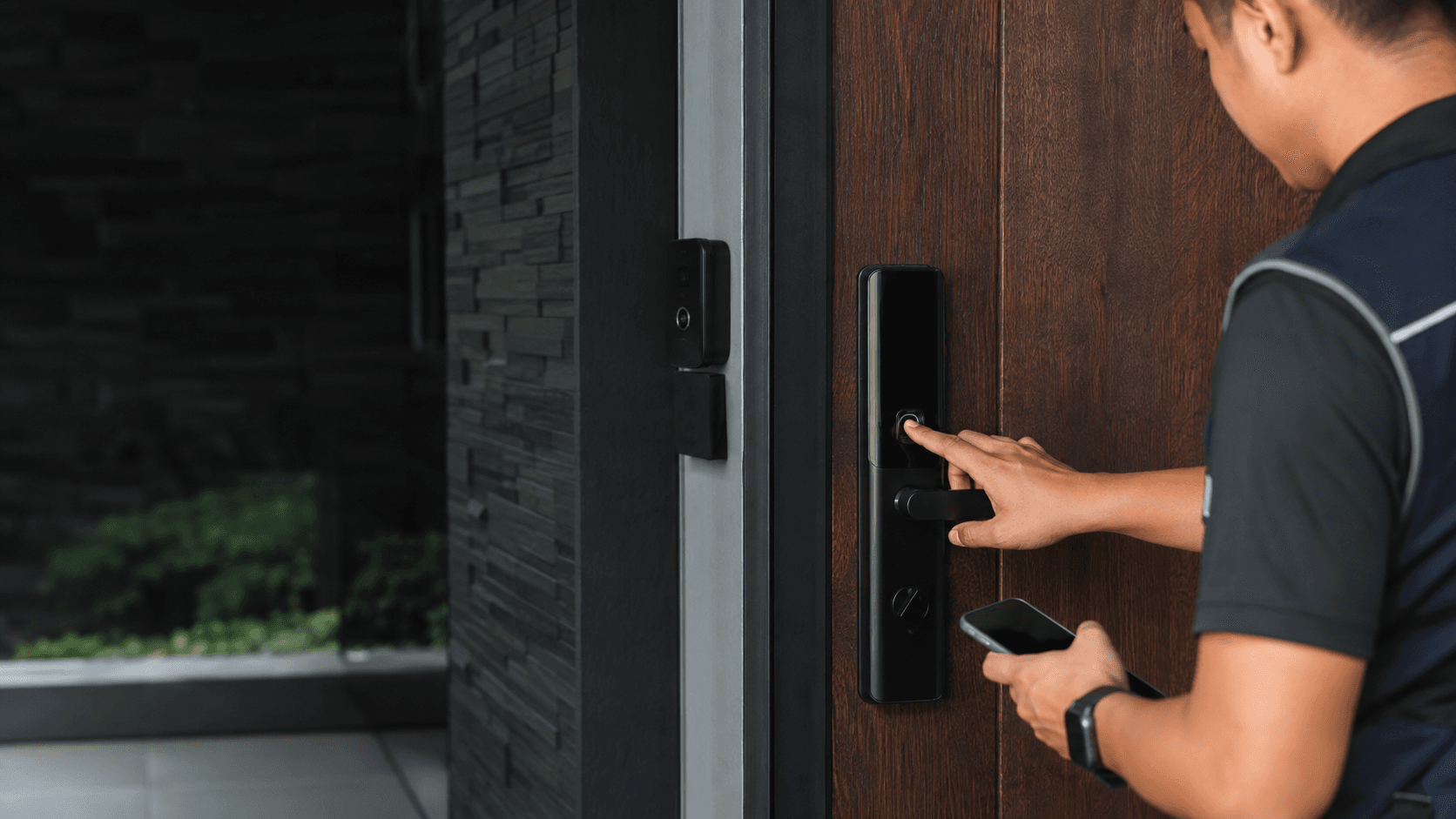
The exact-match phrase "yale smart door handle" describes a small, awkward category. Yale sells smart locks, code handles, and lever-handle replacements, but the company does not market a single product called a smart door handle. Buyers searching that phrase usually want one of three things: a handle that replaces an existing lever, a keypad handle that locks automatically, or a full deadbolt smart lock with a separate handle below it. Sorting those apart before buying prevents the most common mistake in this category, which is ordering a deadbolt replacement for a door that only needs a new handle.
Yale Smart Door Handle. What Matters Before You Choose
Three physical facts decide which product fits. The first is whether the door already has a deadbolt above the handle. The second is the backset, the distance from the door edge to the centre of the handle hole, which is commonly 60 mm or 70 mm on residential doors. The third is the door thickness, because most smart hardware is built for a standard range and thinner or thicker doors need different fittings.
A handle-only smart lock replaces the lever and leaves the existing deadbolt in place. A deadbolt smart lock replaces the lock above the handle and leaves the handle alone. A full entry set replaces both. Yale's own product line reflects this split: the Assure Lock 2 and the Assure Lock SL are deadbolt replacements, the Assure Lever is a handle replacement, and the Code Handle is a keypad handle with the locking mechanism built into the handle itself.
Wirecutter's smart lock testing names the Yale Assure Lock 2 as a runner-up pick and describes it as stylish and sturdy, while CNET names the same lock as its best overall home smart lock. Both outlets test deadbolt replacements, not handle-only hardware, which is a useful signal about where the mature product category sits.
Choosing the Right Yale Smart Door Handle
The decision sequence below follows the order that matters on site: confirm the door, confirm the access method, confirm the power and network path, then confirm the backup entry. Skipping a step usually means a return or a second visit.
- Check whether the door has a separate deadbolt above the handle, and measure the backset and door thickness.
- Decide the access method. PIN code, fingerprint, phone app, or a physical key as the primary route.
- Confirm how the lock gets power and whether it needs a hub, a Wi-Fi module, or a bridge to reach the network.
- Confirm the backup entry method, because a battery lock with no key and no external power point is a lockout risk.
- Confirm the door closes and latches cleanly before installation, since smart hardware amplifies an existing alignment fault.
- Confirm who manages user codes and how they are removed when a tenant, staff member, or contractor leaves.
Step four deserves emphasis. A keypad handle with an automatic locking mechanism opens only when the correct PIN is entered, which is convenient until the battery drains or the code is forgotten. Yale's Code Handle line is built around that automatic locking behaviour, so the backup plan matters more than the feature list.
What is yale smart door handle?
In practice, the phrase covers Yale's keypad and code handle products plus the handle-side hardware that pairs with a Yale smart deadbolt. Yale's own product pages describe code handles as an indoor lock solution with an automatic locking mechanism built into the handle, opened by entering the correct PIN code. That is a narrower product than a full smart deadbolt, and it is aimed at interior doors, offices, and rooms where a keyed cylinder is inconvenient.
Buyers who want app control, remote access, and smart home integration are usually looking at the deadbolt side of the range instead. The Yale Assure Lock 2 supports Bluetooth and keypad entry, with Wi-Fi and Z-Wave Plus modules available depending on the model, and the Yale Access app handles lock and unlock commands. The Yale Approach Lock with Wi-Fi and keypad is a retrofit design that fits over an existing deadbolt rather than replacing it, which suits renters and anyone unwilling to modify the door.
Smart Lock Products | Door Hardware | Yale Home
Yale's retail structure separates smart locks from general door hardware. The smart lock collections carry the Assure family, the Approach retrofit lock, and the Code Handle line, while the wider door hardware catalogue covers levers, deadbolts, exit devices, cylinders, closers, and parts. That split matters when searching, because a query about a smart door handle can land on a page selling mechanical levers with no electronics at all.
Third-party retailers add another layer. The Home Depot lists the Yale Assure Lock 2 with Bluetooth and pushbutton keypad under a specific model code, and specialist sellers such as GoKeyless group Yale Home locks by brand rather than by product type. Availability, finish options, and pricing vary by market, so a model confirmed on a manufacturer page may not be stocked locally.
Handle-only, deadbolt, or retrofit
Handle-only hardware suits interior doors, back doors with a separate deadbolt, and offices where the handle is the only locking point. Deadbolt replacement suits main entry doors and gives the widest choice of access methods. Retrofit hardware suits rented property and doors where the existing deadbolt is sound and only the control layer needs upgrading.
The trade-off is straightforward. Handle-only products are cheaper and simpler but offer fewer access methods and less integration. Deadbolt replacements cost more and need more installation work but support app control, guest codes, and smart home platforms. Retrofit designs avoid door modification but add bulk to the inside face of the door and depend on the existing deadbolt's condition.
Practical Considerations for Yale Smart Door Handle
Installation is the point where most of these projects succeed or fail. Eyonic Sdn Bhd, a security system supplier in Sarawak, reviews smart lock door access and notes that smart locks work best when the door condition, user roles, and backup method are reviewed before installation. The same review states that for business use, the choice between a standalone smart lock and an access-control panel is usually checked first.
That distinction is worth understanding. A standalone smart lock manages one door and a handful of users through an app. An access-control panel manages many doors, many users, and a record of who entered where. A small office with one entrance and five staff fits the first. A building with multiple entrances, shift changes, and a need to review entry records fits the second, and a smart handle alone will not deliver it.
Door condition is the other practical constraint. A door that sticks, a frame that has moved, or a latch that needs lifting to close will cause problems with any motorised or automatic locking mechanism. Fixing alignment before installation is cheaper than replacing hardware afterwards.
Where this fits in a wider security setup
Door hardware is one layer of a building's security. Eyonic's project work includes the Kuching Immigration Office, where the focus was arrival flow, staff areas, visitor movement, and dependable daily operation, and the KTA Sarawak Sdn Bhd office setup in Kuching, which supported staff movement, visitor handling, tidy cabling, and clearer daily site control. Both projects show the same pattern: access at the door only works when the surrounding flow is planned.
For residential and small commercial sites in Sarawak, Eyonic supplies and installs CCTV, alarm, autogate, keyphone intercom, and Starlink internet systems alongside smart lock door access. Package pricing for the Hikvision CCTV package, the Hikvision alarm system, and the autogate package is listed at RM 1,599 each, covering supply, basic configuration, and handover. Larger project work has run in the RM 8,000 to RM 18,000 range for an office setup and RM 12,000 to RM 28,000 for a public office installation.
Limits worth knowing before ordering
Smart handles and smart locks depend on batteries, and battery life varies with usage, temperature, and how often the motor runs. A lock that reports low battery through an app still needs someone to act on that report. In a rental property or a site with no regular occupant, that is a real risk.
Network dependency is the second limit. App control, remote unlock, and entry notifications need a working internet connection and, on some models, a hub or bridge. If the network drops, local keypad or key entry usually still works, but remote features do not. Anyone relying on remote access for deliveries or contractors should confirm the local fallback before committing.
Compatibility is the third. Smart home platforms, wireless protocols, and module options differ between models in the same family, so two locks that look similar on a shelf may not support the same integrations. Checking the specific model number against the intended platform is faster than checking the brand.
Making an Informed Choice About
The practical answer for most buyers is to decide the door first and the product second. A main entry door with an existing deadbolt points toward a deadbolt replacement or a retrofit lock. An interior door with no deadbolt points toward a code handle or lever replacement. A business with multiple doors and staff turnover points toward an access-control panel rather than a standalone smart handle.
For readers in Sarawak, the installation side matters as much as the product. Eric Yong, founder of Eyonic Security Systems, has worked in the industry for more than ten years on technical installation of digital security solutions for commercial businesses in Sarawak, and the company's process runs through site survey, system proposal, installation, and handover. That sequence exists because door condition, user roles, and backup entry are easier to settle on site than over a product listing.
Share the location, property type, and required system with Eyonic on WhatsApp at +60 11-5111 7959 to move from product comparison to a site-specific plan.