
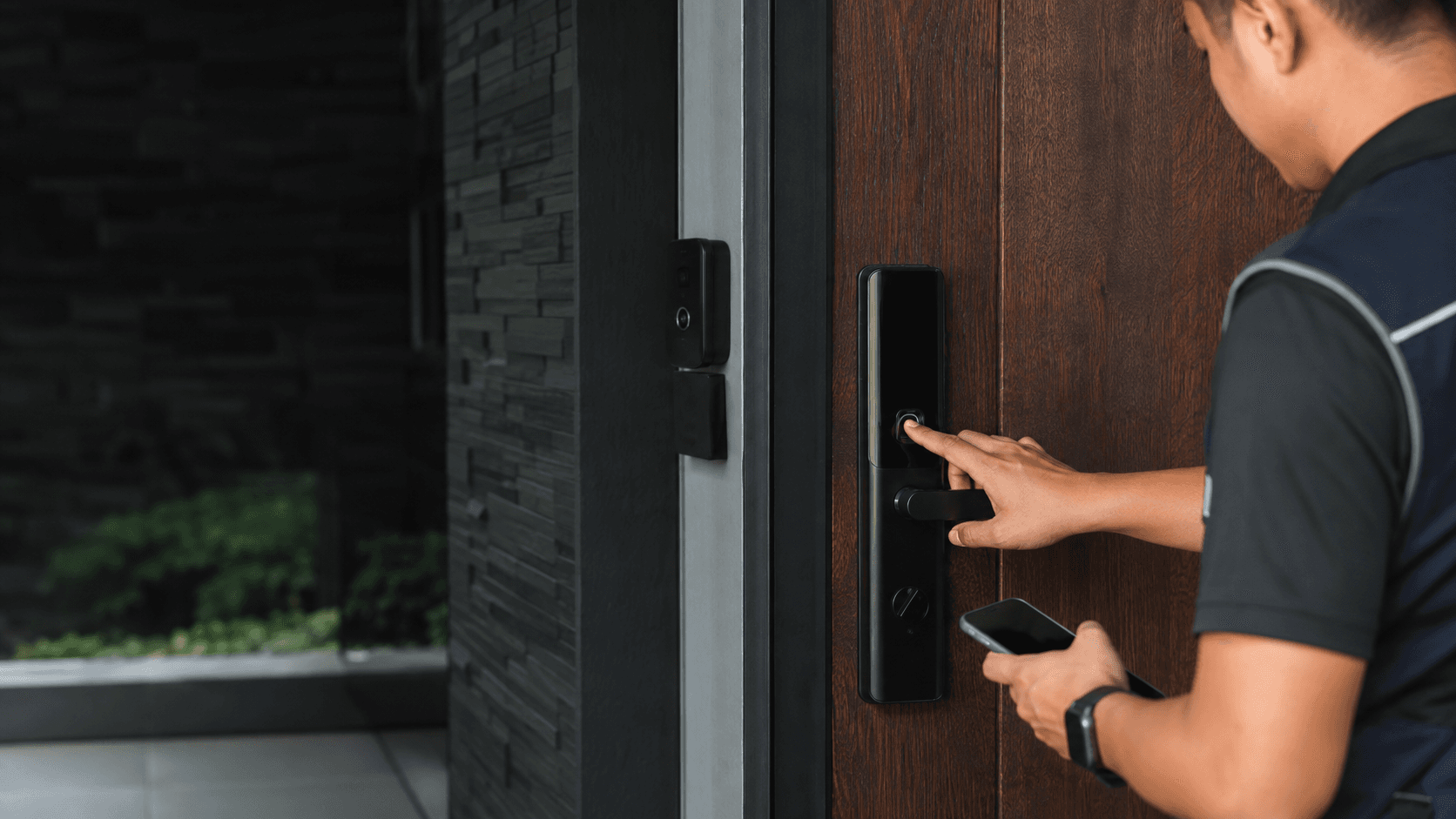
What Is a Thumbprint Door Lock?
A thumbprint door lock reads the unique ridges of a finger to verify identity before releasing the latch. The sensor captures the fingerprint pattern, converts it into a digital template, and compares it against enrolled users stored in the lock's memory. When a match occurs, the lock mechanism disengages and the door opens.
The term "thumbprint door lock" is commonly used interchangeably with fingerprint door lock or biometric door lock in Malaysia. Most units sold locally combine the fingerprint reader with additional entry methods such as PIN codes, RFID cards, mobile apps, or physical backup keys. This multi-factor approach addresses the main practical concern with biometric entry: what happens when a registered finger is wet, injured, or unavailable.
Eyonic, a security system supplier in Sarawak, categorises smart lock door access as suitable for controlled convenience when user permissions and backup entry are planned properly. For business use, Eyonic usually checks whether a standalone smart lock or an access-control panel is more appropriate before recommending a specific configuration.
Why Choose a Thumbprint Door Lock for Your Property?
The primary advantage of a thumbprint door lock is eliminating physical keys that can be lost, copied, or forgotten. Household members no longer need to carry keys for the main entrance, and property owners avoid the cost and delay of rekeying after a lost key incident.
For commercial settings, a thumbprint door lock provides an audit trail of who entered and when, assuming the model records access history. This supports staff movement monitoring and visitor handling in office environments. Eyonic's project work illustrates this need: the Kuching Immigration Office required practical support focused on arrival flow, staff areas, visitor movement, and dependable daily operation. An engineering consultancy client, KTA Sarawak Sdn Bhd, needed an office setup supporting staff movement, visitor handling, tidy cabling, and clearer daily site control.
A thumbprint door lock also removes the security risk of unauthorised key duplication. Fingerprint templates cannot be copied by a local locksmith, and access can be revoked instantly by deleting a user profile rather than collecting keys from a departing employee or tenant.
Key Features to Compare in a Thumbprint Door Lock
Not all thumbprint door locks perform equally in Malaysian conditions. Buyers should compare several technical and practical specifications before purchase.
**Fingerprint sensor type and accuracy.** Optical sensors capture an image of the fingerprint, while semiconductor or capacitive sensors read electrical differences in the ridge pattern. Capacitive sensors generally perform better with dry or worn fingers common in air-conditioned environments. Sensor accuracy affects false rejection rates, where a registered user cannot open the door.
**Fingerprint storage capacity.** Residential locks typically store 20 to 100 fingerprints. Commercial access-control panels support hundreds or thousands of users. A household with extended family, domestic helpers, and frequent visitors needs more capacity than a single occupant.
**Backup entry methods.** Every thumbprint door lock should offer at least one alternative entry method. PIN keypads are standard. Mechanical key override is critical for total battery failure. Mobile app access adds remote convenience but depends on network reliability.
**Power source and battery life.** Most thumbprint door locks run on AA batteries or a rechargeable lithium pack. Battery life ranges from six months to over a year depending on usage frequency. Low-battery warnings appear on the keypad or through the companion app before complete failure.
**Door material and thickness compatibility.** Malaysian homes commonly use timber doors, metal doors, and aluminium-framed glass doors. A thumbprint door lock must match the door thickness, typically 35 mm to 55 mm for residential units, and the lock bore hole spacing. Mortise locks require different mounting than cylindrical bore locks.
The table below summarises the two main configuration types:
| Configuration | Best For | Fingerprint Capacity | Backup Options | Typical Price Range |
|---|---|---|---|---|
| Standalone smart lock | Residential homes, small offices | 20–100 users | PIN, key, app, card | RM 500 – RM 2,500 |
| Access-control panel | Commercial buildings, multi-door sites | 100–1,000+ users | PIN, card, central software | RM 3,000 – RM 15,000+ |
Standalone smart locks suit single-door applications where the owner manages users directly on the device. Access-control panels fit properties with multiple entry points, staff turnover, and centralised management requirements. Eyonic's product review notes that smart locks work best when the door condition, user roles, and backup method are reviewed before installation.
How to Install a Thumbprint Door Lock: Step-by-Step
Proper installation determines whether a thumbprint door lock functions reliably over years of daily use. A poorly aligned latch or loose mounting plate causes false readings and premature wear. The installation sequence below reflects the process Eyonic applies to security system projects, which begins with a site survey and ends with a structured handover.
- Assess the door condition, alignment, and material to confirm the chosen thumbprint door lock fits the existing bore holes and edge preparation.
- Select the lock configuration, standalone smart lock or access-control panel, based on user count, door count, and management needs.
- Prepare mounting tools and verify the power source, checking battery type, polarity, and whether wired power is required for the lock model.
- Remove the existing lock cylinder and latch, then install the new latch mechanism with the correct backset for the door thickness.
- Mount the exterior assembly with the fingerprint reader and the interior assembly with the battery compartment, securing all screws evenly.
- Register fingerprints for each user, assign PIN codes or cards as backups, and test every entry method before closing the door.
Door alignment matters more than most buyers expect. A door that sags or rubs against the frame creates friction that the lock motor must overcome, draining batteries faster and causing false "not closed" errors. Eyonic's CCTV installation process includes a site survey before any work begins, and the same principle applies to lock installation: physical conditions on site determine what will work reliably.
Thumbprint Door Lock Maintenance and Troubleshooting
A thumbprint door lock requires minimal but consistent maintenance. The fingerprint sensor should be wiped clean periodically with a dry cloth to remove oil, dust, and moisture that accumulate from daily touching. Malaysian humidity accelerates this buildup, particularly on exterior doors exposed to rain and direct sunlight.
Battery replacement is the most common maintenance task. When the low-battery indicator appears, replace all batteries at once rather than mixing old and new cells. Keep spare batteries accessible but away from the lock itself, since extreme heat in a metal door frame can shorten battery life.
Common issues and their causes include:
- **Fingerprint not recognised:** Dry, cracked, or wet fingers cause false rejections. Register the same finger multiple times or enrol two fingers per user as a fallback.
- **Lock motor runs but door does not open:** The latch may be misaligned with the strike plate, or the door has shifted. Adjust the strike plate position or door hinges.
- **Keypad unresponsive:** Check battery voltage first. If batteries are healthy, the lock may have entered a lockout mode after repeated failed attempts.
- **Lock beeps but does not function:** Consult the model's error code chart. Different beep patterns indicate low battery, sensor error, or mechanical jam.
For commercial installations, Eyonic recommends reviewing user roles and permissions periodically. When staff leave, their fingerprints and access codes should be removed promptly to maintain security integrity.
Where to Buy Thumbprint Door Locks in Malaysia
Malaysian buyers can source thumbprint door locks through several channels, each with distinct trade-offs.
**Security system integrators** like Eyonic provide planning, supply, and installation services for homes, offices, shops, and industrial sites. This option suits buyers who want professional assessment of door compatibility and installation quality. Eyonic's project portfolio includes government and engineering consultancy clients, demonstrating experience with demanding commercial environments.
**Hardware and home improvement retailers** stock consumer-grade smart locks from international brands. These offer competitive pricing but limited installation support. Buyers must verify door compatibility themselves and arrange separate installation.
**Online marketplaces** provide the widest model selection and price comparison. However, warranty enforcement and after-sales support vary significantly between sellers. Imported models may lack local certification or voltage compatibility.
**Specialist lock shops** carry mechanical and electronic locking products with trained staff who can advise on door types and installation requirements.
The right purchase channel depends on the property type and the buyer's technical confidence. A single residential door with standard timber construction may suit a retail purchase with DIY installation. A commercial property with multiple doors, staff turnover, and integration requirements warrants professional supply and installation through a security system integrator.
Eyonic's approach to smart lock door access focuses on reviewing door condition, user roles, and backup methods before installation. For business use, the company determines whether a standalone smart lock or access-control panel is more appropriate. This assessment prevents the common failure of purchasing a residential-grade lock for commercial traffic levels.
Property owners considering a thumbprint door lock should also evaluate how the lock integrates with existing security systems. A smart lock that connects to a CCTV or alarm system provides a more complete security picture than an isolated device. Eyonic's range of security services, including CCTV, alarm systems, and access control, allows for coordinated installation across these systems.
The practical decision for most Malaysian buyers comes down to three factors: the number of users who need access, the door construction, and the acceptable backup methods. A thumbprint door lock delivers genuine convenience when these factors are matched to the right hardware and professional installation where needed.