
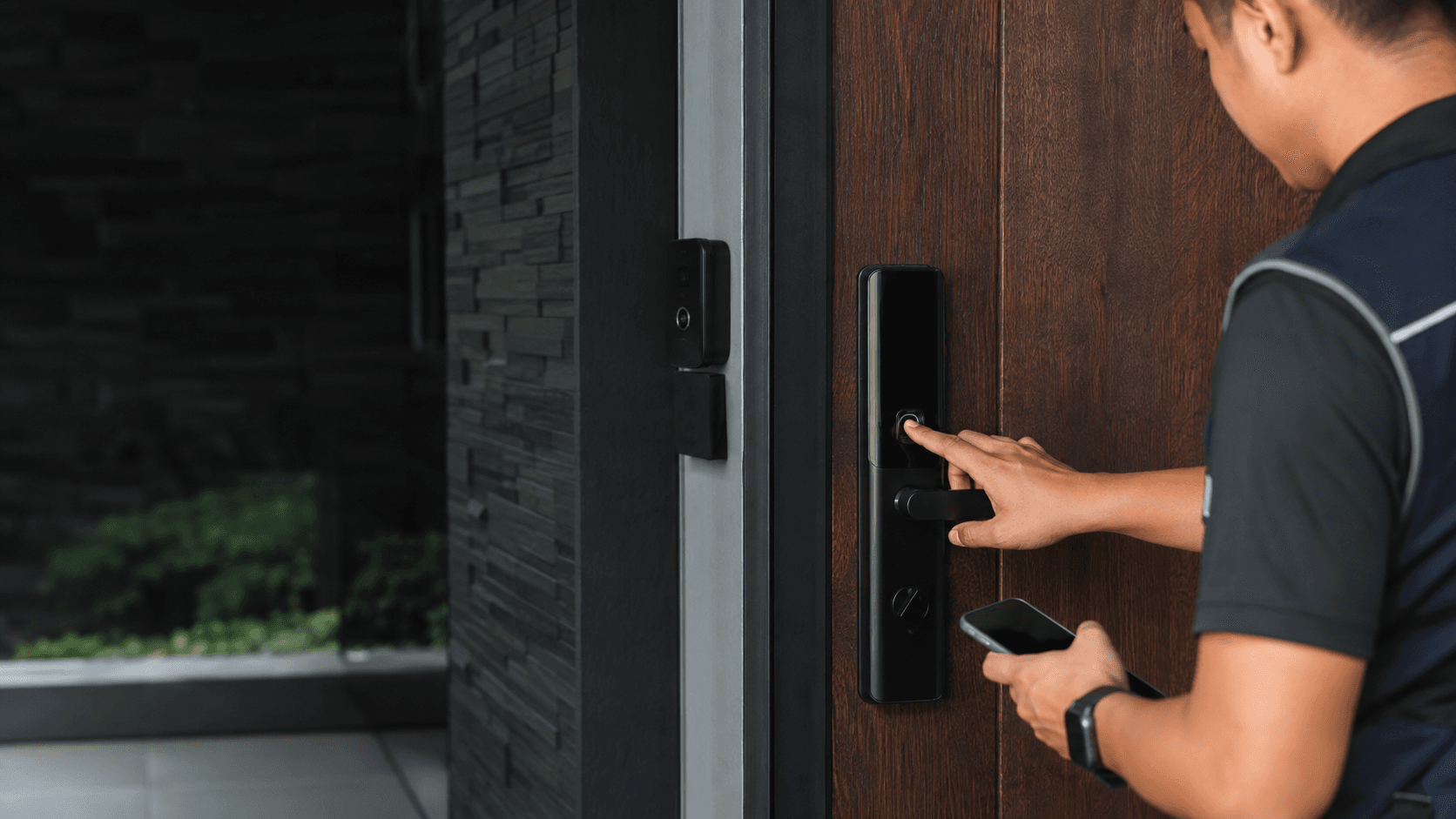
Eyonic Sdn Bhd, a security system supplier in Sarawak, treats smart lock door access as good for controlled convenience when user permissions and backup entry are planned properly. The same review applies to an exterior smart lock fitted on a gate, a front door, a side door or a rental unit, because the lock has to survive rain, heat and daily use rather than only look good in a showroom.
Most buying pages rank models by brand and price. That order does not match how an exterior smart lock is actually chosen in Malaysia, where the deciding factors are usually the mounting surface, the shade over the entry, who needs daily access and what happens when the battery runs flat.
Exterior smart lock choices for Malaysian outdoor entries
An exterior smart lock is not one product category with one answer. The practical split is between a standalone lock that replaces or adds to the existing deadbolt, and a lock that forms part of a wider access-control setup with a panel managing multiple doors and users.
Eyonic's own product review notes that for business use, the company usually checks whether a standalone smart lock or an access-control panel is more appropriate. That check matters at home too. A single front door with a handful of family users behaves very differently from a shop entrance with staff, delivery access and shift changes.
The entry type shapes the choice more than the brand does:
- A covered front door under a porch or awning sees far less direct rain than an exposed gate post.
- A metal gate and a timber door present different drilling, alignment and mounting problems.
- A rental unit adds a further constraint, because the lock may need to be removed or re-keyed when tenancy changes.
- A side or back door is often the least sheltered entry on the property and the one most used by household members.
Because no verified Malaysian model list or pricing is available for this category, the honest position is that model selection follows the site assessment, not the other way round. A lock chosen before the door is measured is a lock that may not fit.
Weather, heat and humidity on an outdoor door
Malaysian conditions test an exterior smart lock in three ways at once: direct rain on exposed faces, sustained humidity that affects electronics and battery compartments, and heat build-up on metal surfaces that sit in afternoon sun.
Manufacturer datasheets normally state an IP rating for water and dust ingress and an operating temperature range. Those two figures are the ones worth checking against the actual mounting position, because a lock rated for sheltered use and installed on an exposed gate post is being used outside its stated conditions. Where a datasheet is not available for a specific model, that model cannot be confirmed as suitable for an exposed position.
Shading changes the calculation. A gate under a tree canopy, a recessed door frame and a covered porch all reduce direct rain and sun load. An entry with no overhead cover and full afternoon sun is the hardest case, and it is also the case where a lock with a documented weather rating matters most.
Humidity is the slower problem. It works on seals, battery contacts and any exposed metal over months rather than days, which is why the condition of the existing door and frame is reviewed at the same time as the lock itself.
Matching an exterior smart lock to gate, grille and door hardware
Fitting an exterior smart lock to a gate, a grille or a door is a hardware question before it is a technology question. The lock has to align with what is already there, or the surrounding hardware has to change with it.
The details that decide fit are the door thickness, the backset distance from the door edge to the centre of the existing bore, the handedness of the door, and whether the frame can accept the strike or latch that comes with the lock. A grille or a metal gate adds its own constraints, because the mounting surface may be hollow section rather than solid timber, and the lock body may need a different fixing approach.
Retrofit and full replacement are the two routes. A retrofit keeps the existing deadbolt and adds smart control on the inside, which suits rented property and doors that should not be modified. A full replacement swaps the deadbolt or handle set, which gives a cleaner result on a door that is being upgraded anyway. Neither route is universally better; the deciding factor is whether the existing hardware is sound and correctly aligned.
Where a gate motor already controls vehicle access, the pedestrian door beside it is a separate entry with its own lock. Mixing the two into one expectation usually creates confusion about which device opens what.
Access methods, user roles and backup entry
Access method is where an exterior smart lock earns its place or becomes a daily irritation. Fingerprint, keypad code, app control, card or tag, and a physical key are the common options, and most locks combine two or more.
User roles decide how those methods are assigned. A household needs a small number of permanent credentials. A rental unit needs temporary or time-limited codes that can be issued and revoked between guests. A shop or office needs a clearer split between staff who enter daily and visitors who need one-time access. Eyonic's review of smart lock door access places user permissions and backup entry at the centre of whether the installation works, which matches how these decisions play out in practice.
Backup entry is the part most often skipped. Every battery-powered lock eventually runs flat, and the recovery path should be decided before installation rather than during a locked-out evening. The usual options are a mechanical key override, an external power contact for a temporary boost, or a second entry that is not dependent on the same lock. Whichever is chosen, the person who needs it should know where the key is kept or how the power contact is used.
For business sites, the same question becomes an access-control question. A standalone lock manages one door well. Multiple doors, staff groups and an audit of who entered when point toward a panel-based setup instead.
Installation checks before an exterior smart lock is fitted
A short pre-installation review prevents most of the problems that appear after fitting. The checks below follow the sequence Eyonic uses across its installation work, where a site survey comes before a system proposal, installation and handover.
- Confirm the door or gate condition, including frame alignment, warping, rust and whether the surface can carry the lock body securely.
- Confirm the existing lock type and dimensions, including door thickness, backset, bore size and handedness, so the replacement or retrofit matches.
- Confirm exposed weather and shading at the exact mounting position, and compare that against the IP rating and operating temperature range on the manufacturer datasheet.
- Confirm who needs daily access, and separate permanent users from temporary or one-time visitors.
- Confirm the backup entry method, whether that is a mechanical key override, an external power contact or a second independent entry.
- Confirm power or battery expectations, including battery type, expected service interval and who is responsible for replacement.
Handover matters as much as the fitting. Users need to be shown how to add and remove credentials, how to check battery status and what to do when the lock does not respond. A lock that only the installer understands is a lock that generates calls later.
Eyonic's wider project work follows the same pattern of matching the setup to how a site is actually used. At the Kuching Immigration Office, the focus was arrival flow, staff areas, visitor movement and dependable daily operation. At KTA Sarawak Sdn Bhd, the requirement was a practical office setup supporting staff movement, visitor handling, tidy cabling and clearer daily site control. Those are the same questions an exterior smart lock raises on a smaller scale: who arrives, how they get in, and whether the entry still works on an ordinary Tuesday.
Exterior smart lock questions Malaysian owners ask
Can an exterior smart lock be fitted to a metal gate? It depends on the gate section and how the lock body can be fixed. A hollow metal section, a grille and a solid plate each need a different mounting approach, and the lock has to align with the gate frame rather than sit proud of it. This is a site assessment question, not a model question.
What happens when the battery dies? The lock stops responding to electronic access. The recovery path is the backup entry method chosen before installation, which is normally a mechanical key override or an external power contact. Battery type and expected service interval should come from the manufacturer datasheet for the specific model.
Is a standalone lock or an access-control panel better? A standalone lock suits a single entry with a small number of users. A panel-based setup suits multiple doors, staff groups and a need to review who entered and when. Eyonic checks this distinction for business use before recommending either.
Does an exterior smart lock suit a rental unit? It can, provided the installation does not permanently alter the door in a way the landlord has not agreed to, and provided temporary codes can be issued and revoked between tenants or guests. A retrofit approach is usually easier to reverse than a full replacement.
What should be checked before confirming a model? The door or gate condition, the existing lock dimensions, the exposure at the mounting position, the user list and the backup entry method. Model selection follows those answers, and any specification claim should be traceable to the manufacturer's own documentation.
For properties in Sarawak, Eyonic handles site survey, system proposal, installation and handover across its security and ELV work, and the same sequence applies when an exterior smart lock is part of the entry plan. Share the location, property type and required system with Eyonic on WhatsApp at +60 11-5111 7959 for the next practical step.