
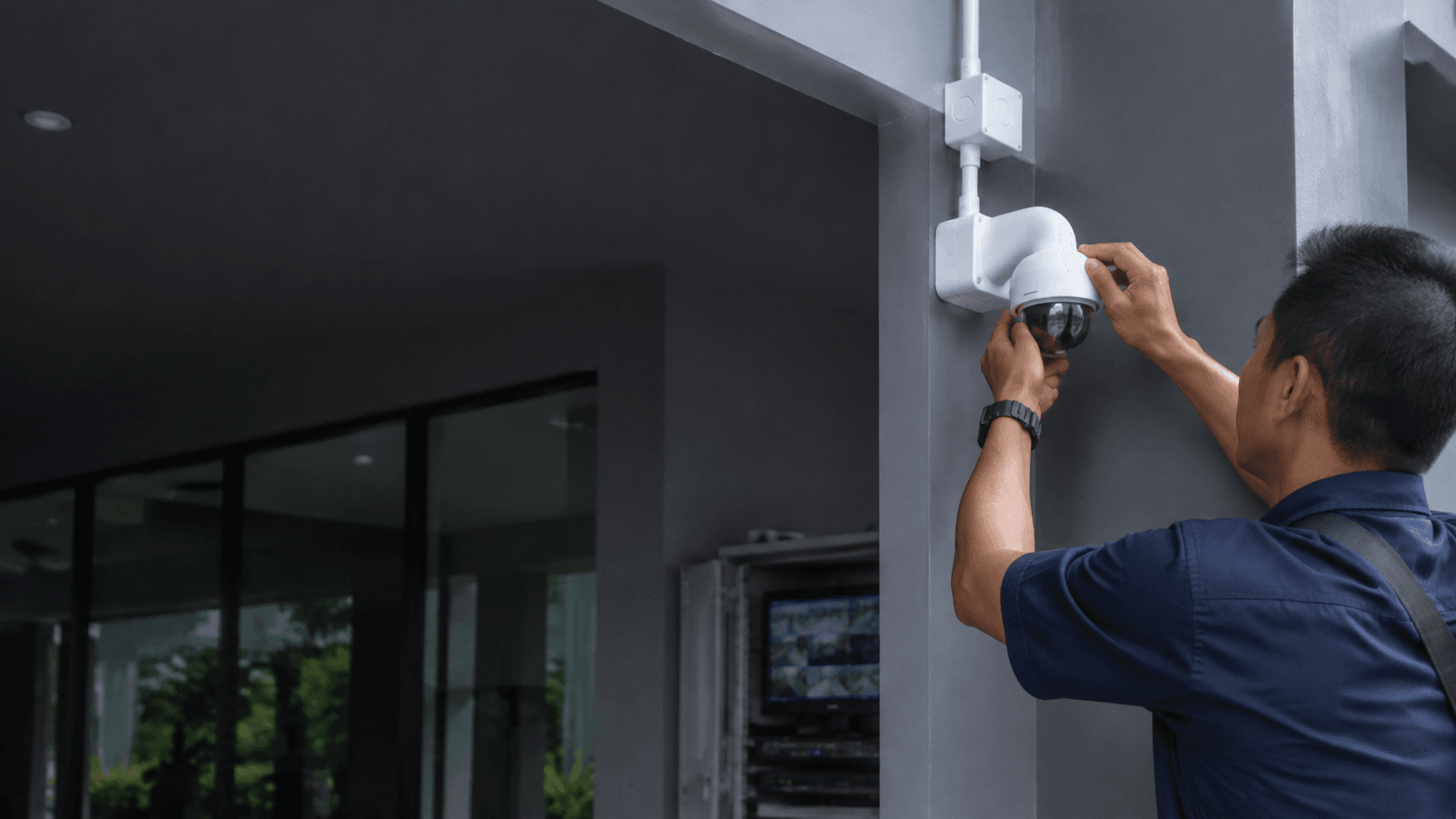
Malaysia's outdoor conditions punish guesswork. Rain arrives in heavy bursts, low-light hours stretch across the year, and a camera aimed at the wrong angle records a wall instead of a gate. The best outdoor CCTV camera decision therefore starts with the property, not the product box.
Eyonic Sdn Bhd is a security system supplier in Sarawak that plans, supplies and installs CCTV and ELV systems. Its founder, Eric Yong, has worked in the industry for more than 10 years, with technical installation experience across commercial sites in Sarawak.
Best Outdoor Cctv Camera: What Matters Before You Choose
An outdoor CCTV camera in Malaysia faces two pressures at once: water and darkness. Rain, humidity and direct sun hit the housing, while dusk, tree cover and shadowed corridors reduce the light a lens can work with. A camera that performs in a bright showroom may behave differently on a north-facing wall that never sees direct sun.
This is why Eyonic treats the site survey as the first real step. The survey records where water runs, where light falls, and where people and vehicles actually move. Those observations shape camera placement, recording configuration and remote viewing setup far more than a specification sheet does.
Public buildings show the same logic at larger scale. Eyonic's project for the Kuching Immigration Office focused on arrival flow, staff areas, visitor movement and dependable daily operation. The cameras served the building's daily routine, not a demonstration.
Lighting decides more than resolution for an outdoor CCTV camera
Resolution describes how much detail a sensor can capture. Lighting decides whether that detail exists at all. A high-resolution camera pointed at an unlit back lane at night records noise and silhouettes; a lower-resolution camera in adequate light records faces and number plates.
Eyonic's guidance on ColorVu-style cameras is to check actual lighting conditions before confirming placement. ColorVu cameras are designed to produce colour images in low light, but the result still depends on what light is present on site. A corridor with a single bulb behaves differently from a driveway with a streetlight nearby.
Practical checks during a survey include:
- Whether the area has any artificial light at night, and when it switches on.
- Whether headlights, streetlights or neighbouring lights create glare across the lens.
- Whether trees, awnings or walls cast shadow across the target area at different hours.
- Whether the camera can be aimed to avoid pointing directly into a light source.
Where light is genuinely absent, the answer is often supplementary lighting or a different camera position rather than a more expensive sensor. That trade-off is easier to settle before installation than after.
How Eyonic plans an outdoor CCTV camera installation
Eyonic's CCTV installation process follows four stages, and each one produces something the next stage depends on.
- Site survey — the property is reviewed for camera placement, lighting conditions, cable routes and recording location.
- System proposal — the survey findings are turned into a proposed system covering cameras, NVR setup and remote viewing.
- Installation — cameras, cabling and recording equipment are installed and configured.
- Handover — recording, playback and mobile viewing are explained and tested with the user.
The sequence matters because a proposal written before a survey is a guess. Camera placement decided on site can account for a gate that opens inward, a shop counter that faces a window, or a corridor where the only sensible mounting point is above head height.
NVR setup and remote viewing are part of the same plan rather than add-ons. Recording location determines how much footage is retained and who can review it, while remote viewing determines what the owner can check from a phone. Both are settled during the proposal stage so the installed system matches what was agreed.
What the survey should record
A useful survey captures entry and exit points, the movement of people and vehicles, existing lighting, power availability near mounting points, and the route cabling can take without damaging finishes. For commercial premises, it also captures staff areas and visitor handling, which is the pattern Eyonic applied at the Kuching Immigration Office.
Eyonic's work for KTA Sarawak Sdn Bhd followed a similar pattern for an engineering consultancy: staff movement, visitor handling, tidy cabling and clearer daily site control. In both cases the camera plan served an operating routine rather than a generic coverage diagram.
Outdoor CCTV camera placement and coverage questions worth settling early
Placement questions are cheaper to answer on paper than on a ladder. The following points tend to decide whether a system performs as expected.
Where should cameras point first?
Entry and exit points usually earn the first cameras, because they capture who arrives and who leaves. Driveways, gates, back doors and shopfronts follow. Coverage of an entire compound is rarely the goal; coverage of the routes people actually use is.
How high should a camera be mounted
Higher mounting reduces the chance of tampering but flattens the angle, which can turn a face into a hat. Lower mounting captures better identification but is easier to reach. The right height depends on what the camera is expected to prove.
What about privacy and neighbouring property
Cameras should be aimed at the property they protect. A camera that sweeps a neighbour's window or a public walkway creates a problem the footage rarely solves. Aim and field of view are worth confirming with the people who live or work on site.
How is footage reviewed after an incident
Playback is only useful if someone can find the relevant clip quickly. Recording configuration, retention and the way footage is searched should be demonstrated at handover, not discovered later.
Costs packages and the next practical step
Eyonic publishes three packages at RM 1,599 each. The Hikvision CCTV Package covers camera supply and setup, basic recording configuration and mobile viewing handover. The Hikvision Alarm System covers a control panel and sensors, siren and zone setup, and user testing and handover. The Autogate Package covers motor recommendation, remote-control setup, and safety testing and handover.
Larger projects sit above package level. Eyonic's Kuching Immigration Office project carried an approximate budget of RM 12,000 to RM 28,000, and the KTA Sarawak Sdn Bhd project an approximate budget of RM 8,000 to RM 18,000. Those figures reflect site-specific scope rather than a standard price for an outdoor CCTV camera.
Hardware pricing beyond the published package is not fixed in advance, because the camera count, mounting positions and cabling route all change with the property. A survey is what converts those variables into a proposal.
Share your location, property type and required system with Eyonic on WhatsApp at +60 11-5111 7959 for the next practical step.