
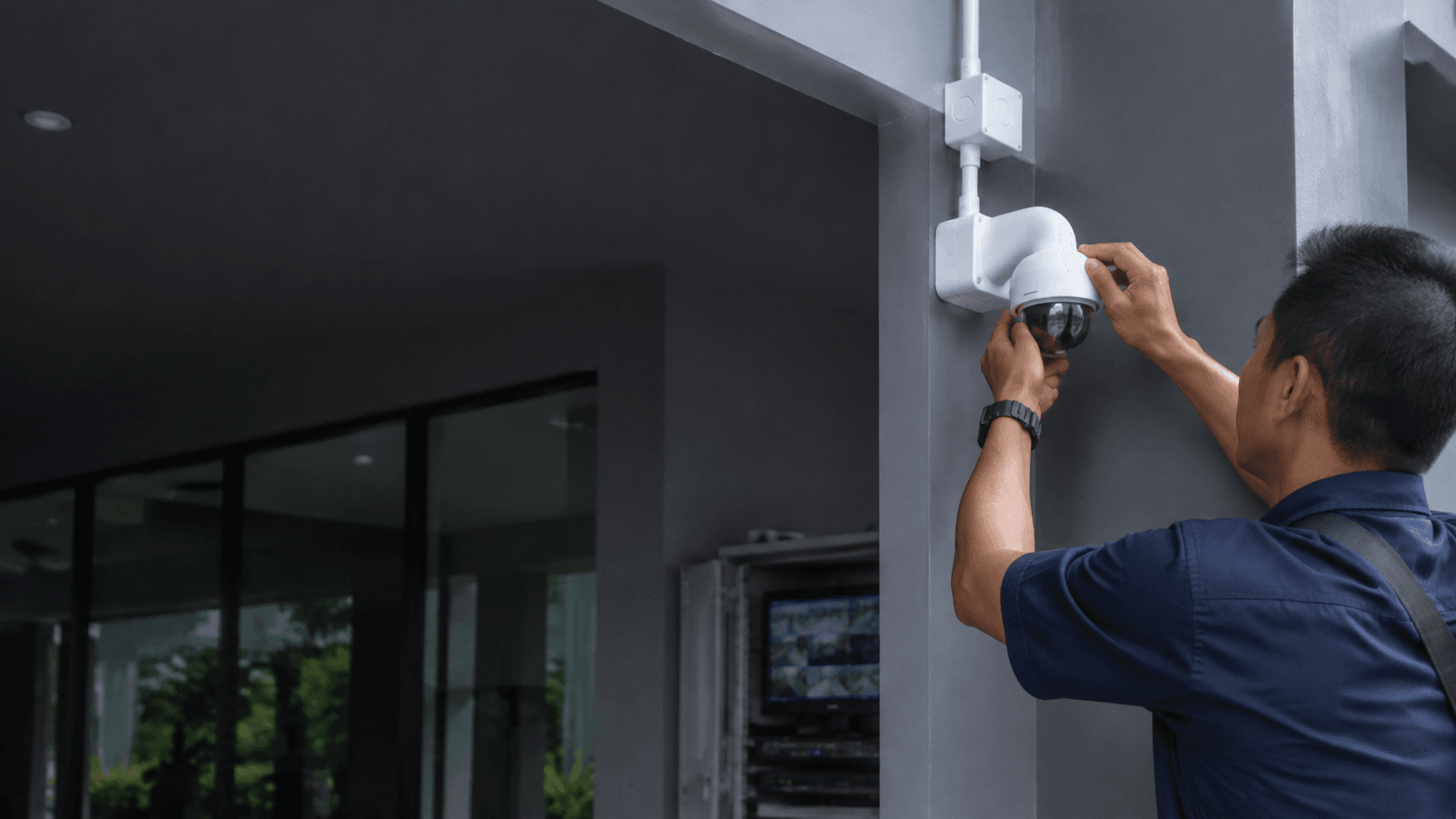
The work is less about the box of hardware and more about the decisions made before a single bracket is fixed. A camera pointed at the wrong angle, or one that meets a bright doorway at night, records footage that answers no useful question. That is why the survey and the placement plan carry as much weight as the drilling.
Camera System Installation in Malaysia: What the Work Actually Involves
Camera system installation is the planning, supply, mounting, configuration, and handover of a monitoring setup that records and can be viewed remotely. In Malaysia the practical variables are the building materials, the power and cabling routes, the lighting at each camera position, and how the recorded footage will be reviewed after an incident.
Eyonic Sdn Bhd is a security system supplier based in Sarawak that plans, supplies, and installs monitoring systems with camera placement, recording, and remote viewing for homes, offices, shops, and industrial sites. The company also supplies Hikvision cameras and smart locks, and has completed work for government and engineering consultancy clients.
Three decisions shape most of the outcome:
- Coverage versus identification. A wide view shows that something happened. A tighter view shows who or what did it. Most sites need both, which is why a single camera rarely covers an entrance well.
- Wired or wireless. Wired runs are more stable and avoid battery changes, but they depend on a viable cable path. Wireless suits finished interiors where chasing walls is impractical, at the cost of power maintenance and signal reliability.
- Where recording lives. An NVR keeps footage on site and under the owner's control. Cloud or app-based storage shifts the footage off site but depends on the internet connection staying up.
None of these choices can be made properly from a floor plan alone. The survey exists to settle them against the real building.
How Eyonic Runs a Camera System Installation from Survey to Handover
Eyonic's CCTV installation process has four stages: site survey, system proposal, installation, and handover. Each stage produces something the next stage depends on, which is why skipping the survey tends to surface as rework later.
- Site survey. The property is walked to identify entry points, movement routes, existing cabling, power availability, and the lighting at each candidate camera position.
- System proposal. The survey findings become a proposed camera count, placement plan, recording setup, and package scope, so the quoted work matches the site rather than a generic template.
- Installation. Cameras are mounted, cabling is run, the recorder is set up, and recording is configured.
- Handover. Mobile viewing is set up on the owner's device, the system is tested, and the user is shown how to review footage.
The handover stage is where many installations quietly fail. A system that records correctly but that nobody can review on a phone is only half delivered. Eyonic's basic Hikvision CCTV Package at RM 1,599 covers camera supply and setup, basic recording configuration, and mobile viewing handover, which maps directly onto that final stage.
What the survey is actually looking for
A survey is not a sales visit. It answers specific questions. where power can be drawn from, whether a cable path exists between each camera and the recorder, which surfaces can take a mount, and what happens to each view when the light changes. The answers determine the camera count and the labour, and both determine the price.
What handover should include
A complete handover leaves the owner able to open the app, find a past recording by time or event, and export a clip if needed. It also leaves a clear record of what was installed and where. If a system is handed over without that, the first real incident becomes a troubleshooting session instead of a review.
Camera Placement and Lighting Checks Before Any Camera Is Fixed
Camera placement decides whether footage is useful. The common failure is a camera aimed at a bright road or doorway while the area that matters sits in shadow, producing a silhouette instead of a face.
Eyonic recommends checking actual lighting conditions before confirming placement for ColorVu-style cameras. ColorVu is Hikvision's low-light camera range, and the point of the check is that low-light performance depends on the light actually present at that position at night, not on the specification alone. A position that looks bright during a daytime survey can behave very differently after dark.
Placement decisions that hold up in practice:
- Cover the entry and exit points first, since those are the routes that matter most in a review.
- Avoid aiming directly into a strong light source, which flattens the subject into a silhouette.
- Keep cameras high enough to resist tampering but angled to capture faces rather than the tops of heads.
- Check the view at night, not only at the time of the survey.
- Confirm the recorder and any network equipment sit somewhere with power and reasonable ventilation.
There is a real trade-off between coverage and detail. Widening a view to cover more ground reduces the pixels available for any one face. On larger sites the practical answer is more cameras at narrower angles rather than fewer cameras stretched across a wide area.
What a Camera System Installation Costs in Malaysia
Cost tracks camera count, cable route difficulty, and whether recording and remote viewing are included. Eyonic's basic Hikvision CCTV Package is RM 1,599, covering camera supply and setup, basic recording configuration, and mobile viewing handover.
Larger sites sit well above that figure. Two Eyonic projects give a sense of the range for commercial work:
- The Kuching Immigration Office project had an approximate budget of RM 12,000 to RM 28,000.
- The KTA Sarawak Sdn Bhd project, an engineering consultancy office in Kuching, had an approximate budget of RM 8,000 to RM 18,000.
The gap between a basic package and a commercial project is not the cameras alone. It is the number of positions, the length and difficulty of cable runs, the recorder capacity, and the amount of configuration needed to make the system usable by several people rather than one.
Two cost drivers are worth understanding before comparing quotes. First, cable route difficulty: a run through an existing ceiling void costs far less than one requiring conduit across a finished wall. Second, camera count: each additional position adds hardware, cable, labour, and recorder capacity at the same time.
Quotes that look unusually low often exclude the cable route, the recorder, or the handover. Those are the parts that decide whether the system works on the day it is needed.
Kuching Immigration Office. A for Daily Public Use
The Kuching Immigration Office project is a useful example because a public office has requirements a home does not. Eyonic provided practical support for the office focused on arrival flow, staff areas, visitor movement, and dependable daily operation.
Each of those four concerns points to a different camera position. Arrival flow needs coverage of the approach and entrance. Staff areas need coverage that respects how staff move through the building. Visitor movement needs the routes visitors actually take rather than the routes a plan assumes. Dependable daily operation means the system has to keep working through long opening hours without constant attention.
That last point is the one most often underestimated. A system that needs resetting every week is not a security system; it is a maintenance task. For a public office, reliability matters more than any single specification.
The KTA Sarawak Sdn Bhd project shows a related pattern in a smaller setting: a practical office setup in Kuching supporting staff movement, visitor handling, tidy cabling, and clearer daily site control. Tidy cabling is not cosmetic. Exposed or poorly routed cable is the most common point of failure and the easiest thing to get wrong when a job is rushed.
Questions to Settle Before Booking a
Most problems that surface after installation were answerable before it started. Settling these questions first keeps the proposal and the finished system aligned.
How many cameras are needed
The count follows the number of positions that need coverage, not the size of the building. A small shop with one entrance and one counter may need fewer cameras than a house with a long driveway and a rear gate. The survey settles this.
Wired or wireless
Wired suits new builds, renovations, and any site where a cable path exists, because it avoids battery maintenance and signal problems. Wireless suits finished interiors where chasing walls is not practical. Many sites end up with a mix.
Who will review the footage and how
If more than one person needs access, that affects the recorder setup and the app configuration at handover. Deciding this early avoids a second visit.
What happens if the internet goes down
On-site recording continues regardless of the internet connection. Remote viewing is what stops. Sites that depend on remote viewing should treat the internet connection as part of the system, not as a separate utility.
What is not covered by the package
Scope matters more than headline price. The basic Hikvision CCTV Package covers camera supply and setup, basic recording configuration, and mobile viewing handover. Anything beyond that, such as additional positions or extended cabling, sits outside the package and should be confirmed in the proposal.
Eyonic's founder, Eric Yong, has been in the industry for more than 10 years and works on technical installation of digital security solutions for commercial businesses in Sarawak. That background is most useful during the survey, when placement and lighting decisions are still open.
Share your location, property type and required system with Eyonic on WhatsApp at +60 11-5111 7959 for the next practical step.