
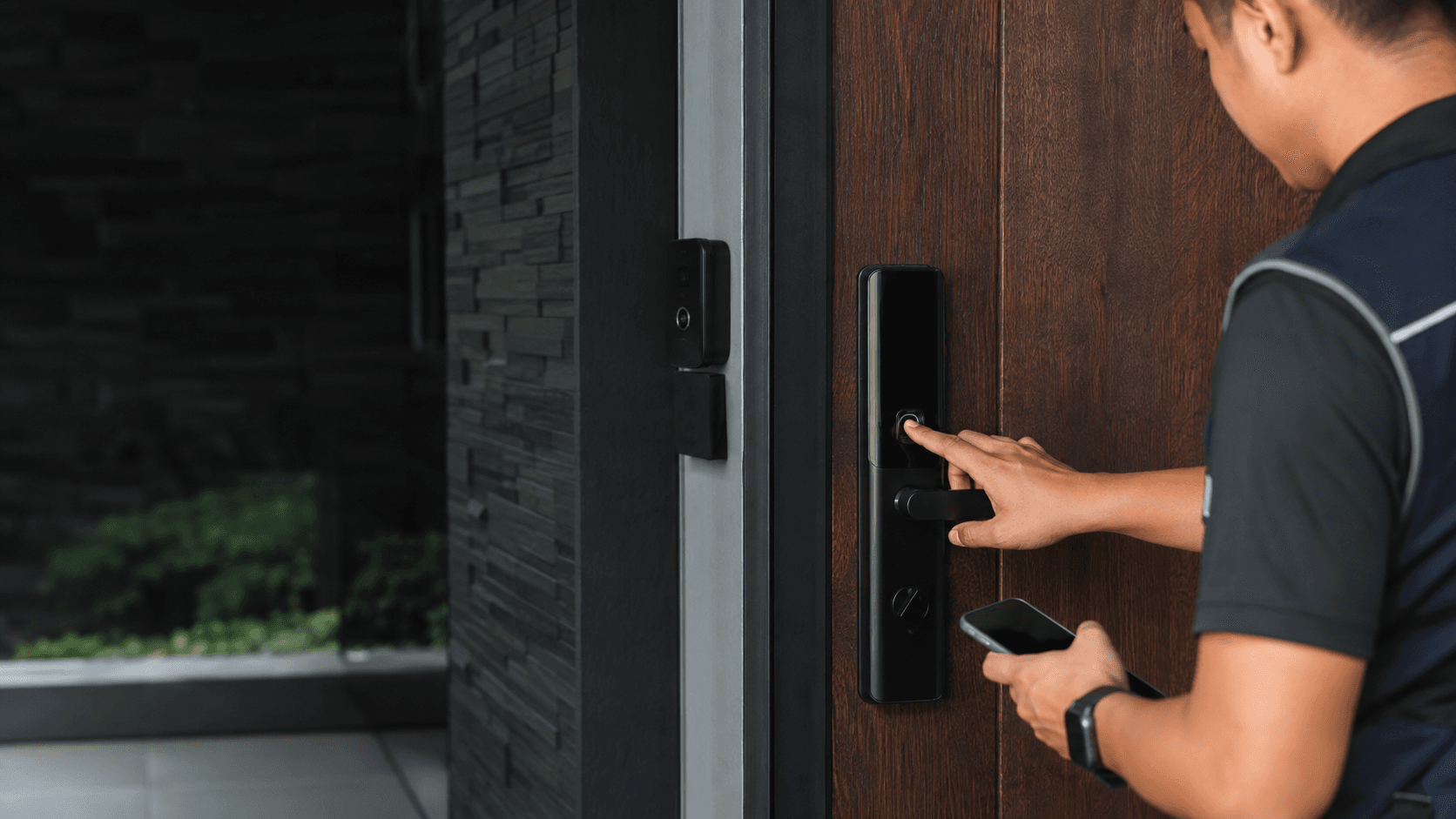
The name covers a specific combination rather than a single product. Baldwin builds keyless touchscreen deadbolts, and the Z-Wave version adds a radio module so the lock can report status and accept commands through a smart-home controller instead of standing alone. That distinction matters in Malaysia, where most homes and offices already run some form of hub, app or access-control panel, and where a lock that cannot join that system becomes an expensive keypad.
What follows is a practical reading of the category: how the naming works, what has to be checked on the hub side, what has to be checked on the door side, and what should be confirmed before any money changes hands. Nothing here substitutes for the manufacturer's own documentation for a specific model, because Baldwin's published specifications vary by variant and finish.
Baldwin Z Wave Lock. what the name covers
A Baldwin Z Wave Lock is a motorised or electronic deadbolt with a Z-Wave radio inside, controlled by touchscreen keypad on the exterior and by hub or app remotely. The lock still functions as a deadbolt first: it throws a bolt into a strike, and it can be opened by keypad code or by a physical key where the model supports one.
Z-Wave is a low-power mesh protocol. Each mains-powered device in the mesh repeats the signal, which is why a lock at the far end of a building often works better once other Z-Wave devices sit between it and the hub. Battery-powered locks do not repeat the mesh themselves, so the lock depends on the surrounding network rather than strengthening it.
Two practical consequences follow. First, a Z-Wave lock is only as reliable as the mesh around it. Second, the lock's remote features — status reporting, code management, audit history — depend on the hub, not on Baldwin. If the hub is removed, the lock reverts to a standalone keypad deadbolt.
How it differs from a standalone smart deadbolt
A standalone smart deadbolt stores codes on the lock itself and is managed at the door. A Z-Wave version hands that management to a controller, which is what allows one person to add or revoke a code for a staff entrance without walking to the door. For a shop or office with changing users, that difference is the whole point. For a single home entrance with two regular users, the standalone version often does the same job with fewer moving parts.
Baldwin Z Wave Lock models and naming
Baldwin's connected deadbolts are sold under design names rather than a single product line, and the same design is often offered in both a Z-Wave version and a standalone version. That is the single most common source of ordering mistakes: two listings can look identical in photographs and differ only in whether a radio module is present.
Finish codes are the second source of confusion. Baldwin publishes a long finish list, and the finish code is usually embedded in the model string rather than shown as a separate field. A buyer comparing two quotations should compare the full model string, not the design name and colour description.
Because Baldwin's model numbers, dimensions, grade ratings and warranty terms are not verified here, the safe approach is to obtain the manufacturer's specification sheet for the exact variant being quoted and check it against the door and the hub. A supplier who cannot produce that sheet for the specific variant is quoting a category, not a product.
Hub pairing and protocol checks
Z-Wave pairing is not universal. A lock and a hub must agree on protocol generation and on the radio frequency used in the region, and the hub must have a device handler or driver that recognises the lock. Community discussion around Baldwin locks on SmartThings shows this is a real friction point rather than a theoretical one: users have reported that a lock is not listed among a hub's officially supported devices even when the lock itself is a Z-Wave product.
Three checks resolve most of the risk before purchase.
- Confirm the door's condition and preparation: deadbolt bore, backset, door thickness, edge bore and whether the existing strike and frame will accept the new bolt without cutting.
- Confirm hub compatibility in writing: protocol generation, regional radio frequency, and whether the hub's current firmware lists the specific lock variant as supported.
- Confirm user roles and code management: how many codes are needed, who administers them, and whether the hub or the lock holds the master credential.
- Confirm the backup entry method. a physical key override, a second entrance, or a documented recovery procedure if the keypad or battery fails.
Where a hub is old or the protocol generation is unclear, the honest answer is often that the lock should be treated as a standalone keypad unit until the hub is replaced. That is a planning decision, not a defect.
What happens when pairing fails
A failed pairing usually leaves the lock working at the door and not working remotely. The lock is not bricked. The practical cost is time. exclusion, re-inclusion, and sometimes a hub-side driver change. On a commercial site, that work should be scheduled rather than discovered on the day of installation.
Door, thickness and finish checks
Electronic deadbolts are heavier and deeper than mechanical ones, and the interior assembly takes up space on the inside face of the door. On a thin or hollow-core door, or on a door with an existing large bore, the fit has to be measured rather than assumed.
Finish is not only cosmetic on an exterior door. Coastal and high-humidity environments in Sarawak put more demand on plating and coating than a dry interior door does, and the finish code determines what is actually supplied. Matching a new deadbolt to existing handles and hinges is a separate exercise from choosing the lock, and it is worth settling before ordering rather than after.
Fire-rated doors and doors in regulated premises add another constraint: hardware changes on those doors may need to match the door's existing certification, and that is a question for the door supplier or the building's compliance contact rather than for the lock retailer.
Installation and handover in Sarawak
Eyonic Sdn Bhd plans, supplies and installs security and ELV systems in Sarawak, and its documented process runs through site survey, system proposal, installation and handover. That sequence applies to door hardware as much as to cameras: the survey establishes what the door and the existing network will accept, and the handover establishes that the people who use the door know how to use it.
Eyonic's published review guidance on smart lock door access notes that smart locks work best when door condition, user roles and backup method are reviewed before installation, and that for business use the choice between a standalone smart lock and an access-control panel should be checked rather than assumed. That is the same set of questions a Baldwin Z Wave Lock raises, and it is the reason a survey comes before a quotation.
Eyonic's completed work includes the Kuching Immigration Office, where the focus was arrival flow, staff areas, visitor movement and dependable daily operation, and the KTA Sarawak Sdn Bhd office in Kuching, where staff movement, visitor handling and tidy cabling were the priorities. Neither project is evidence about Baldwin hardware specifically, and neither should be read as a Baldwin reference. They are evidence that entry and movement planning is part of how this work is approached locally.
For a door that has to keep working every day, the handover matters as much as the install. Codes have to be issued to the right people, removed when they leave, and the backup entry method has to be known by more than one person.
What to confirm before ordering
The order should not be placed until four things are settled: the exact model string including finish code, the hub's compatibility with that variant, the door's measurements and condition, and the backup entry method. A fifth item — who administers codes after handover — determines whether the lock stays useful six months later.
Local availability, pricing and lead time for Baldwin hardware in Malaysia are not verified here, and they vary by supplier and by variant. A quotation should state the model string, the finish, what is included, and what happens if the lock does not pair with the existing hub.
Where the requirement is a single controlled entrance with a small number of regular users, a standalone smart deadbolt may be the simpler and more supportable choice. Where the requirement is multiple entrances, changing users, and central visibility of who entered and when, a Z-Wave lock on a supported hub earns its complexity. The deciding factor is the hub and the door, not the finish.
Share the location, property type and required system with Eyonic on WhatsApp at +60 11-5111 7959 for the next practical step.