
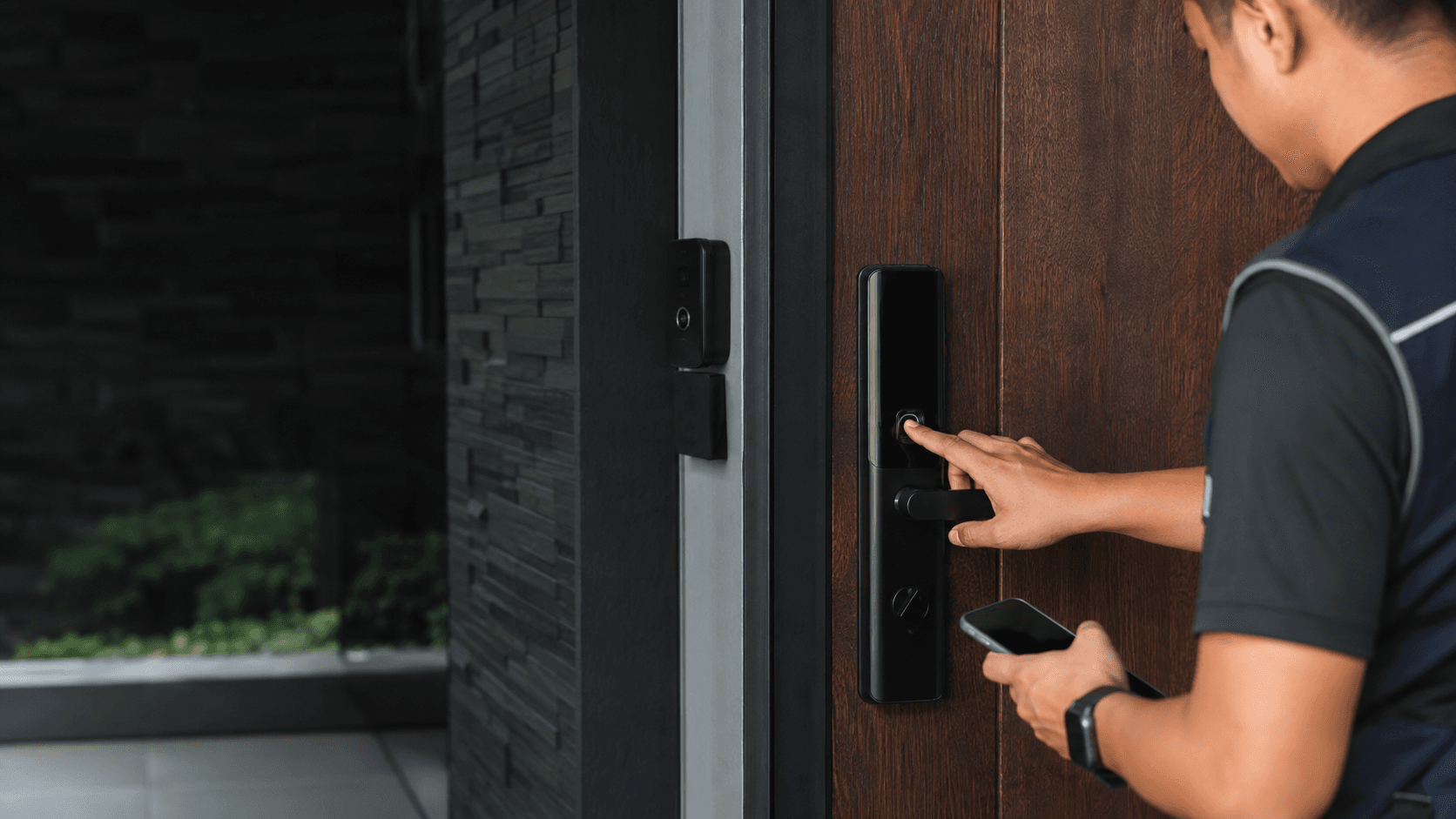
The phrase appears in searches because retailers list a Halo smart deadbolt together with a matching knob or handle set as one bundle. The lock and the knob are different products doing different jobs on the same door, and the naming in listings blurs that line.
Why the Halo name appears on deadbolts, not knobs
Halo is the name used for a smart deadbolt. A deadbolt is the locking hardware that throws a bolt into the door frame, and in the Halo line that bolt is driven electronically rather than by a key alone. A door knob is the round turning handle used to open and close the door. It is not the locking element in a standard residential setup.
That split explains why a search for a Halo lock door knob returns deadbolt listings. The lock carries the Halo name. The knob is the hardware the lock is paired with, and it usually comes from a different product family within the same brand's range.
Retail listings make this clearer than brand pages do. A single product title can name an electronic deadbolt, an entry door handle set, and a door knob together, because the listing covers a bundle rather than one item. The lock is the electronic part. The knob and handle are mechanical trim.
Door knob hardware that ships alongside a Halo lock
Combo packs are the common format. A pack pairs the electronic deadbolt with a matching entry set and knob so the finish and style line up across the door. Buying the two separately risks a visible mismatch in finish or design family.
What the knob does in that pairing is simple. It handles everyday opening and closing. The deadbolt handles security. On a door with both, the knob alone does not secure the opening, and the deadbolt alone does not give a turning handle for daily use.
Passage knobs are the usual match. A passage knob turns freely and has no lock of its own, which suits a door where the deadbolt is the locking device. A knob with its own keyed cylinder would create two separate locking points and two separate key or code sets to manage.
This is also where the phrase gets awkward. A reader searching for a Halo lock door knob may be looking for a knob branded Halo, a knob sold with a Halo lock, or a smart knob that works like a Halo deadbolt. Those are three different products, and only the middle one is confirmed by how these items are listed together.
What to check before pairing a smart lock with an existing knob
Door condition decides whether a smart deadbolt and an existing knob will work together without extra work. The checks below are the ones that surface problems before hardware is ordered.
- Measure the existing bore holes and the backset, the distance from the door edge to the centre of the hole, and confirm the new deadbolt matches.
- Check the door thickness against the deadbolt's supported range, since a thin or unusually thick door can rule out a model.
- Confirm the door frame has room for the deadbolt strike and that the frame is sound enough to hold it.
- Check whether the existing knob is passage trim or a locking knob, because a second lock changes how the door is used day to day.
- Decide how the door is opened when the smart lock is unavailable, and confirm that method does not depend on the knob.
- Confirm the finish and design family of the knob matches the deadbolt so the door does not end up with mismatched hardware.
The fourth and fifth checks matter most in practice. A smart lock is convenient when user permissions and a backup entry method are planned properly, and the same planning applies to the knob beside it. If the knob is the only other way in, its condition and its key situation become part of the entry plan rather than an afterthought.
Halo Lock Door Knob questions that need the product manual
Several details cannot be settled from a listing title. Bore diameter, backset, door thickness range, finish options, and whether a specific knob is compatible with a specific deadbolt all come from the manufacturer's documentation for the exact model. A bundle listing may not state them at all.
The same applies to the name itself. A product sold as a Halo lock and a product sold as a door knob can appear in one listing without any single item being officially called a Halo Lock Door Knob. Treating the phrase as a product name rather than a description of a bundle is the most common source of confusion here.
Two further questions belong with the manual rather than the listing. The first is whether the deadbolt and the knob are sold as a matched set or as separate items that happen to share a finish. The second is what the deadbolt needs in order to be managed remotely, since app control, user permissions, and any hub requirement are model-specific.
For a business door, the choice is wider than a single product. A standalone smart lock suits a door with light, predictable traffic. A door with staff shifts, visitors, and a need to review who entered when is usually better served by an access control panel, where permissions and records sit in one place instead of on individual locks.
Getting the door condition and entry plan reviewed first
Hardware decisions go better when the door is assessed before anything is ordered. Bore size, backset, frame condition, and how the door is actually used each rule models in or out, and a mismatch found after purchase costs more than a check beforehand.
Eyonic Sdn Bhd plans, supplies, and installs security systems in Sarawak, including smart lock door access alongside CCTV and ELV work. The same review-first approach applies across that range. A public office project in Kuching focused on arrival flow, staff areas, visitor movement, and dependable daily operation, which is the same set of questions a single entry door raises in miniature: who comes through, when, and what happens if the primary method fails.
For a door that already has a knob, the practical sequence is to confirm the door's measurements, decide whether the opening needs a standalone smart lock or a managed access system, and only then choose hardware. Where the door is one of several entry points, treating them as a single plan avoids a mix of locks that cannot be managed together.
Share the location, property type, and required system with Eyonic on WhatsApp at +60 11-5111 7959 to move from the naming question to the door itself.