
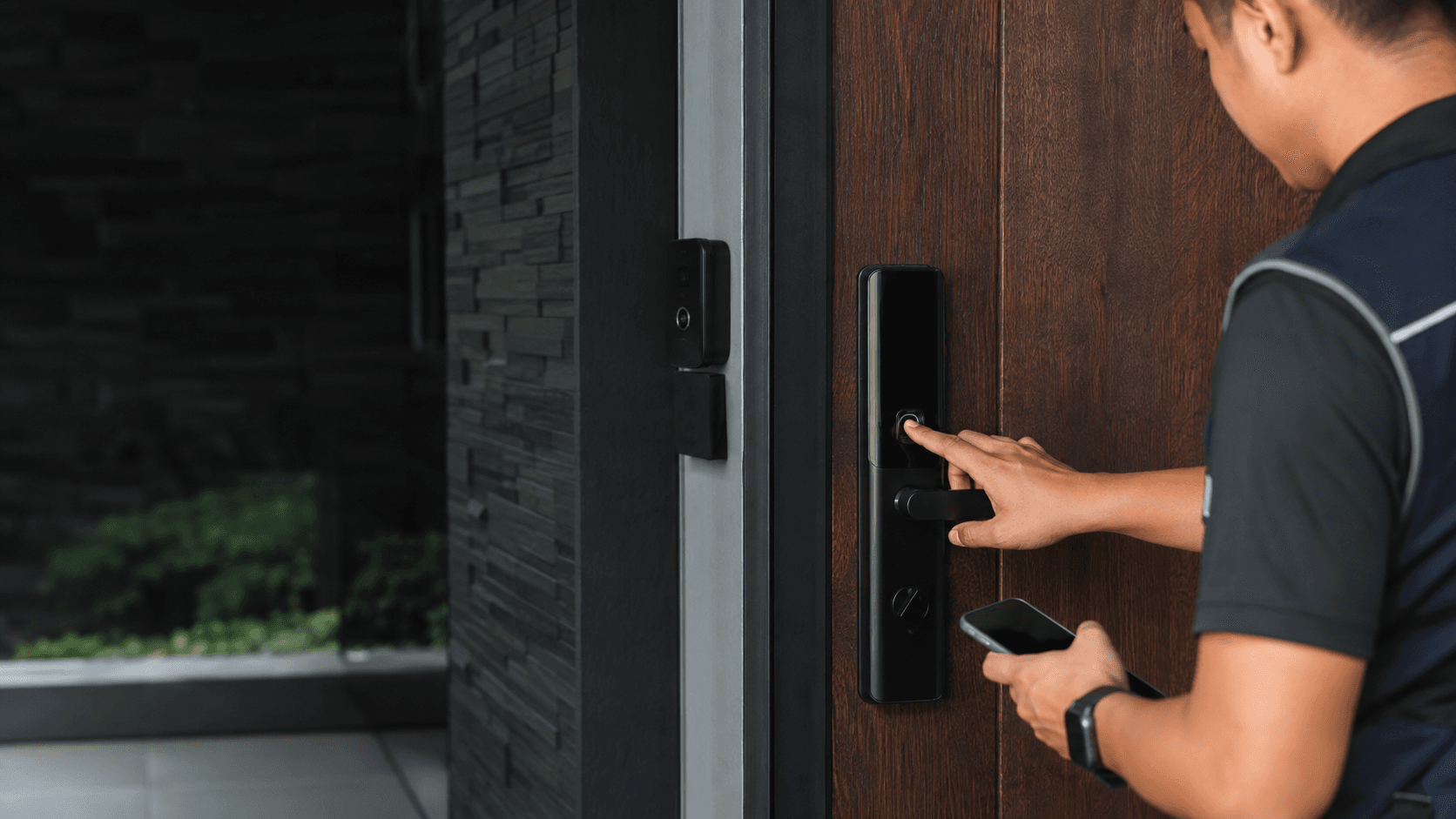
The term covers a family of hardware rather than one product. A digital door handle lock can be a full handle replacement with the reader built into the lever, a knob-style unit for lighter interior doors, or a deadbolt with a separate keypad. Each shape solves a different problem, and the door itself usually decides which one fits.
Eyonic's own product review notes that smart locks work best when the door condition, user roles and backup method are reviewed before installation, and that for business use the choice between a standalone smart lock and an access-control panel is worth checking first. That review order matters more than the feature list on a box.
Digital Door Handle Lock. what the term covers
A digital door handle lock is a handle assembly with an electronic credential reader and an electric or motorised locking mechanism inside the same body. The reader sits on the outside face; the battery pack, motor and wiring sit on the inside face. Because the lock and the handle share one housing, the unit replaces the existing handle set rather than sitting above it as a separate deadbolt.
That single-body design is the main difference from a keypad deadbolt. A deadbolt adds a second locking point above an unchanged handle. A handle lock keeps one piece of hardware on the door, which suits doors where a second bore hole is unwanted or impossible.
Three sub-types appear most often in the market:
- Lever handle locks — the reader is built into the lever or the rose behind it. Common on main entrances and office doors.
- Knob locks — a round knob with a keypad or fingerprint pad. Usually lighter duty, often used on bedrooms, storerooms and interior offices.
- Handle-plus-deadbolt sets — a matched handle and deadbolt sold as one set, where the keypad controls the deadbolt and the handle stays mechanical.
Terminology in the market is loose. Retailers list the same hardware as a smart door lock, an electronic door lock, a keyless entry lock or a biometric door knob. The physical format, not the label, determines whether it fits a given door.
Handle, knob or deadbolt: matching the door
The door decides the format before preference does. Four physical facts narrow the choice quickly: how thick the door is, what latch or mortise is already cut into it, which way the door swings, and whether the frame closes squarely against the latch.
Door thickness is the first constraint. Handle locks are built for a specific thickness range, and a door outside that range either will not accept the unit or will leave the spindle and through-bolts short. A door that is too thin can also crush under the clamping force of a handle lock.
Latch type is the second. A tubular latch, a mortise lock body and a rim latch each need different hardware, and a handle lock designed for a tubular latch will not drop into a mortise cutout without door work. Existing bore holes matter too. a handle lock needs the spindle hole and the latch hole in the positions the unit expects.
Handing is the third. A lever handle lock is handed, meaning a left-hand door and a right-hand door need different units or a reversible one. Getting this wrong is a common reason a lock arrives and cannot be fitted.
Frame alignment is the fourth and the most overlooked. An electronic lock pushes a latch or bolt into a strike plate with less tolerance than a hand-turned knob. A door that has dropped on its hinges, or a frame that has swollen, will cause false lock errors and battery drain long before the electronics fail.
Access methods and who needs entry
Access method should follow the people who use the door, not the feature count. A household with two adults and a helper needs something different from an office with staff, cleaners and occasional contractors.
| Access method | Who it suits | What to confirm |
|---|---|---|
| Keypad code | Households, offices and rental units where several people need entry without carrying a key | Whether individual codes can be added and removed, and whether one-time or temporary codes exist |
| Fingerprint | Regular users who want entry without a code or a phone | How many fingerprints can be stored, and how the reader behaves with wet or worn fingers |
| Card or fob | Offices and staffed premises where credentials are issued and returned | Whether the lock reads the card format already in use, or needs its own cards |
| App or remote control | Sites where entry needs to be granted or checked from elsewhere | Whether the lock needs a gateway or hub, and what happens when the network is down |
User permissions are the part that separates a convenience lock from an access-control decision. A standalone digital door handle lock stores its own users and its own history. An access-control panel manages many doors, many users and a shared record. Eyonic's product review notes that for business use, the choice between a standalone smart lock and an access-control panel is usually checked before installation, because a single door with a handful of users and a building with dozens of doors are different problems.
Backup entry belongs in the same conversation. Every credible unit needs a way in when the battery is flat, the reader fails or the phone is lost. That is normally a mechanical key override, a 9V jump terminal, or a power bank contact. The backup method should be decided at the same time as the access method, not after the first lockout.
Fitting checks before any purchase
These checks are worth completing on the actual door before any unit is ordered. Each one can rule out a format entirely.
- Measure door thickness at the latch edge, not at the face, and compare it against the unit's stated range.
- Identify the latch or lock body already fitted — tubular latch, mortise body or rim latch — and confirm the replacement matches that cutout.
- Confirm handing by standing on the outside and noting which side the hinges are on, then checking whether the unit is handed or reversible.
- Check frame alignment by closing the door and watching whether the latch enters the strike plate without lifting or pushing.
- Measure the existing bore holes — backset, spindle hole diameter and latch hole height — against the unit's template.
- Check power access if the unit needs mains power or a gateway, and confirm the battery compartment is reachable on the inside face.
Two edge cases are worth naming. Metal doors and fire-rated doors are not ordinary handle-lock candidates, because cutting or boring them can affect their rating and their structure. Glass doors and narrow aluminium stile doors usually need a different hardware family altogether. In both cases the door, not the lock, sets the limit.
Power, backup entry and daily reliability
Battery behaviour is the most common source of complaints about any digital door handle lock, and it is usually a door problem rather than a battery problem. A latch that binds in the strike plate makes the motor work harder on every cycle, which shortens battery life and produces intermittent lock errors.
Three habits keep a handle lock dependable:
- Keep the strike plate aligned so the latch or bolt moves freely without the motor forcing it.
- Replace batteries on a schedule rather than waiting for the low-battery warning, and keep the backup key or jump method accessible outside the door.
- Review the user list periodically, removing codes and fingerprints that are no longer needed.
Reliability also depends on the environment. An outdoor gate or an exposed entrance faces rain, heat and humidity that an interior office door never sees, and hardware rated for one setting is not automatically suited to the other. Where a door is exposed, the honest answer is often that a handle lock is the wrong family and a different access product is the right one.
For sites that need more than one controlled door, or that need entry records, the sensible path is to treat the door as part of a wider access-control plan rather than buying standalone units one at a time. Eyonic's completed work for the Kuching Immigration Office focused on arrival flow, staff areas, visitor movement and dependable daily operation, which is the same question a multi-door site asks: who moves through which door, and what record is needed afterwards.
Getting a digital door handle lock supplied and installed in Malaysia
Eyonic Sdn Bhd is a security system supplier based in Sarawak, Malaysia, working across CCTV and ELV systems for homes, offices, shops and industrial sites. Its published process runs through site survey, system proposal, installation and handover, and the same sequence applies to door hardware: the door is surveyed, a suitable unit is proposed, the unit is fitted, and the users and backup method are handed over.
Eyonic's product range includes smart locks alongside Hikvision cameras, and its product review page lists smart lock door access as multi-brand, suited to controlled convenience when user permissions and backup entry are planned properly. The founder, Eric Yong, has worked in technical installation of digital security solutions for commercial businesses in Sarawak for more than ten years.
Two limits are worth stating plainly. Eyonic's published service pages describe installation work in Sarawak, and no supplied information confirms coverage outside that area. No supplied information states which digital door handle lock brands or models are stocked, or gives prices, warranty terms, battery life or user capacity for any unit. Those details need to come from a current quotation rather than an assumption.
Where a door sits alongside cameras, an alarm or an intercom, planning the whole entry point together usually costs less than fitting each device separately. Eyonic's other published packages — a Hikvision CCTV package, a Hikvision alarm system and an autogate package, each listed at RM 1,599 — show the shape of that bundled approach for other systems.
Share the location, property type and required system with Eyonic on WhatsApp at +60 11-5111 7959 for the next practical step.