
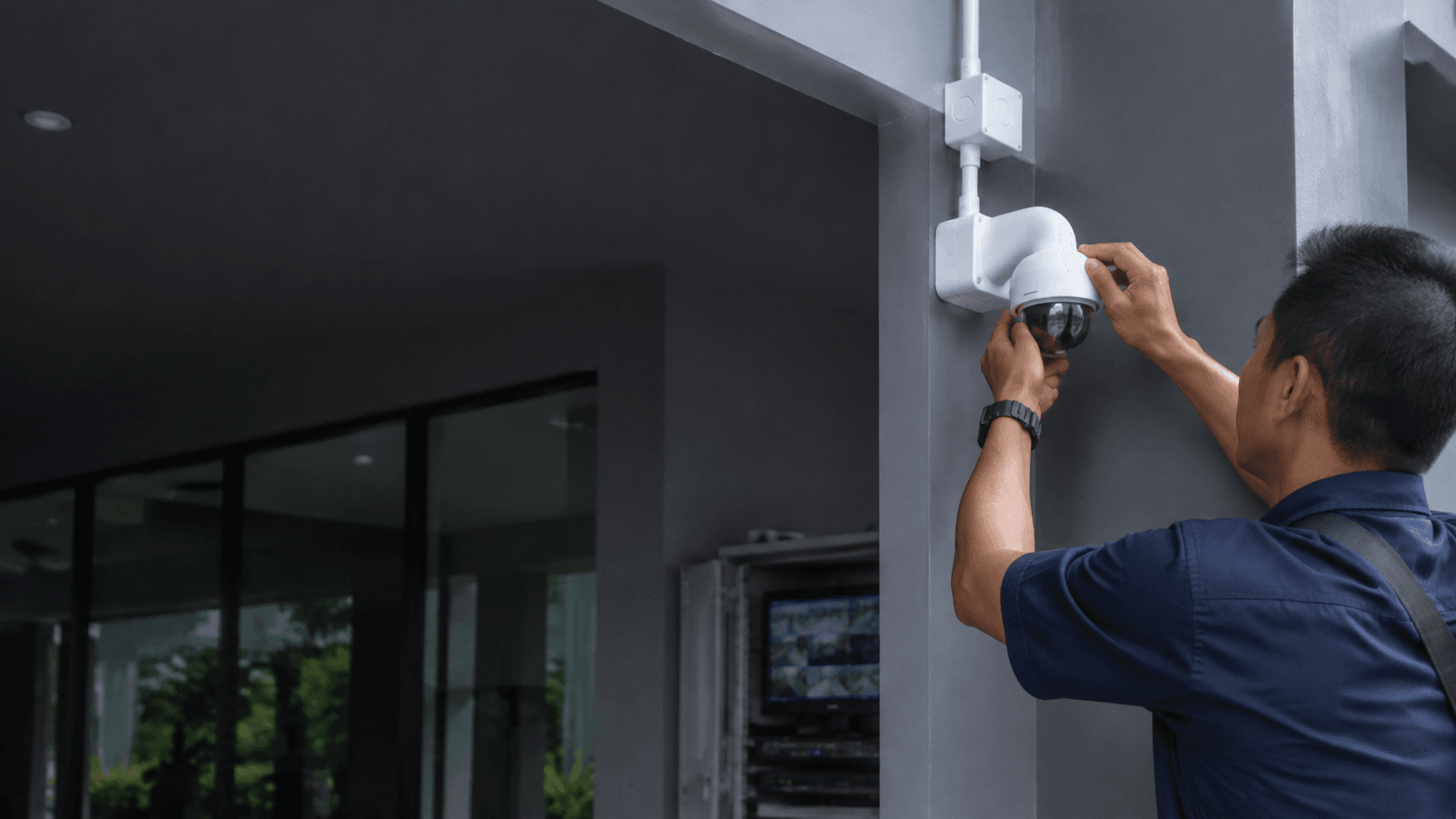
The device itself is simple to describe and harder to place well. A porch camera is a fixed outdoor camera aimed at the entry path, the car porch, or the door itself, and its usefulness depends far more on where it points and what light falls on that spot than on the badge on the housing. Eyonic Sdn Bhd, a security system supplier in Sarawak, plans, supplies and installs monitoring systems with camera placement, recording and remote viewing for homes, offices, shops and industrial sites.
Most disappointing footage comes from one of four causes: the camera faces a light source, the angle misses the gate, the recorder keeps too little history, or nobody was shown how to pull a clip when it mattered. Working through those four in order is faster than shopping model by model.
Porch Camera Coverage at a Malaysian Front Entry
A Malaysian front entry is rarely one open rectangle. It is usually a gate, a driveway or car porch, a short walkway, and a door under some form of cover. Each of those is a different viewing distance and a different lighting problem, and one camera rarely serves all of them well.
Two questions decide most layouts. First, what must be identifiable — a face, a vehicle plate, or simply the fact that someone crossed the line? Second, at what distance does that identification need to hold? A camera that reads a face at the door may only register a shape at the gate.
Where the gate and the door are far apart, the practical answer is often two cameras rather than one wide lens stretched across both. A wide view covers ground but shrinks faces, and a face that occupies a small part of the frame is hard to use later.
What a Porch Camera Watches Between Gate and Door
Coverage is a chain, not a single point. The camera, the recorder, the network and the phone all have to work together before a clip is useful.
Motion detection decides when recording starts. Sensitivity set too high triggers on rain, insects, moving foliage and passing headlights; set too low, it misses a slow approach. The setting that suits a covered walkway rarely suits an open car porch, so the two zones are usually tuned separately.
Night vision decides what the recording looks like after dark. Infrared gives a monochrome image and depends on the camera's own light source reaching the subject. Colour-capable low-light cameras depend on whatever ambient light already falls on the scene, which is why the actual lighting at the spot matters more than the label on the box.
Recording decides whether the clip still exists next week. A recorder keeps footage locally for a set retention period; cloud or app storage keeps a shorter window and depends on the internet connection staying up. Retention is a decision to make deliberately, because the moment a clip is needed is usually after the default window has passed.
Lighting and Placement Checks Before Fixing a Porch Camera Position
Eyonic recommends checking actual lighting conditions before confirming placement for ColorVu-style cameras, and the same check applies to any entry camera. The sequence below is the one that avoids a re-mount.
- Stand at the camera's intended height at the time of day the entry is busiest, and note what the camera would face.
- Identify every light source in the frame — porch lamp, street light, gate light, vehicle headlights — and check whether any points toward the lens.
- Check the same spot after dark, since a position that looks clean at midday can face straight into a lamp at night.
- Confirm the angle covers the gate line, the walkway and the door threshold without tilting so far down that faces disappear.
- Only then fix the bracket, and re-check the live image before the cable is dressed.
A lamp inside the frame is the most common cause of a washed-out or flared image, and it cannot be fixed by changing settings afterwards. Moving the camera a short distance sideways usually solves it; moving it after the cable is run does not.
Height is a trade-off. Mounting high keeps the camera out of reach and reduces tampering, but a steep downward angle shows the top of a head rather than a face. Mounting lower gives a better facial angle but puts the device within reach. Most entries settle somewhere between the two, and the right point depends on whether the priority is identifying people or protecting the hardware.
Wiring, Recording, and Remote Viewing for a Porch Camera
Power is the constraint that shapes everything else. A wired camera needs a cable route from the entry back to a power source and, for a networked system, back to the recorder. A wireless camera needs a stable signal at the entry point and a plan for charging or replacing batteries.
The cable route is often the hardest part of the job, not the camera. Running cable along an existing conduit, under a porch soffit, or through a wall into an indoor point keeps the installation tidy and reduces the chance of water tracking along the cable into a connection. Tidy cabling was one of the practical outcomes Eyonic delivered for KTA Sarawak Sdn Bhd, an engineering consultancy office in Kuching that needed clearer daily site control alongside staff movement and visitor handling.
Recording and remote viewing are configured together. NVR setup determines how long footage is kept and how it is searched; remote viewing determines whether that footage can be checked from outside the property. Both are handed over at the end of the job, because a system nobody can operate is a system that gets ignored.
For a public-facing site, the same principles scale up. Eyonic's work at the Kuching Immigration Office focused on arrival flow, staff areas, visitor movement and dependable daily operation — the same coverage logic applied to a much larger entry.
Porch Camera Installation Steps Eyonic Follows
Eyonic's CCTV installation process runs through four stages, and the first two happen before any hardware is fixed.
- Site survey — the entry, gate, car porch and door are reviewed on site, along with lighting, cable routes and where the recorder can sit.
- System proposal — the camera positions, recording setup and remote viewing arrangement are set out for the property.
- Installation — cameras are mounted, cable is run and dressed, and the recorder and network are configured.
- Handover — the live view, playback and mobile access are demonstrated so the system can be operated without a call-back.
The survey stage is where most problems are avoided. A position that looks obvious from a photograph often fails once the actual light, the actual cable path and the actual gate line are in front of you.
Eyonic's founder, Eric Yong, has worked in the industry for more than 10 years and is experienced in technical installation of digital security solutions for commercial businesses in Sarawak. The same installation discipline applies to a single home entry.
Porch Camera Questions Buyers Ask Before Booking a Site Survey
Does a porch camera need its own light to work at night? Not always, but it needs something. Infrared models supply their own illumination and return a monochrome image. Colour low-light models rely on ambient light already present at the entry, which is why the lighting check comes before the mounting decision.
How much footage should be kept? Enough to cover the longest realistic gap between an incident and someone noticing it. A short retention window is cheaper in storage terms and useless if a clip is needed a fortnight later.
Can one camera cover the gate and the door? Sometimes, if the two are close and the priority is awareness rather than identification. Where the distance is long, two cameras usually cost less than the frustration of footage that shows a shape but not a face.
What happens if the internet goes down? Local recording continues if the recorder is on site and powered. Remote viewing stops until the connection returns, which is a reason to keep local recording as the primary copy rather than the backup.
Who installs and hands over the system? Eyonic plans, supplies and installs monitoring systems with camera placement, recording and remote viewing, and closes the job with a handover. The evidenced packages are the Hikvision CCTV Package, the Hikvision Alarm System and the Autogate Package, each at RM 1,599, covering supply, setup and handover; none is confirmed as a porch camera package, so scope is confirmed against the property during the survey.
Share your location, property type and required system with Eyonic on WhatsApp at +60 11-5111 7959 for the next practical step.