
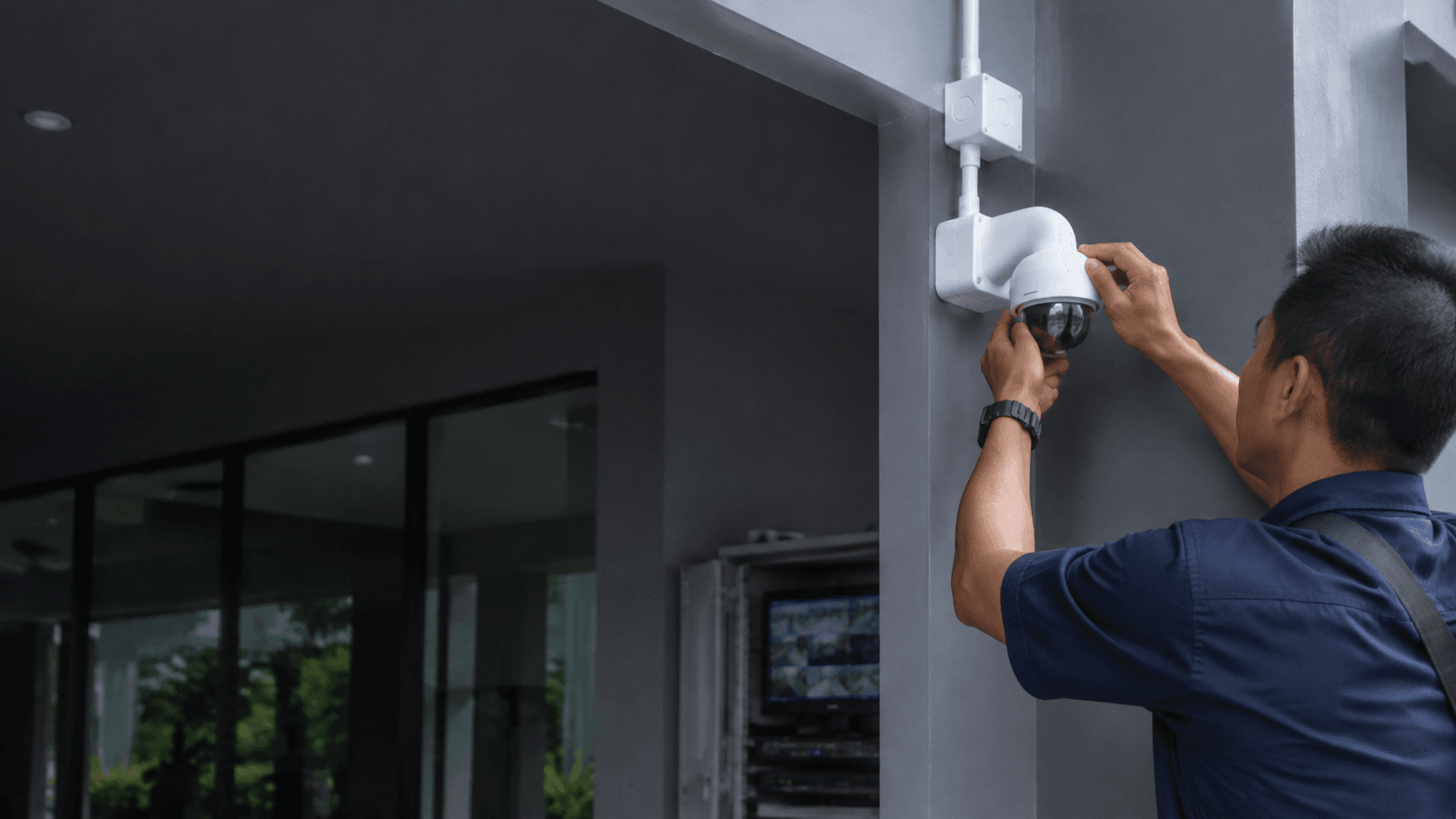
The exact-match query doorbell camera installation describes a small job with an outsized number of variables. A camera at the gate or front door has to see faces, survive weather, reach the network, and stay powered. Each of those depends on what already exists at the entry point.
Eyonic Sdn Bhd plans, supplies, and installs monitoring systems with camera placement, recording, and remote viewing for homes, offices, shops, and industrial sites. The company is based in Sarawak and works across Kuching and the surrounding state.
Doorbell Camera Installation. What the Work Involves
A doorbell camera installation is not one task. It is a short chain of decisions that must be made in order, because each one constrains the next. Placement decides what the lens can see. Power decides which models are even possible. Network reach decides whether remote viewing works. Mounting decides whether the unit survives the first monsoon season.
The four-stage process Eyonic uses for its security installations runs as follows.
- Site survey. The entry point is inspected for existing wiring, mounting surface, sightlines, and lighting at different times of day.
- System proposal. The findings become a written scope covering camera position, power method, network path, and recording or viewing setup.
- Installation. Cabling, mounting, power connection, and configuration are carried out to the agreed scope.
- Handover. The system is tested with the user, mobile viewing is set up, and daily operation is explained.
That sequence matters because skipping the survey is the most common cause of a doorbell camera that points at a wall, misses the gate, or loses Wi-Fi whenever it rains.
Why the survey comes first
Eyonic recommends checking actual lighting conditions before confirming placement for ColorVu-style cameras. The same principle applies to any camera at a door. A position that looks clear at noon can be a silhouette at 7pm, and a position that catches every face in daylight can be blinded by a porch light after dark.
A survey also settles the question that decides most installations: whether the existing doorbell or intercom point can be reused.
Doorbell Camera Installation at Malaysian Homes and Shops
Malaysian entry points differ from the North American front doors that most installation guides assume. A typical terrace house, shoplot, or office unit may have a gate, a porch, a grill door, and a wall-mounted intercom rather than a single doorbell button beside a wooden door.
That changes the job. The camera often needs to cover a gate approach rather than a doorstep, and the mounting surface is frequently brick, tile, or metal rather than timber trim. Cable runs may have to cross a porch ceiling or follow an existing conduit line.
Eyonic's project work in Sarawak shows the same pattern at larger scale. The Kuching Immigration Office project focused on arrival flow, staff areas, visitor movement, and dependable daily operation. KTA Sarawak Sdn Bhd needed a practical office setup in Kuching to support staff movement, visitor handling, tidy cabling, and clearer daily site control.
Both cases point to the same lesson for a smaller entry point: the camera is only useful if it covers the route people actually take, and the cabling is only acceptable if it looks deliberate.
Homes, shops, and offices
A landed home usually cares about who approaches the gate and whether a parcel was left. A shop or office usually cares about who enters during opening hours and what happens at the counter or entrance after closing. Those are different camera positions even when the hardware is identical.
For business premises, Eyonic checks whether a standalone device or a wider access-control arrangement is more appropriate before recommending hardware. The same logic applies at a shop entrance, where a doorbell camera may sit alongside existing CCTV rather than replace it.
What a Doorbell Camera Installation Covers
A complete installation covers more than the camera body. The scope normally includes the mounting position, the power method, the network connection, the recording or viewing setup, and the handover walkthrough.
Camera placement is the first item. The lens needs a clear view of the approach, the face height of a visitor, and enough width to catch someone standing slightly off-centre. A camera aimed too high records the top of heads. One aimed too low records feet.
Power is the second. A wired position that already has a doorbell or intercom supply is the simplest case. A position with no existing wiring needs a different approach, and that decision belongs in the proposal rather than on the installation day.
Network reach is the third. Remote viewing depends on the camera holding a stable connection. A gate camera at the far end of a long driveway may sit at the edge of coverage, and a weak link shows up as dropped clips rather than a clean failure.
Recording and viewing setup is the fourth. Whether footage is stored locally, in the cloud, or on a recorder determines how far back events can be reviewed and what happens when the internet drops.
What is not covered by a standard scope
Some things sit outside a typical installation. Structural alteration to a gate pillar, running new mains power to a position that has none, and changes to a building's shared infrastructure usually need separate arrangements. Raising these during the survey keeps the proposal accurate.
and Existing Entry Points
The single biggest fork in any doorbell camera installation is whether an existing entry point can be reused. A working doorbell or gate intercom point usually means an existing cable path, an existing mounting location, and a shorter job.
Reuse is not automatic. An old intercom point may sit at the wrong height, face the wrong direction, or serve a gate rather than a door. A cable may be present but damaged, or present but too short to reach a better position a metre to the side.
When no wiring exists, the options narrow. The camera can be positioned where a new cable run is practical, or the installation can move to a battery-powered or wireless approach where the model supports it. Each choice trades convenience against maintenance.
Eyonic's keyphone intercom installation work in Sarawak deals with the same entry-point question at building scale, where the intercom position and the camera position have to be planned together rather than separately.
Questions worth settling before installation day
Does the existing point still carry power? Is the mounting surface solid enough to hold the bracket and the cable? Can the position see the full approach, including the gate if there is one? Is there a network path within reach? Answers to those four questions determine most of the scope.
and Lighting Conditions
Lighting decides whether a camera is useful after dark. A position that works in daylight can fail at night for three reasons: too little light on the subject, too much light behind the subject, or a light source aimed straight into the lens.
A visitor standing between the camera and a bright streetlight becomes a silhouette. A porch light beside the camera can wash out the frame. A position under a deep porch roof may receive almost no ambient light at all.
Eyonic's guidance on ColorVu-style cameras is to check actual lighting conditions before confirming placement. That check is best done at the times the camera matters most, which for most properties means evening and night rather than mid-morning.
Where lighting is genuinely poor, the placement may need to shift, or the scope may need to include a light source. Both are survey findings, not installation-day surprises.
Weather and mounting conditions
Sarawak's rainfall and humidity put real demands on an outdoor unit. A mounting position under an eave or porch overhang reduces direct rain exposure. A position fully exposed on a gate pillar needs a housing or a model rated for it. Cable entry points need to be sealed, because water tracking along a cable is a common cause of intermittent faults.
Handover and Daily Use
Handover is where the installation becomes usable. It covers testing the camera with the user present, confirming the view covers the intended area, setting up remote viewing on a phone, and walking through what happens when motion is detected.
Remote viewing is the feature most people actually use day to day. It depends on the camera, the network, and the app being configured together. A camera that records perfectly but cannot be viewed remotely has not delivered the main benefit.
Handover also sets expectations about storage. How long footage is kept, whether clips are saved automatically, and what happens during an internet outage are all worth confirming before the installer leaves.
Eyonic's CCTV package includes camera supply and setup, basic recording configuration, and mobile viewing handover at RM 1,599. The alarm system package at the same price covers a control panel and sensors, siren and zone setup, and user testing and handover. The autogate package covers motor recommendation, remote-control setup, and safety testing and handover. Those packages show the shape of a handover: the system is tested with the user, not simply powered on.
Who should carry out the work
A doorbell camera installation can be a straightforward DIY task when an existing doorbell point is being reused and the mounting surface is simple. It becomes a different job when there is no wiring, when the mounting surface is brick or metal, when the cable run crosses a porch or gate structure, or when the camera has to integrate with existing CCTV or an intercom.
Eric Yong, founder of Eyonic Security Systems, has worked in the industry for more than ten years and is experienced in technical installation of digital security solutions for commercial businesses in Sarawak. That background is relevant to entry-point work because the constraints are usually structural and electrical rather than software-related.
For a single camera at an existing point, the decision is mostly about time and tools. For a property with a gate, an intercom, and existing CCTV, the decision is about whether the new camera fits the existing setup or fights it.
Where the work fits alongside other systems
Eyonic supplies and installs CCTV, alarm systems, autogate systems, keyphone intercoms, and Starlink internet in Sarawak. A doorbell camera at an entry point often sits alongside one or more of those, and the entry point is usually the place where they meet.
An autogate and a gate camera share the same approach. An intercom and a door camera share the same visitor. Planning them together avoids two separate cable runs to the same pillar and two separate apps for one doorway.
Share the location, property type, and required system with Eyonic on WhatsApp at +60 11-5111 7959 for the next practical step.