
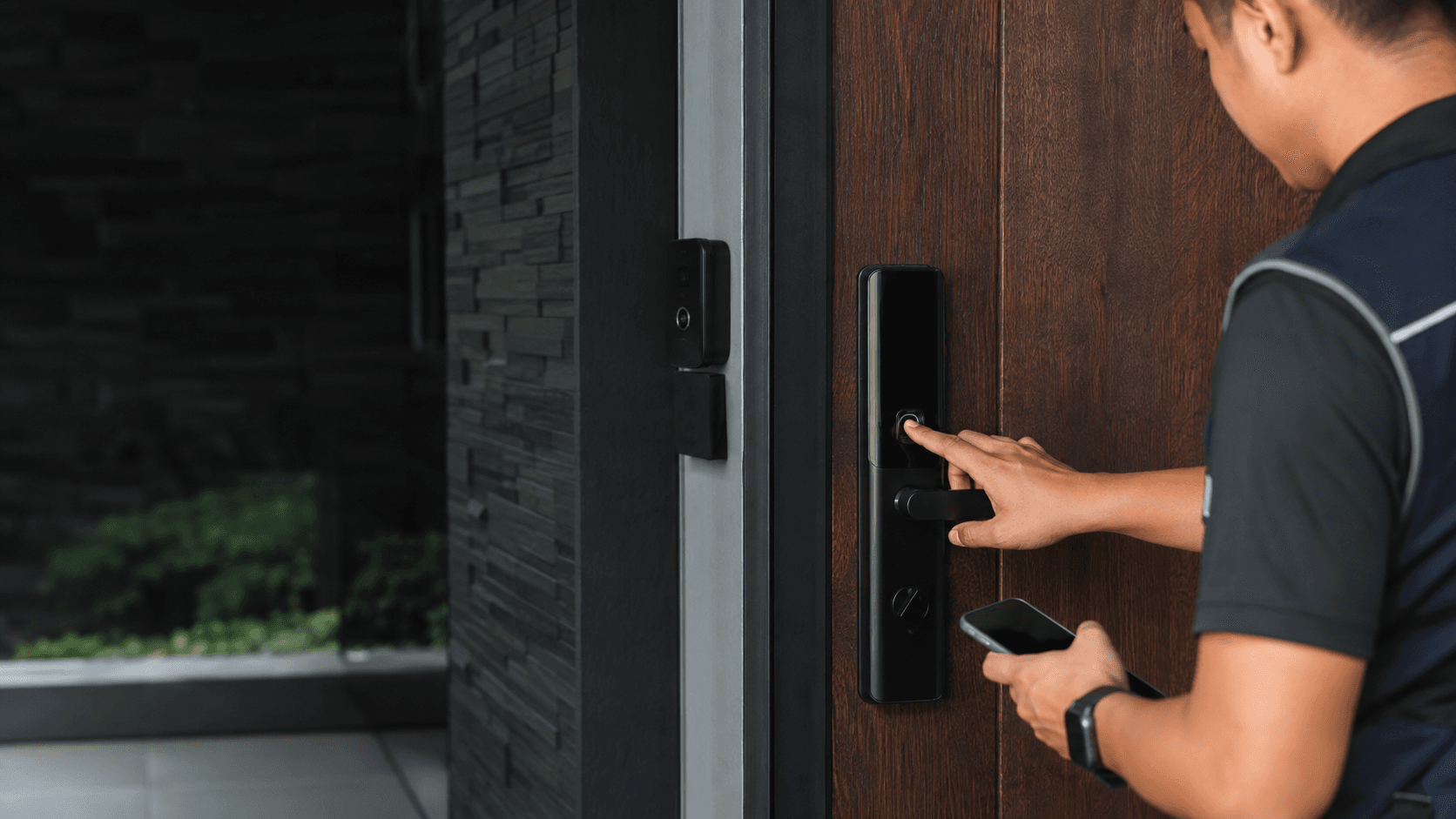
The exact-match query hotel electronic door locks describes a category of access hardware rather than a single product. The category covers keypad locks, RFID card locks, Bluetooth and mobile-key locks, and hybrid systems that accept more than one credential type. Each option changes how a property issues access, how it revokes access, and what happens when a battery dies or a network drops.
This guide explains what the category includes, how the main types differ, and which practical constraints decide the choice for hotels, B&Bs and guesthouses.
Hotel Electronic Door Locks. What Matters Before Choosing
Three questions decide most of the decision. Who issues credentials, how quickly must a lost credential stop working, and what happens during a power or network failure. A property that answers those three questions honestly will usually find that only one or two lock types fit.
Door condition matters as much as electronics. A lock body must match the door thickness, the existing mortise or cylindrical cutout, and the closing hardware. A heavy fire-rated door and a light guesthouse door do not take the same lock. Reviewing the door before ordering avoids a return or a rebuild.
User roles also shape the choice. A small guesthouse may need one code per room and a master code for the owner. A larger property may need separate credentials for housekeeping, maintenance, management and guests, each with different access windows. The more roles, the more a management layer matters.
What Is Hotel Electronic Door Locks?
Hotel electronic door locks are battery- or mains-powered locking devices that grant entry when a credential is presented, instead of when a physical key turns. The credential is usually a PIN code, an RFID card or fob, a smartphone key, or a fingerprint.
The lock itself is only part of the system. A working setup also includes a way to create and cancel credentials, a record of who entered and when, and a fallback method for the day the electronics fail. Properties that plan only the lock and not the management side often discover the gap during their first lost-card incident.
Common credential types in the category include:
- PIN or keypad codes, which need no card and no phone.
- RFID cards and fobs, which are fast to present and easy to reissue.
- Bluetooth or mobile keys, which use a guest's own phone.
- Fingerprint readers, which remove the credential-carrying step entirely.
- Hybrid locks, which accept two or more of the above.
Choosing the Right Hotel Electronic Door Locks
The sequence below follows the same order a site review normally takes: understand the door, understand the users, then choose the credential and the management layer.
- Survey each door for thickness, cutout, closing hardware and fire rating.
- List every user role that needs entry, from guest to housekeeping to management.
- Decide how fast a lost or returned credential must stop working.
- Choose the credential type that fits those roles and that speed.
- Confirm the fallback method for power loss, network loss and dead batteries.
- Confirm how entry records will be reviewed and retained.
- Confirm who maintains batteries, firmware and credentials after handover.
Eyonic's own installation process follows a comparable path: site survey, system proposal, installation, and handover. The survey stage is where door condition, user roles and backup method get reviewed before any hardware is ordered.
Credential Types and Where They Fit
PIN codes suit small properties with few rooms and no front desk. There is nothing to carry and nothing to reissue, but a shared code is hard to trace to one person.
RFID cards suit properties with a front desk and a steady turnover of guests. Cards are quick to present, quick to cancel, and can be programmed with an expiry. The trade-off is that cards get lost, and each lost card is a small replacement cost.
Bluetooth and mobile keys suit properties whose guests expect to check in from a phone. They remove the card handover step, but they depend on the guest's phone, the app, and a working network at the moment of entry.
Fingerprint entry suits staff areas and back-of-house doors more often than guest rooms, because enrolment and re-enrolment add a step at every staff change.
Offline and Online Locks
An offline lock stores its own credential list and its own entry log. It keeps working when the network is down, and it costs less to install because no cabling is needed. The trade-off is that a credential cancelled at the front desk may still open the door until the lock is updated in person.
An online lock talks to a management system, so a cancellation takes effect immediately and entry records arrive without a manual download. The trade-off is cabling, network dependency, and a higher installation cost. Many properties run online locks on main entrances and offline locks on individual guest rooms.
Take Control Of Access In Hotels, B&Bs And Guesthouses
Control comes from the management layer, not from the lock body. A property that can create a credential, set its expiry, cancel it, and read the entry record has control. A property that can only issue a code has convenience, not control.
Small properties often start with standalone keypad locks and a master code. That works until the property needs to know which staff member entered which room, or until a code has to be cancelled without changing every other code. At that point a management layer becomes the practical next step.
Eyonic's own product guidance makes the same distinction: smart locks work best when door condition, user roles and backup method are reviewed before installation, and for business use the choice between a standalone smart lock and an access-control panel is worth checking first.
What a Managed Setup Adds
A managed setup adds three things a standalone lock cannot provide. It creates credentials with a defined start and end time. It records which credential opened which door and when. It cancels a credential centrally, so a lost card or a departed staff member does not require a physical visit to every door.
Those three functions are what turn a lock into an access-control system. They also add a dependency. the management software, the network that carries its updates, and the person who administers it.
Where the Evidence Comes From
Eyonic's completed work in Sarawak gives a practical reference point. The Kuching Immigration Office project focused on arrival flow, staff areas, visitor movement and dependable daily operation, with an approximate budget of RM 12,000 to RM 28,000 for that type of work. The KTA Sarawak Sdn Bhd project supported staff movement, visitor handling, tidy cabling and clearer daily site control, with an approximate budget of RM 8,000 to RM 18,000.
Both projects show the same pattern: the access decision follows the movement pattern, not the other way around. A public office with a steady visitor flow and a consultancy office with staff and visitors need different balances of control and convenience.
Practical Considerations for
Battery life, network dependency and door hardware decide whether a chosen lock survives its first year. These are the constraints that cause the most rework when they are skipped at the survey stage.
Power Network and Battery Limits
Battery-powered locks avoid cabling but need a replacement schedule. A lock that fails at 2am because a battery was not changed is an operational problem, not a hardware fault. A property should know the expected battery interval and who is responsible for changing it.
Network-dependent locks need a stable connection at the door. If the network drops, an online lock may fall back to a cached credential list, which means a cancelled credential can still work until the connection returns. That fallback behaviour should be confirmed before installation, not after.
Door Hardware and Retrofit Constraints
Retrofitting an electronic lock onto an existing door is not always a straight swap. The lock body must fit the existing cutout, the door thickness must be within the lock's range, and the closing hardware must align so the bolt seats correctly. A door that does not close cleanly will wear out a lock faster than any electronic fault.
Fire-rated doors add a further constraint, because the lock and any modification must not compromise the door's rating. That is a specification question for the door supplier, not a decision to make on site.
Cost and Budget Ranges
Eyonic's published package pricing covers RM 1,599 for a Hikvision CCTV package, RM 1,599 for a Hikvision alarm system, and RM 1,599 for an autogate package. Those figures cover CCTV, alarm and autogate work rather than door locks, so they are a reference for how the company prices packaged security work, not a lock price.
For access-control work, the two completed Sarawak projects give a wider range: approximately RM 12,000 to RM 28,000 for the Kuching Immigration Office project and approximately RM 8,000 to RM 18,000 for the KTA Sarawak Sdn Bhd project. Both figures cover the whole scope of work, not a single lock.
Maintenance and Handover
Handover is where most access-control problems are prevented or created. A handover that covers credential creation, cancellation, battery replacement, entry-record review and the fallback procedure leaves the property able to run the system without a call-out for routine tasks.
Eyonic's installation process ends with handover, and the company's founder, Eric Yong, has more than 10 years in technical installation of digital security solutions for commercial businesses in Sarawak. That experience sits behind the survey and handover stages rather than the product choice alone.
Making an Informed Choice About
The choice narrows once the door, the user roles and the fallback method are known. A small guesthouse with few rooms and no front desk usually fits a keypad or standalone smart lock. A property with a front desk and regular guest turnover usually fits RFID cards with a management layer. A property that wants mobile keys needs the network and the app support to match.
The most common mistake is choosing the credential first and the door second. A lock that does not fit the door, or a credential that does not match how guests and staff actually move, will be replaced sooner than a lock with fewer features that fits properly.
For properties in Sarawak, Eyonic Sdn Bhd plans, supplies and installs security and ELV systems for homes, offices, shops and industrial sites, including smart lock door access. Sharing the location, property type and required system with Eyonic on WhatsApp at +60 11-5111 7959 is the next practical step.