
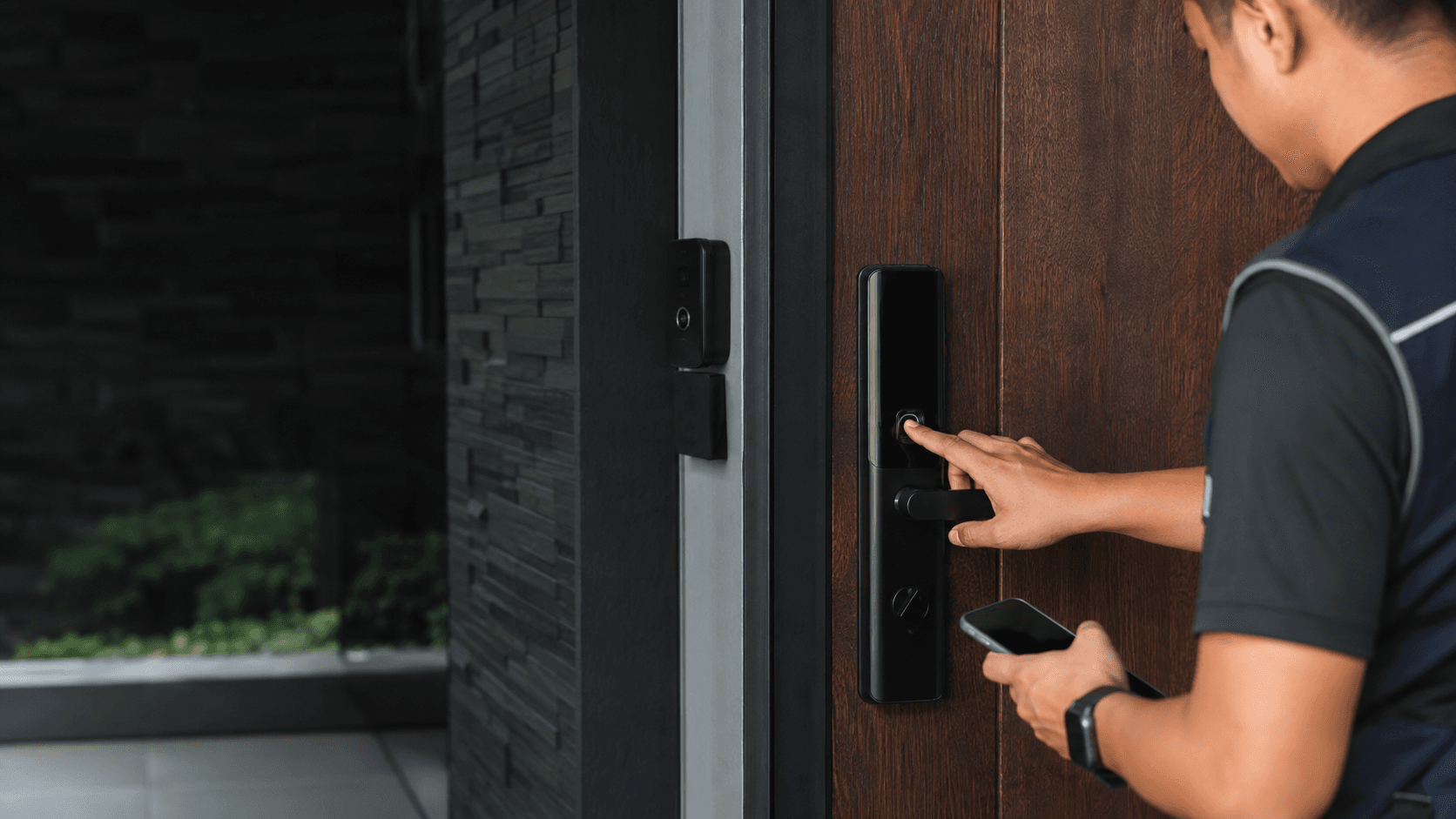
The exact-match phrase best smart door handle describes a narrow slice of the smart lock market. Most buying guides, including the competitor pages reviewed for this article, lead with deadbolt replacements and treat the handle form as one sub-category. That ordering reflects supply more than suitability. A handle-style smart lock solves a different problem: it puts electronic access on the part of the door a hand already touches, and it can work on doors that never had a deadbolt bore.
Eyonic Sdn Bhd, a security system supplier in Sarawak, reviews smart lock door access as part of its product review work and notes that smart locks work best when door condition, user roles and backup method are reviewed before installation. That sequence is the spine of this article.
Best Smart Door Handle Options and What Separates Them
There is no single best smart door handle, because the deciding variables are physical rather than electronic. Two doors of the same width can differ in bore diameter, backset, mortise depth and whether the existing latch is a tubular or mortise type. The electronics sit inside whichever housing the door can accept.
What separates one handle-style smart lock from another, in practical terms:
- Form factor. Some units replace the whole handle set, including the latch. Others are a handle-shaped assembly that still relies on an existing latch body.
- Access methods. Fingerprint access, keypad entry, app control and a mechanical backup key appear in different combinations. A unit with all four has more failure paths covered than one with two.
- Power source. Battery type and location determine how often the door needs attention and whether a low-battery warning is visible before the lock stops responding.
- Connectivity. Some handles are standalone and store credentials locally. Others bridge to a network for remote control and logging.
- User capacity. A household needs a handful of credentials. A shop counter or office door may need dozens, with different permission levels.
Because no verified model specifications, prices or performance figures for specific smart door handles are present in the evidence behind this article, no model names or measured claims appear here. The comparison below stays at the level of form and function, which is where the real decision usually sits.
Handle or Deadbolt. Which Door Setup Fits
The choice between a handle-style smart lock and a deadbolt-style smart lock is mostly a question of what the door already has and what the door is for.
| Consideration | Handle-style smart lock | Deadbolt-style smart lock |
|---|---|---|
| Form factor | Replaces the lever or knob set; the latch and handle are one assembly | Replaces or adds the deadbolt above an existing handle |
| Door preparation | Depends on the existing bore and latch type; a door with only a latch bore is the natural fit | Usually needs a deadbolt bore, or a retrofit adapter over an existing deadbolt |
| Typical access methods | Keypad, fingerprint, app, mechanical key, depending on the unit | Keypad, fingerprint, app, mechanical key, depending on the unit |
| Backup entry | Mechanical key cylinder or an external power point, where the unit provides one | Mechanical key cylinder or an external power point, where the unit provides one |
| Best fit | Doors where the handle is the only locking point, or where the handle is the main daily touchpoint | Doors where a separate deadbolt already exists and the handle can stay mechanical |
A door with a deadbolt and a plain handle does not need a smart handle at all; a smart deadbolt leaves the handle untouched and usually costs less disruption. A door with only a latch and handle, common on interior and some utility doors, has no deadbolt to automate, so a handle-style unit is the only way to add electronic entry without new door preparation.
There is a security trade-off worth stating plainly. A latch alone is a weaker locking point than a deadbolt. A smart door handle improves convenience and access control on a latch door, but it does not turn that door into a deadbolt-secured door. Where the door is an external entrance, the stronger arrangement is usually a deadbolt for security plus a smart handle or keypad for daily entry.
Where handle-style units make the most sense
Handle-style smart locks fit best where the door is used constantly and the locking point is the handle itself: a back door, a utility room, a staff entrance, a gate-side pedestrian door, or a rental unit where the owner wants to change access without changing hardware. They also suit doors where drilling a new deadbolt bore is undesirable, such as a fire-rated door or a door in a rented property.
Access Methods. Fingerprint, Keypad, App and Key
Access methods are not interchangeable features; each one fails in a different way, and the right mix depends on who uses the door.
Fingerprint access is fast for regular users and removes the need to carry anything. It depends on a clean, dry finger and a sensor that has been enrolled properly. It is a poor fit for a door used by visitors whose prints are not enrolled, and it can be unreliable for users with worn or damp fingertips.
Keypad entry works for anyone who can be told a code, which makes it the most flexible method for guests, contractors and staff. The trade-off is code management: shared codes need changing when people leave, and a code that is never rotated is effectively a key left under the mat.
App control adds remote unlocking, temporary credentials and an activity record. It depends on the lock having a network path and on the phone being charged and connected. App control is the method most likely to be unavailable during an internet outage, which is why it should never be the only way in.
A mechanical backup key is the method that works when everything else does not. A handle-style smart lock with a key cylinder can still be opened with a physical key during a flat battery, a failed sensor or a network outage. Units without a key cylinder need another documented backup, such as an external power terminal.
Matching access methods to users
A household of four needs fingerprint access and a keypad code, plus one key kept off-site. A shop with rotating staff needs keypad entry with codes that can be deleted, plus app control for the owner. A rental unit needs keypad or app-issued temporary codes so the previous guest's access disappears at checkout. In every case, the backup key or external power option is the method that keeps the door usable when the electronics do not cooperate.
Smart Home Compatibility and Network Reality
Smart home compatibility is where marketing language and daily experience diverge most. A handle-style smart lock may connect over Wi-Fi, Bluetooth, or a low-power mesh protocol, and it may or may not work with a particular voice assistant or hub. No primary source in the evidence behind this article confirms which ecosystems or protocols any specific smart door handle supports, so compatibility must be checked against the manufacturer's own documentation for the exact model before purchase.
The network reality is simpler than the compatibility list. Three things matter.
- Whether the lock talks to the network directly or through a separate bridge or hub.
- Whether the lock keeps working locally when the internet is down, even if remote app access stops.
- Whether the door's location has usable Wi-Fi or mesh coverage at all.
A lock that depends on a hub adds a device that needs power and a place to sit. A lock with direct Wi-Fi draws more battery than a low-power mesh device, which shortens the interval between battery changes. A lock installed at a gate or a rear door far from the router may have no reliable connection, in which case local keypad and fingerprint access become the primary methods and app control becomes a convenience rather than a requirement.
For business sites, the compatibility question often resolves into a different one: whether a standalone smart door handle is enough, or whether an access-control panel is more appropriate. Eyonic's smart lock review notes that for business use, the company usually checks whether a standalone smart lock or an access-control panel is more appropriate. A single office door with a handful of staff is a standalone case. A site with multiple doors, shift patterns and a need for central records is usually a panel case, even if the individual doors carry handle-style hardware.
Battery Power and Backup Entry
Battery life is the constraint that decides how much maintenance a smart door handle demands. No measured battery-life data for any handle-style smart lock is present in the evidence behind this article, so the honest guidance is about behaviour rather than hours.
What drives battery consumption.
- How often the lock is used. A door opened forty times a day drains faster than a door opened four times.
- Whether the radio is always on. Direct Wi-Fi and frequent app polling cost more than a lock that only wakes on a local credential.
- Whether the lock drives a motor or a solenoid, and how much force the latch needs.
- Ambient temperature. A lock on an external door in direct sun or in a cold room behaves differently from one on an interior door.
What matters more than the number is the warning system. A lock that reports low battery through the app, a keypad indicator or an audible alert gives time to replace cells before the door stops responding. A lock that simply dies does not.
Backup entry is the second half of the power question. The reliable arrangements are a mechanical key cylinder, an external power terminal that accepts a battery from outside, or a documented secondary entrance. A handle-style smart lock with none of these turns a flat battery into a locksmith call. This is the single most common oversight in handle-style installations, because the handle is often the only locking point on the door.
What happens during an outage
A power cut does not usually affect a battery-powered handle lock, because the lock is not wired to mains. A network outage does affect app control and remote logging, but local keypad, fingerprint and key entry normally continue. The failure that actually locks people out is a dead battery combined with no mechanical or external-power backup. Planning for that case is a five-minute decision made before installation, not after.
Installation Checks Before Ordering
Installation fit is decided before any order is placed. The checks below are ordered so that an unsuitable door is identified before money is committed.
- Confirm door condition and thickness. Check that the door is solid enough to carry the handle assembly, that the existing bore and latch are compatible, and that the door closes and latches cleanly today. A door that already sticks will not improve with heavier hardware.
- Confirm who needs entry and at what permission level. List every regular user, every occasional user and every temporary user, and decide which access method each one gets. This determines user capacity and whether app-issued credentials are needed.
- Confirm the backup entry method. Decide in advance whether the door will have a mechanical key, an external power terminal, or a second entrance. If none is possible, reconsider the hardware choice.
- Confirm network and power expectations. Check whether the door has usable Wi-Fi or mesh coverage, whether a hub is acceptable, and how often battery replacement is realistic for the people who use the door.
- Confirm whether a standalone smart door handle or an access-control panel suits the site. A single door with a few users is a standalone case. Multiple doors, shift patterns or a need for central records point toward a panel, even when the doors themselves carry handle-style hardware.
Eyonic's own installation process follows a comparable order: site survey, system proposal, installation and handover. The same logic applies to a single door as to a full site. A survey that checks the door, the users and the backup method before supply prevents the most expensive outcome, which is hardware that fits the budget but not the door.
For sites in Sarawak, Eyonic's project work has covered both public offices and commercial premises. The Kuching Immigration Office project focused on arrival flow, staff areas, visitor movement and dependable daily operation, and the KTA Sarawak Sdn Bhd project supported staff movement, visitor handling, tidy cabling and clearer daily site control. Both are examples of the same principle: access hardware is chosen around how people actually move through a building, not around a feature list.
Where a door needs both security and daily convenience, the practical arrangement is often a deadbolt for the locking point and a smart door handle or keypad for entry. Where the handle is the only locking point, the handle-style unit is the whole solution, and its backup method carries the full weight of the decision.
Share the door location, property type and required system with Eyonic on WhatsApp at +60 11-5111 7959 for the next practical step.