
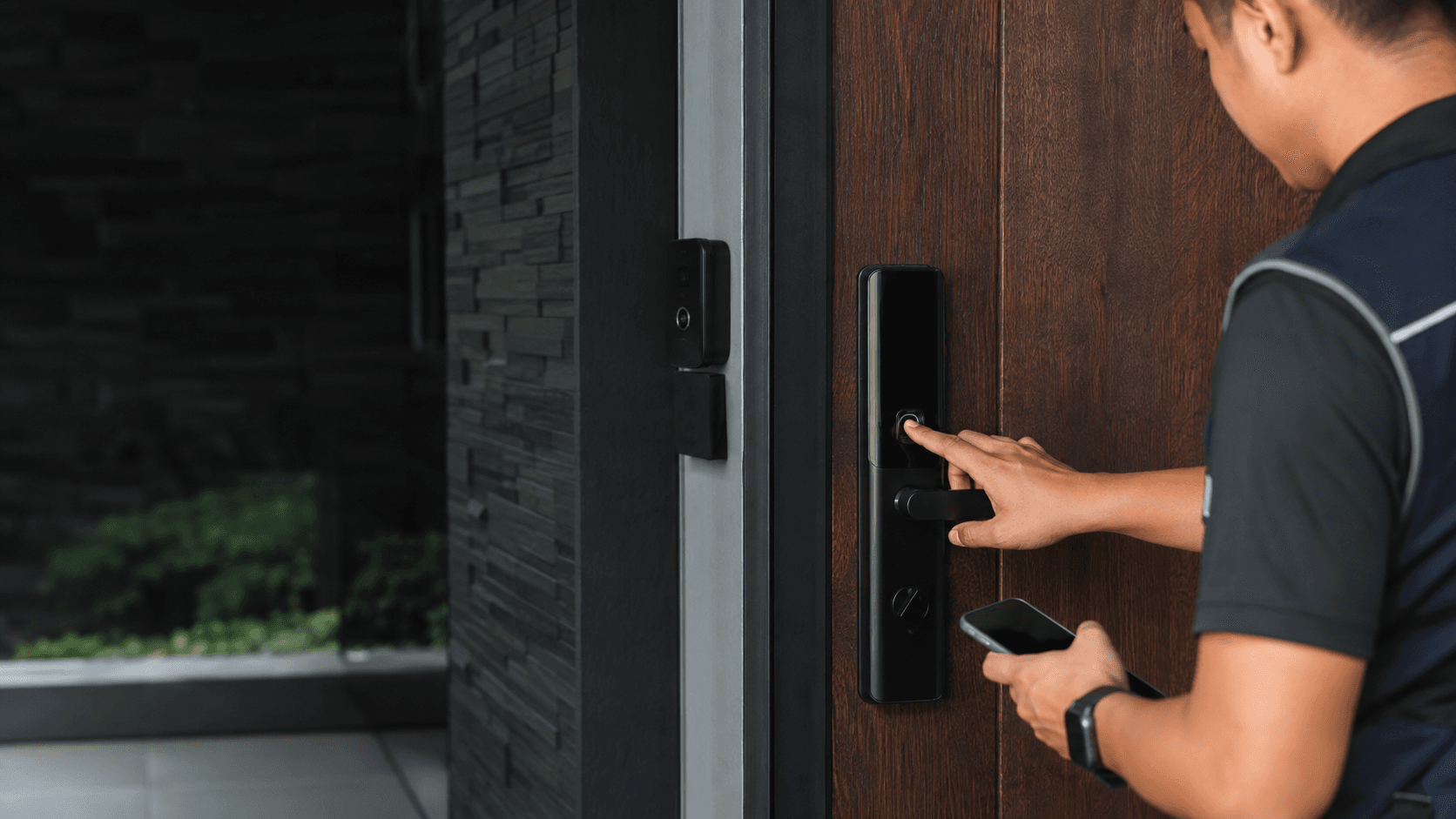
The exact phrase best smart deadbolt for ring hides a harder question than it looks. Ring does not make a deadbolt. Ring makes a hub, an app and an alarm system, and a deadbolt only joins that system if the lock speaks a language Ring understands. That is why two locks that both carry the word "smart" on the box can behave completely differently once they reach the same front door.
This guide covers what Ring compatibility actually means, how a lock connects, which lock families are commonly compared, what to verify before installation, and how setup works for properties in Malaysia.
Best Smart Deadbolt for Ring. What Compatibility Actually Means
Compatibility is not a badge on a product page. It is a chain of four links, and every link has to hold.
The first link is the radio. A lock that communicates over Z-Wave can pair with a Ring Alarm base station, which acts as the hub. A lock that communicates only over Wi-Fi or Bluetooth does not pair with the base station at all; it connects through the Ring app or through a separate integration path. The second link is the app layer, where lock and unlock commands, access codes and activity history appear. The third link is the automation layer, where arming or disarming the alarm can trigger lock behaviour. The fourth link is the physical door, which no amount of software can fix.
Most disappointment with a smart deadbolt for Ring traces back to the first or fourth link. A buyer picks a lock because it looks good and supports an app, then discovers the base station cannot see it. Or the lock arrives, the electronics are fine, and the door is not.
Z-Wave and Wi-Fi Are Not Interchangeable
Z-Wave locks pair to a hub. Wi-Fi locks talk to a router. Ring Alarm uses Z-Wave for device pairing, so a Z-Wave deadbolt is the route that puts lock control inside the Ring app alongside cameras and sensors. A Wi-Fi lock may still be controllable from a phone, but it sits outside that hub relationship unless a supported integration exists.
Neither route is automatically better. Z-Wave depends on signal reaching the lock from the base station, which matters in larger or older properties with thick walls. Wi-Fi depends on a stable home network and puts more demand on the lock's own power budget. The right choice follows the building, not the marketing.
What Ring Compatibility Does Not Guarantee
Pairing is not the same as full control. A lock can appear in the app and still not support every automation, every code type or every notification. Feature depth varies by lock and by firmware, and the only reliable confirmation is the manufacturer's own documentation for the specific model, checked against the Ring system in use.
How a Smart Deadbolt For Ring Connects to the Ring System
Connection happens in one of two ways, and the difference shapes everything downstream.
In the hub route, the Ring Alarm base station pairs with a Z-Wave lock. The lock joins the same device list as contact sensors and motion sensors. Commands travel from the app to the base station, then over Z-Wave to the lock. Because the base station is mains-powered and always listening, this route tends to be the more stable of the two.
In the direct route, a Wi-Fi lock connects to the home network and is managed through the Ring app or a linked service. There is no base station in the middle. Setup is often simpler, but the lock now depends on router coverage at the door, which is frequently the weakest point in a house.
Both routes share one requirement: the lock must be reachable. A deadbolt sits inside a metal-lined cavity in a door, which is a poor place for radio signals. If the base station or router is at the far end of the property, pairing may succeed during setup and then fail intermittently in daily use.
Access Codes, Permissions and Activity History
Once connected, the practical value of a smart deadbolt for Ring is not the remote unlock. It is the record. Codes can be issued to family members, staff or recurring visitors, and each entry can be attributed to a code rather than to a shared key. That distinction matters in homes with domestic help, in offices with shift changes, and in any property where a lost key would otherwise mean rekeying every lock.
Permissions deserve a decision before purchase, not after. A household needs to know who can add codes, who can delete them, and who can see the entry history. A business needs to know whether the lock alone is sufficient or whether a managed access-control panel is the better fit. Eyonic's own product guidance notes that smart locks work best when door condition, user roles and backup method are reviewed before installation, and that for business use the choice between a standalone smart lock and an access-control panel is worth checking first.
Smart Deadbolt For Ring Options Commonly Compared
Buyers in Malaysia usually end up comparing the same handful of lock families, and the comparison is rarely about which one is objectively best. It is about which trade-off fits the door.
Z-Wave deadbolts from established lock brands are the most direct route into a Ring Alarm system, because they pair with the base station without extra hardware. They typically offer keypad entry, scheduled codes and auto-lock. The trade-off is that they need the hub to be useful remotely, and they need decent Z-Wave signal at the door.
Wi-Fi deadbolts remove the hub requirement and often install with fewer steps. They suit households that want app control without building an alarm system around it. The trade-off is network dependence and, in many cases, higher battery draw.
Retrofit locks that sit behind an existing deadbolt are a third category. They keep the exterior hardware unchanged, which appeals to anyone unwilling to alter the look of a front door or a rented property. The trade-off is that they depend on the existing deadbolt's mechanical condition, and a stiff or misaligned bolt will defeat them.
Keypad-first deadbolts prioritise code entry over app control. They remain useful when the network is down and when a phone is not at hand. The trade-off is that remote management is thinner unless the lock also carries a radio that the Ring system can use.
No single category wins. A landed property with a solid door and an existing Ring Alarm points one way. A rented apartment with a landlord's original hardware points another.
What to Check Before Installing a
Five checks prevent most installation problems. They are worth completing before any lock is ordered.
- Confirm the door and frame condition. The door must close cleanly, the existing bolt must move without binding, and the frame must be sound enough to hold the strike plate. A smart deadbolt cannot compensate for a door that already sticks.
- Confirm how the lock will connect. Establish whether the property has a Ring Alarm base station for Z-Wave pairing or whether the lock will rely on Wi-Fi, and check signal strength at the door rather than at the router.
- Confirm user permissions and access codes. Decide in advance who issues codes, who can revoke them, and who can view entry history, because these settings shape which lock is suitable.
- Confirm the backup entry method. Every smart deadbolt needs a way in when the battery is flat or the network is down. That may be a physical key, a keypad with its own power, or a temporary external power point.
- Confirm who handles installation and handover. Decide whether the work is done in-house or by an installer, and make sure the handover includes app pairing, code setup and a test of the backup method.
The fourth check is the one most often skipped. A lock with no working backup entry turns a flat battery into a locksmith call, and that risk is entirely avoidable at the planning stage.
Door Condition and Edge Cases
Older wooden doors in Malaysian homes sometimes carry deadbolts that were fitted decades ago, with the bore hole slightly off-centre or the strike plate worn. A new smart deadbolt in that opening may sit under tension, which drains batteries faster and shortens motor life. Metal doors and grille doors introduce a second problem: the door itself blocks radio signals, so a lock that paired easily on the bench may struggle once installed.
Rented properties add a constraint. Replacing a deadbolt may require landlord consent, and the original hardware should be kept so it can be reinstated at the end of a tenancy. Retrofit locks avoid that conversation entirely.
Setup and Local Installation
Setup follows a predictable sequence, and the sequence matters more than the speed.
Installation begins with the physical fit: removing the old deadbolt, checking the bore and bolt alignment, and mounting the new hardware so the bolt moves freely by hand before any electronics are powered. A lock that binds mechanically will misbehave electronically, and no amount of app configuration fixes it.
Pairing comes next. For a Z-Wave lock, that means putting the base station into pairing mode and bringing the lock within range, then confirming the device appears correctly in the app. For a Wi-Fi lock, it means joining the lock to the network and confirming it responds reliably from outside the property, not just from the hallway.
Configuration follows pairing. naming the lock, setting auto-lock timing, creating codes, assigning permissions and testing the backup entry method. Handover should include a walkthrough of these settings, because a lock that only the installer understands will generate a support call the first time a code needs changing.
Eyonic's installation work follows a site survey, system proposal, installation and handover sequence, and the same logic applies to door hardware. The survey is where door condition, signal path and user roles get settled. Skipping it is what turns a straightforward fitting into a return visit.
For properties in Sarawak, Eyonic Sdn Bhd plans, supplies and installs security and ELV systems for homes, offices, shops and industrial sites, and has completed work for government and engineering consultancy clients, including a project for the Kuching Immigration Office covering arrival flow, staff areas, visitor movement and dependable daily operation. That project context is useful for anyone weighing a single residential lock against a managed access setup across multiple doors.
Cost Backup Entry and Daily Use
Cost has two parts. the lock and the work. Lock prices vary widely by brand, radio type and finish, and no single figure covers the category. Installation cost depends on door condition, whether new wiring or a hub is needed, and whether the property has one door or several.
Eyonic's published package pricing covers other security systems rather than smart locks: the Hikvision CCTV package, the Hikvision alarm system and the autogate package are each listed at RM 1,599, covering supply, setup and handover. Larger projects sit in a different range, with the Kuching Immigration Office work falling in an approximate budget band of RM 12,000 to RM 28,000 and the KTA Sarawak Sdn Bhd office project in an approximate band of RM 8,000 to RM 18,000. Those figures describe project-scale security work, not a single deadbolt, and they are useful mainly as a sense of how costs scale when access control extends beyond one door.
Daily use is where the real judgement happens. Auto-lock is convenient until it locks someone out during a delivery. Remote unlock is useful until the network drops. Battery life depends on how often the motor runs, how well the bolt is aligned and how far the lock sits from the hub, so a well-fitted lock on a straight door will outlast a poorly fitted one on the same battery.
Backup entry deserves a fixed place in the routine. Batteries should be replaced on a schedule rather than on a warning, and the physical key or external power point should be stored somewhere reachable from outside the property. A backup method kept inside the house is not a backup method.
For anyone comparing options in Malaysia, the practical next step is to describe the property, the door and the existing Ring setup, then confirm which connection route applies before choosing hardware. Eyonic can be reached on WhatsApp at +60 11-5111 7959 with the location, property type and required system.