
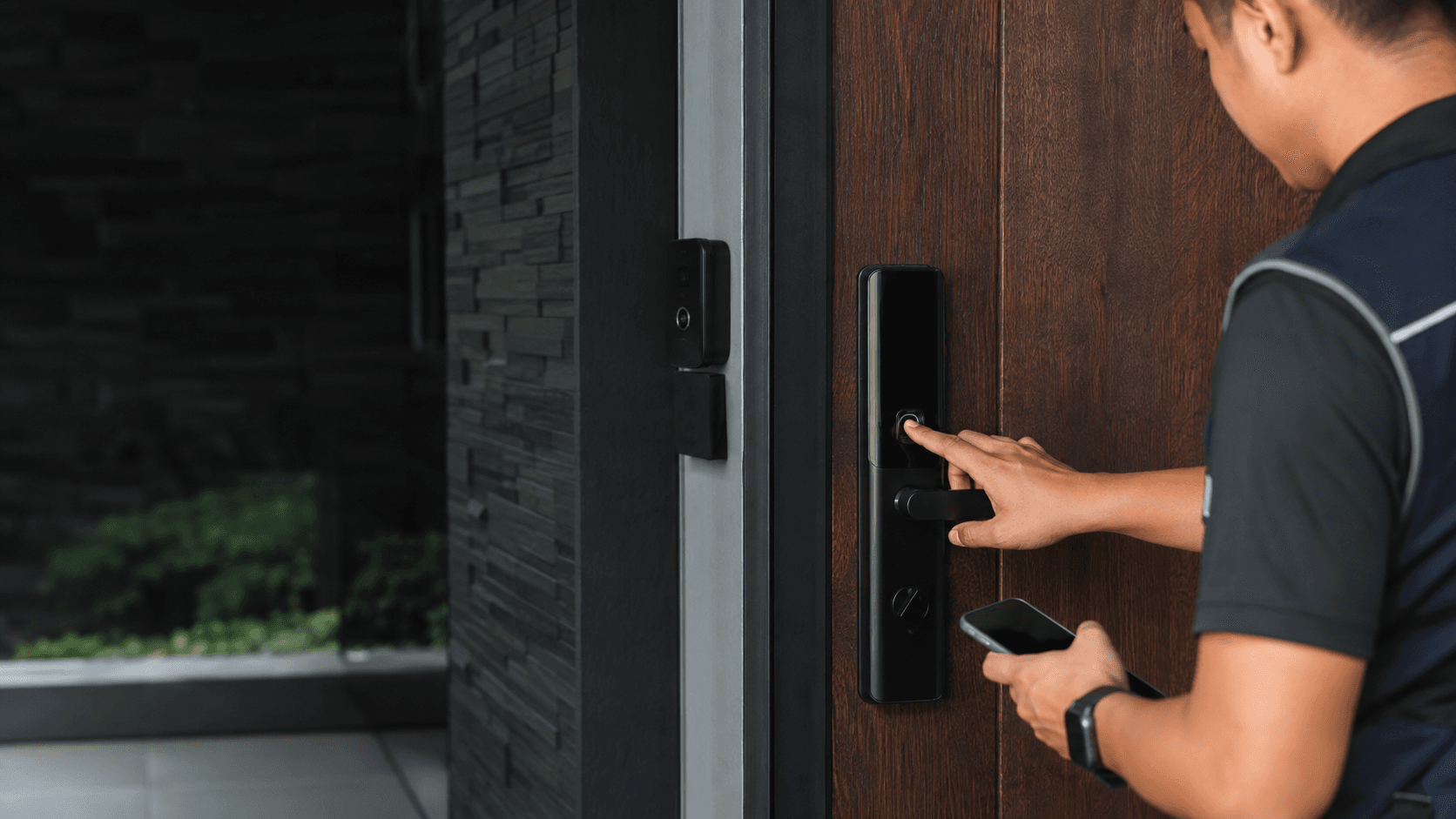
The category has matured quickly. Retailers and testing labs now group locks by how they connect, how they are installed, and what happens when the battery dies. That structure matters more than any single brand name, because a lock that fits a hollow metal office door in Kuching is often the wrong choice for a rented apartment with a decorative wooden door.
Best Wifi Front Door Lock. What Matters Before You Choose
Five checks separate a lock that works for years from one that becomes a nuisance within months. Run through them in order, because each one can eliminate options before price or brand enters the conversation.
- Confirm the door type and existing hardware. A deadbolt replacement needs a standard bore hole; a retrofit adapter keeps the existing exterior key cylinder; a lever or knob replacement changes the whole handle set.
- Decide how the lock connects. Built-in Wi-Fi removes the need for a separate hub, while Bluetooth-only and Thread or Matter models often need a bridge for remote access.
- Count the entry methods required. Keypad codes suit cleaners and contractors, fingerprint readers suit frequent users, and a physical key remains the fallback when batteries run flat.
- Check the door thickness, backset and handing. Most residential deadbolts assume a standard backset, and thicker or non-standard doors may need an adapter kit.
- Plan power and backup. Battery type, expected battery life and the low-battery warning method determine how much maintenance the lock demands.
Consumer Reports organises its 2026 testing around the same practical split, with separate categories for Wi-Fi smart locks, fingerprint models, Apple Home Key locks, Matter locks and retrofit designs. That grouping is a useful signal: the connection method and the installation type change the buying decision more than the brand badge on the front.
Choosing the Right Wifi Front Door Lock
The right lock depends on who uses the door and how often. A family home with a single main entrance has different needs from a shop with staff arriving in shifts or a rental unit with rotating guests.
Match the lock to the door and the building
Residential deadbolt replacements assume a standard bore and a door thick enough to house the mechanism. Retrofit adapters sit over the interior thumb turn and leave the exterior key cylinder untouched, which suits rented properties where the original hardware must stay intact. Lever and knob replacements change the visible handle, so they suit entrances where the existing handle is worn or where a lever is easier to operate.
Door condition is the first thing Eyonic checks on smart lock work. The company's own product review notes that smart locks work best when door condition, user roles and backup method are reviewed before installation, and that business premises sometimes need a standalone lock while other sites need an access-control panel instead. That distinction matters in Sarawak, where shop lots, offices and homes often sit on the same street with very different door constructions.
Decide between built-in Wi-Fi and a hub
A lock with built-in Wi-Fi connects directly to the router, so remote locking and unlock notifications work without extra hardware. Bluetooth-only locks usually need a phone within range, and Matter or Thread models typically need a compatible hub or border router to reach the internet. The trade-off is power. a Wi-Fi radio draws more current than Bluetooth, so battery life is often shorter on direct-connect models.
For a single entrance, built-in Wi-Fi keeps the setup simple. For a property with several doors, a hub-based system can be easier to manage centrally, and it avoids putting a Wi-Fi radio on every lock.
Plan entry methods and backup access
Keypad codes are the most flexible option for households with regular visitors, because a code can be changed without rekeying anything. Fingerprint readers remove the need to remember anything but can struggle with very dry or worn fingertips. A physical key override remains the standard fallback, and it is worth confirming that the override cylinder is accessible from outside the property.
Eyonic's guidance on smart lock door access frames the same point: the technology suits controlled convenience when user permissions and backup entry are planned properly. Skipping that planning is what turns a convenience feature into a lockout.
What Is a Wifi Front Door Lock?
A wifi front door lock is a powered locking device fitted to an entrance door that communicates over a wireless network so access can be granted, revoked or reviewed remotely. It is not a single product type. The term covers full deadbolt replacements, retrofit adapters that sit over existing hardware, and lever or knob replacements that change the entire handle set.
Three components do the work. A motor or solenoid moves the bolt. A radio links the lock to a phone, hub or network. An access layer decides who gets in, whether that is a keypad code, a fingerprint, a phone app, a key fob or a physical key.
Two limits are worth stating plainly. A Wi-Fi lock depends on a working network and a charged battery, so a mechanical override is not optional. And a smart lock changes how a door is operated, not how strong the door is; the frame, strike plate and door material still determine how much force the entrance resists.
The Best Smart Locks of 2026
Published testing from several outlets converges on a similar shortlist, though the winners differ by category. The table below reflects how those outlets group their picks rather than a single ranking.
| Category | Representative models named in 2026 testing | Best-fit situation |
|---|---|---|
| Wi-Fi deadbolt replacement | Schlage Arrive Smart WiFi Deadbolt, Yale Assure Lock 2, August Wi-Fi Smart Lock | Main entrance with a standard deadbolt bore and a home network in range |
| Retrofit adapter | Yale Approach Lock with Wi-Fi, August Wi-Fi Smart Lock | Rented property where the exterior key cylinder must stay unchanged |
| Fingerprint entry | Yale Assure Lock 2 Touch, Aqara Smart Lock U100, Lockly Visage | Households where several people enter daily and codes are inconvenient |
| Apple Home Key | Schlage Encode Plus, Aqara Smart Lock U100 | Apple-centred homes wanting tap-to-unlock from a phone or watch |
| Lever or handle replacement | Schlage Encode Smart WiFi Lever, Aqara Smart Lock U300 | Entrances with a lever handle rather than a separate deadbolt |
| Budget-focused | Eufy Smart Lock C34, Wyze Lock Bolt, Ultraloq U-Bolt Pro with Wi-Fi | Secondary doors or first smart lock where cost leads the decision |
Wirecutter names the Schlage Arrive Smart WiFi Deadbolt as its top pick and the Yale Assure Lock 2 as a runner-up, with the Aqara Smart Lock U100 for Apple Home and the Eufy Smart Lock C34 as a budget option. CNET's 2026 round-up leads with the Yale Assure Lock 2 and separates picks into overall, budget, retrofit, handle, invisible and high-end categories. The Verge, working from a larger test pool, highlights the Kwikset Halo Select, the Wyze Lock Bolt, the Nuki Smart Lock, the Yale Approach Lock with Wi-Fi and the Yale Assure Lock 2 Touch.
SafeHome's ranking places August first, followed by Yale and Schlage, and scores brands across customer service, value, equipment, features and ease of use. Consumer Reports takes a different route, testing lock hardware and electronics in a lab and grouping results by Wi-Fi, fingerprint, Apple Home Key, Matter and retrofit categories.
The disagreement is informative. August and Yale appear near the top of several lists because they install easily and integrate widely. Schlage models recur where build quality and a conventional deadbolt feel matter. Aqara and Eufy appear where price or Apple compatibility is the priority. No single lock wins every category, which is why the door and the household should decide before the brand does.
Practical Considerations for Installation
Installation difficulty varies more by lock type than by brand. A retrofit adapter typically takes minutes because the exterior hardware stays in place. A full deadbolt replacement involves removing the existing cylinder and aligning the new bolt with the strike plate, which can require adjusting the strike or enlarging the bore on older doors.
Network coverage is the second practical constraint. A lock at the far end of a property may sit outside reliable Wi-Fi range, and a weak signal causes delayed commands and missed notifications. Checking signal strength at the door before purchase avoids that problem.
Battery behaviour is the third. Most locks warn before the battery fails, and many allow a temporary charge from a phone or a 9-volt battery at external contacts. A mechanical key override remains the simplest fallback, and it should be tested before the lock is relied on.
For commercial premises, the decision often shifts from a standalone lock to a managed access system. Eyonic's project work in Sarawak reflects that pattern. The Kuching Immigration Office project focused on arrival flow, staff areas, visitor movement and dependable daily operation, and the KTA Sarawak Sdn Bhd project supported staff movement, visitor handling, tidy cabling and clearer daily site control. Both are access and monitoring problems rather than single-door lock problems, and both were delivered through a process that starts with a site survey and a system proposal before installation and handover.
Eyonic's published packages sit at RM 1,599 for a Hikvision CCTV package, RM 1,599 for a Hikvision alarm system and RM 1,599 for an autogate package, each covering supply, setup and handover. Those figures are useful context for anyone weighing a single smart lock against a wider entrance system, because a lock is often one part of a larger access and monitoring plan.
Making an Informed Choice About
The decision narrows quickly once the door type, connection method and entry requirements are settled. A standard residential deadbolt with a home network in range points toward a Wi-Fi deadbolt replacement. A rented property points toward a retrofit adapter. A shop or office with staff and visitors points toward a managed access system rather than a standalone lock.
Two questions resolve most remaining doubt. What happens when the battery dies, and who can still get in? If both answers are clear and tested, the lock is ready for daily use. If either is uncertain, the installation is not finished.
For properties in Sarawak, Eyonic Sdn Bhd plans, supplies and installs security and ELV systems for homes, offices, shops and industrial sites, and reviews door condition, user roles and backup method before recommending a smart lock or an access-control panel. Sharing the location, property type and required system with Eyonic on WhatsApp at +60 11-5111 7959 is the next practical step.