
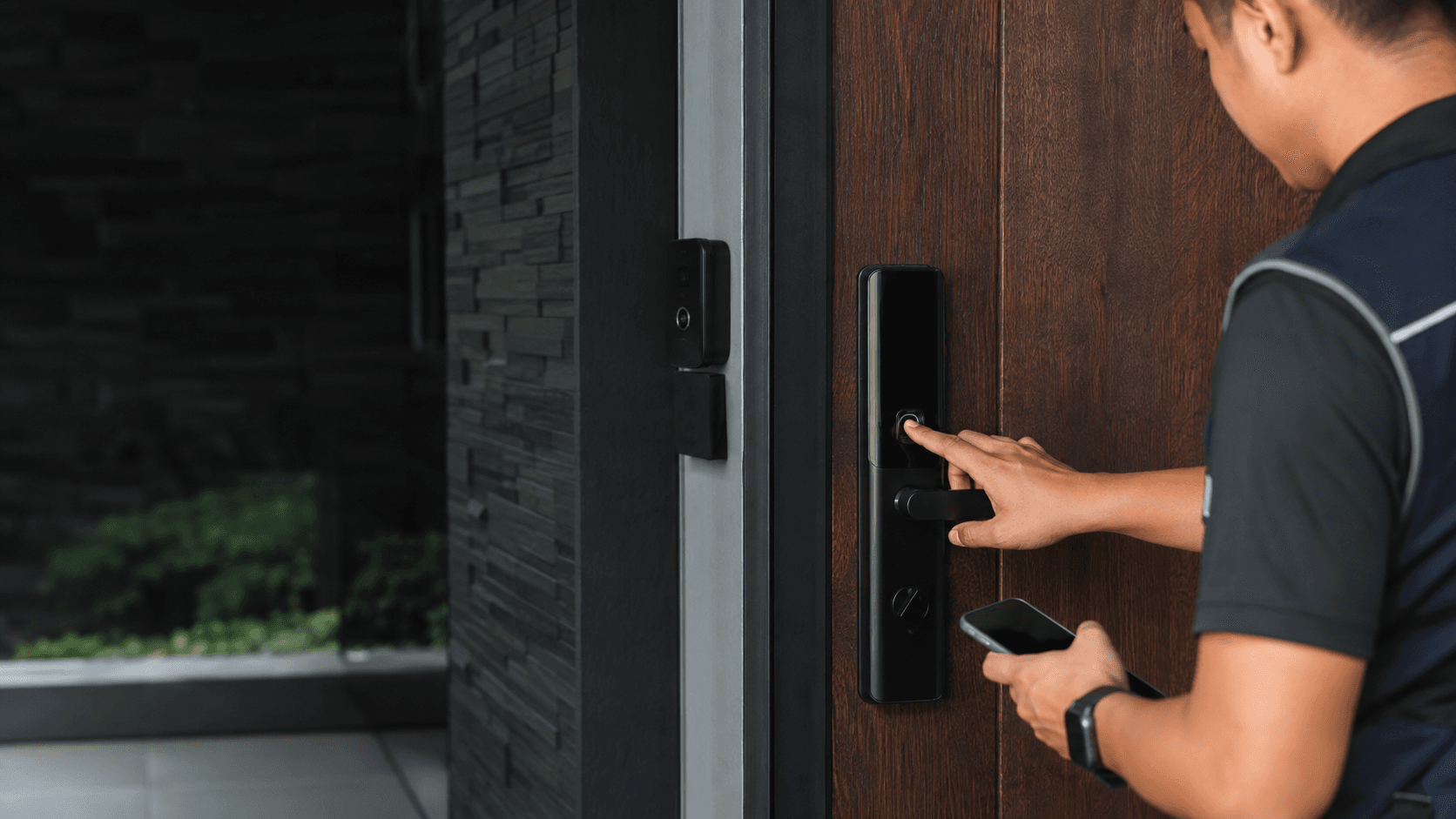
The finish is the easy part. What decides whether a black smart door lock works well over years of daily use is the door it sits on, the way people are given access, and what happens when the battery or the network fails. Eyonic treats smart lock door access as controlled convenience, useful when user permissions and backup entry are planned properly rather than added afterwards.
Black Smart Door Lock. What Matters Before Choosing
Most buying pages for a black smart door lock sort products by price, brand and finish. That ordering hides the three variables that actually determine satisfaction: whether the existing door and frame accept the lock body, how many people need different levels of access, and which entry method still works when power, Wi-Fi or a phone is unavailable.
Eyonic's own review of smart lock door access notes that smart locks work best when the door condition, user roles and backup method are reviewed before installation. For business use, the same review states that Eyonic usually checks whether a standalone smart lock or an access-control panel is more appropriate. That distinction matters more than colour, because a matte black finish is available across both categories.
Three figures frame the decision in Sarawak. Eyonic's published packages for related security work sit at RM 1,599 for a Hikvision CCTV package, RM 1,599 for a Hikvision alarm system and RM 1,599 for an autogate package. Completed office projects have carried approximate budgets of RM 8,000 to RM 18,000 and RM 12,000 to RM 28,000. Those numbers describe wider security scopes, not a lock on its own, but they show the range a property owner is usually working within once access control joins a larger system.
Choosing the Right Black Smart Door Lock
A short sequence keeps the choice grounded. It follows the same order Eyonic uses on installation work: understand the site first, then propose, then install, then hand over.
- Confirm the door type and condition, including thickness, existing deadbolt bore, frame alignment and whether the door is timber, metal or glass.
- List every person or group who needs entry, and decide which of them should have permanent codes, temporary codes or no code at all.
- Choose the entry methods that will actually be used, such as keypad, fingerprint, card, app or mechanical key.
- Decide the backup path for a flat battery, a lost phone or a dropped network connection.
- Check how the lock will be powered and whether the chosen connectivity suits the building.
- Confirm who installs it, who hands over the credentials, and who handles a fault later.
Steps one and two eliminate most unsuitable options before price is discussed. A lock that fits the door but cannot express the access rules will be replaced or worked around.
What is black smart door lock terminology actually describing
The phrase describes two separate attributes joined together. "Black" is a finish, usually matte black or a similar dark coating applied to the exterior escutcheon, handle and keypad surround. "Smart" describes the mechanism: an electronic lock that accepts a credential other than a cut key, and that can usually be managed through an app, a keypad or an access platform.
Because the two attributes are independent, a black smart door lock can be a full deadbolt replacement, a lever-handle lock, a retrofit unit that sits over an existing deadbolt, or a knob-style lock. Each form has different installation consequences, and the finish does not indicate which one is being sold.
Matte black and electronic finishes in practice
Matte black hardware is popular because it reads as deliberate against timber, white and grey doors, and because it hides fingerprints better than polished metal. The trade-off is surface wear. Coated finishes on frequently touched parts such as handles and keypads can show scuffing over time, and coastal or high-humidity environments in Sarawak place more demand on any exterior coating than a dry inland setting.
Finish choice does not change the electronics, the credential capacity or the battery behaviour. Two locks from the same range in different colours will perform identically; only the exterior appearance and the wear pattern differ.
Practical Considerations for Black Smart Door Lock Installation
Installation is where most disappointment originates. A lock that is specified correctly but fitted to a misaligned frame will report jams, fail to throw the bolt cleanly and drain batteries faster than expected.
Eyonic's installation process for security systems runs through site survey, system proposal, installation and handover. The same four stages apply to a lock: the survey confirms the door and frame, the proposal sets out the access rules and entry methods, the installation fits and configures the hardware, and the handover transfers credentials and explains the backup path.
Two constraints deserve attention before any order is placed. First, a smart lock needs a door that closes and latches reliably by hand; electronics cannot compensate for a swollen frame or a dropped hinge. Second, the backup method must be physically available on site, not stored only inside the app that might be unreachable.
Access rules for homes, offices and mixed-use doors
A home usually needs a small number of permanent users plus occasional access for family, cleaners or contractors. An office typically needs grouped permissions, a record of who entered, and a way to revoke access the same day someone leaves. A mixed-use door, such as a shop entrance that also serves as a staff entry, often needs time-based rules so the door behaves differently during trading hours.
This is the point where a standalone lock and an access-control panel diverge. Eyonic's review of smart lock door access notes that for business use the company usually checks whether a standalone smart lock or an access-control panel is more appropriate. A single door with a handful of users usually suits a standalone lock. Multiple doors, shared credentials across departments, or a need for central records usually point towards a panel-based approach.
Power connectivity and failure behaviour
Battery life varies by lock, by how often the door is used and by how much the radio has to work. A lock on a busy entrance with frequent app communication will consume more than one on a quiet internal door. The practical response is to know the low-battery warning behaviour before it happens, and to keep a mechanical key or a second entry method available.
Connectivity is a separate decision. A lock that communicates directly over Wi-Fi needs a stable signal at the door, which is not guaranteed on a metal-framed entrance or at the far end of a building. A lock that relies on a phone being nearby works differently again. The right answer depends on whether remote unlocking and entry records are genuinely required, or whether local keypad and fingerprint entry is sufficient.
Eyonic applies the same principle to camera placement, recommending that actual lighting conditions be checked before confirming a position rather than assuming a specification will hold. Door hardware deserves the same treatment: the door, the frame and the signal at that exact spot are the conditions that matter.
Making an Informed Choice About
The decision narrows quickly once the door, the users and the backup path are settled. A single residential entrance with a few permanent users and a mechanical key as backup is a straightforward standalone lock. A commercial entrance with staff turnover, visitor access and a need for records is a different project, and the lock is one component of it.
Eyonic's completed work shows how access and movement are handled in practice. The Kuching Immigration Office project focused on arrival flow, staff areas, visitor movement and dependable daily operation. The KTA Sarawak Sdn Bhd project supported staff movement, visitor handling, tidy cabling and clearer daily site control. Both are office environments where entry points serve different groups of people, which is exactly the situation that shapes lock selection.
Eric Yong, founder of Eyonic Security Systems, has worked in the industry for more than ten years and is experienced in the technical installation of digital security solutions for commercial businesses in Sarawak. That background is relevant to lock choice mainly because installation quality and access planning decide the outcome more than the product listing does.
For a property in Sarawak, the practical next step is to describe the door, the people who need access and the system already in place. Eyonic can be reached on WhatsApp at +60 11-5111 7959 with the location, property type and required system.