
The exact-match query best residential door locks is a comparison question, not a brand question. Malaysian homeowners are usually weighing four things at once: what the door can physically accept, how much resistance the lock offers, who needs daily access, and what happens when the electronics or the key fail. Eyonic Sdn Bhd, a security system supplier in Sarawak, reviews door condition, user roles and backup method before recommending a lock, and treats a standalone smart lock and an access-control panel as different answers to different problems.
This guide covers the comparison sequence, the lock types available, how security ratings and door condition interact, how permissions and backup entry work on smart and keyless locks, and what installation and handover should include in Sarawak.
Best Residential Door Locks. What Malaysian Homes Should Compare
Comparison should follow the door, not the product catalogue. A lock that fits one leaf may not fit the next, and a feature set that suits a family home may be the wrong shape for a rented unit or a shoplot with heavy daily traffic.
The sequence below keeps the decision in the right order, so a lock is not chosen before the door and the access needs are understood.
- Confirm door condition, thickness, existing cut-outs and frame alignment.
- Choose the lock type that suits the door and how it is used.
- Check the security rating or resistance class the lock is stated to meet.
- Decide the access method. key, keypad, card, fingerprint or app.
- Plan backup entry for power loss, battery drain or a failed reader.
- Schedule installation and handover, including user setup and testing.
Two constraints shape this list in Malaysia. First, many homes already have a cut-out from a previous lock, and reusing it limits the models that will fit without patching or re-drilling. Second, external doors on terrace houses and shoplots face heat, humidity and direct rain exposure, which affects both mechanical wear and the electronics inside a smart lock.
Over-buying is common. A household that only needs a reliable mechanical deadbolt on the main door does not gain much from app-based control, while a household with regular guests, contractors or short-stay tenants gains a great deal from time-limited codes and an audit trail.
Residential Door Locks Types. Deadbolt, Knob, Lever and Smart
Lock type determines both the security ceiling and the installation work. The four families below cover almost every Malaysian home door.
Deadbolt. A deadbolt throws a solid bolt into the frame and does not rely on a spring latch. It is the standard upgrade for a main entrance because the bolt resists being slipped or pushed back. Single-cylinder deadbolts are operated by a key outside and a thumb-turn inside; double-cylinder versions need a key on both sides, which adds security through a glass panel but creates an exit problem during a fire.
Knob lock. A knob set combines a latch and a handle in one unit. It is common on older doors and interior rooms. The security limit is the latch itself, which is short and spring-loaded, so a knob lock alone is a weak point on an external door.
Lever lock. A lever handle operates the same latch mechanism but is easier to grip, which matters for elderly residents and for anyone carrying items. Lever sets are frequently paired with a separate deadbolt on the same door.
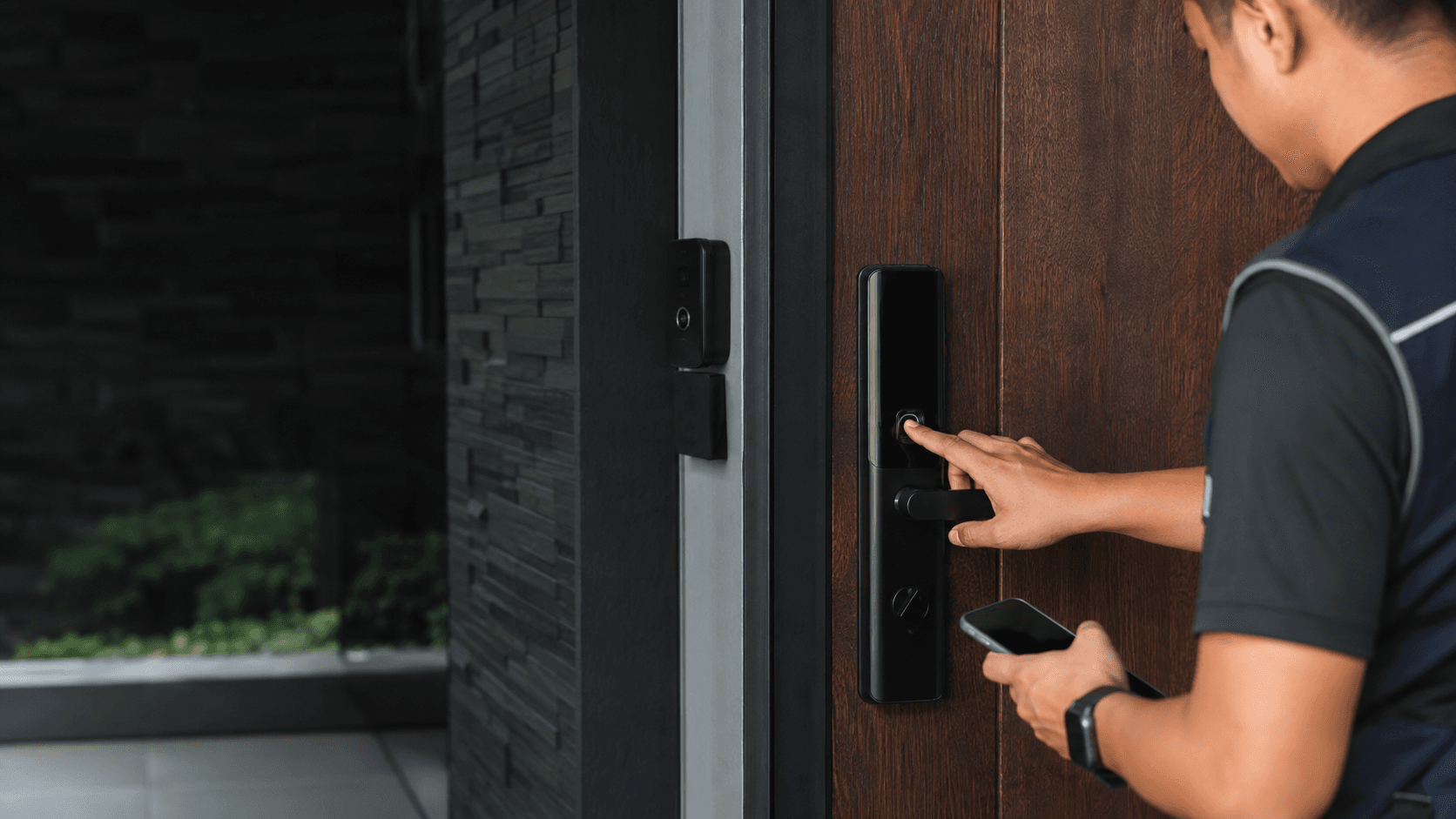
Smart lock. A smart lock adds electronic authentication to a deadbolt or lever body. Access can be by keypad code, card, fingerprint, phone app or a combination. Eyonic's own product review notes that smart locks work best when door condition, user roles and backup method are reviewed before installation, and that for business use the choice between a standalone smart lock and an access-control panel should be checked first.
The practical combination for most Malaysian main doors is a deadbolt as the primary security element, with a lever or knob set for daily handling. Smart functionality is then layered onto the deadbolt rather than replacing it.
Security Ratings and Door Condition Before Buying Residential Door Locks
A rating on a box describes the lock, not the door it is fitted to. A high-rated deadbolt installed into a soft frame with a short strike plate still fails at the frame.
Ratings used in the door hardware market are typically expressed as grades or resistance classes, and they describe tested performance against forced entry, drilling and picking. The specific scheme, the testing body and the grade achieved vary by manufacturer and by market, so the rating should be read from the documentation supplied with the exact model rather than assumed from the brand name.
Door condition carries equal weight. Four checks matter before buying residential door locks:
- Door material and thickness. Solid timber, hollow-core, metal and glass-panelled doors accept different hardware and different fixing depths.
- Existing cut-outs. A previous lock leaves a bore hole and a mortise. A new lock that does not match those dimensions means patching, re-drilling or a new door.
- Frame and strike plate. The bolt is only as strong as what it enters. A reinforced strike plate and sound frame timber matter as much as the lock body.
- Alignment and clearance. A door that has swollen or dropped will bind against a deadbolt, which shortens the lock's working life and causes false "jammed" faults on smart models.
Where the door is hollow-core or badly warped, the honest answer is often that the door needs attention before the lock is upgraded. Fitting an expensive lock to a failing door moves the weak point rather than removing it.
Smart and Keyless Residential Door Locks: Permissions and Backup Entry
Smart and keyless locks change who can enter and when, which is a management question as much as a hardware question.
Permissions are the core of it. A household lock typically needs a small number of permanent users plus a way to issue temporary access. A lock used in a rental or short-stay setting needs codes that expire, a record of which code was used and when, and a simple way to revoke access when a tenancy ends. Eyonic's guidance is that smart locks suit controlled convenience when user permissions and backup entry are planned properly — the planning is the part that decides whether the lock is convenient or frustrating.
Backup entry is the second half. Every electronic lock has at least one failure mode: a flat battery, a power interruption, a failed reader or a forgotten code. A workable backup plan includes a mechanical key override where the model provides one, a documented physical key stored off-site, and a clear procedure for what happens if the primary entry method fails while nobody with admin rights is present.
Three trade-offs are worth stating plainly:
- Convenience versus dependency. Keyless entry removes the lost-key problem but adds a battery and electronics dependency.
- Audit trail versus privacy. Access logs are useful for managing a rental or a shared entrance, and they record the movement of household members too.
- Feature depth versus support. A lock with many access modes needs someone able to reconfigure it later. If no local support exists, a simpler lock is the better long-term choice.
For a business entrance, the decision point is whether a standalone smart lock is sufficient or whether a managed access-control panel is more appropriate. That depends on the number of doors, the number of users and whether access needs to be administered centrally.
Installation and Handover for Residential Door Locks in Sarawak
Installation quality decides whether a good lock performs as intended. The work is not only fitting the body; it is making the bolt, frame and strike plate line up so the lock operates with minimal force.
Eyonic's installation process for security systems follows site survey, system proposal, installation and handover. Applied to door locks, that means the door is inspected before a model is proposed, the fixing and alignment are done on site, and the handover covers how the lock is used day to day.
A handover for residential door locks should leave the household able to do five things without calling anyone:
- Unlock and lock the door using the primary method.
- Use the backup entry method and know where the physical key is kept.
- Add or remove a user code or credential.
- Recognise a low-battery or fault indication and know what to do about it.
- Contact the right person if the lock fails or the door starts binding.
In Sarawak, humidity and rain exposure are practical factors. External locks benefit from being checked periodically for stiffness, corrosion on the bolt and moisture ingress around the electronics. A lock that is stiff to operate is usually an alignment or lubrication issue rather than a failed lock, and it is cheaper to correct early.
Eyonic has completed security work for the Kuching Immigration Office, focused on arrival flow, staff areas, visitor movement and dependable daily operation, and for KTA Sarawak Sdn Bhd, an engineering consultancy office in Kuching needing support for staff movement, visitor handling and tidy cabling. Both projects show the same pattern that applies to door locks: the access requirement is defined first, and the hardware follows.
What Eyonic Checks Before Recommending Residential Door Locks
Eyonic Sdn Bhd is a security system supplier in Sarawak working across CCTV, alarm, autogate, intercom and access control, including smart lock door access. The review process for a lock starts with the door and the people using it.
The checks cover door condition and dimensions, the existing cut-out, frame and strike plate condition, the number and type of users, whether temporary access is needed, the preferred access method, and the backup entry plan. Where the door is unsuitable for the lock under consideration, that is raised before supply rather than after installation.
For households comparing options, the useful next step is to gather three details: the door type and thickness, a photo of the existing lock and cut-out, and a list of who needs access and how often. Those three items are enough to narrow the field considerably and avoid buying a lock that will not fit or a feature set that will not be used.
Eyonic's documented packages cover Hikvision CCTV, alarm systems and autogate at RM 1,599 each, with camera supply and setup, recording configuration and mobile viewing handover on the CCTV package, control panel and sensor setup with user testing on the alarm package, and motor recommendation, remote-control setup and safety testing on the autogate package. Door lock supply and installation is handled as a separate scope based on the door and access requirement.
Share your location, property type and required system with Eyonic on WhatsApp at +60 11-5111 7959 for the next practical step.