
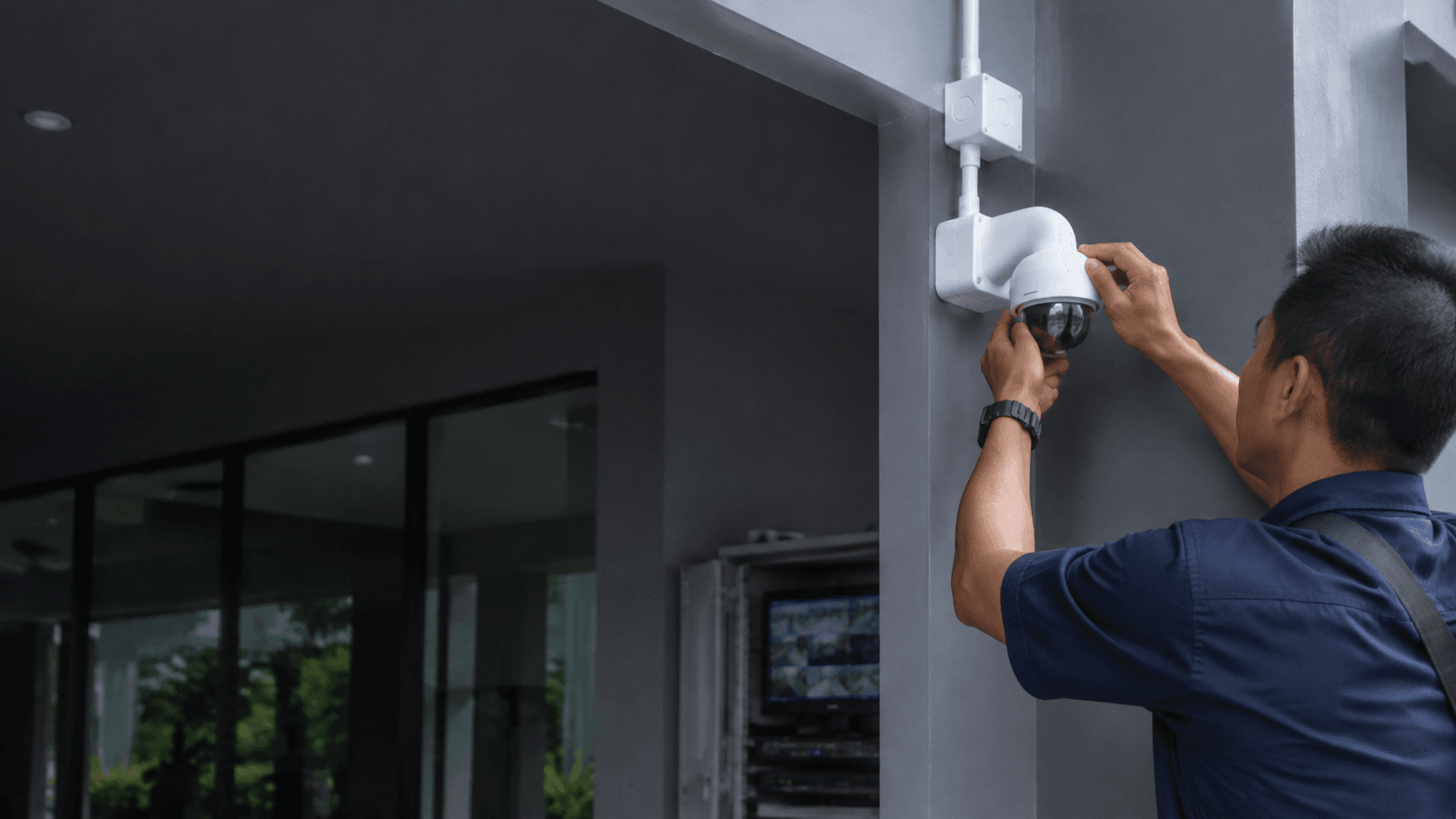
The exact-match query outdoor use blink camera describes a practical question rather than a product category. Blink sells outdoor cameras and publishes support material on using them, so the real work sits in deciding where a unit goes, what it will see at night, and how it stays powered and connected. In Sarawak, that decision also involves who surveys the site, mounts the hardware and hands over a working view.
Outdoor Use Blink Camera. what outdoor placement actually involves
Outdoor placement means the camera sits outside the building envelope, exposed to rain, heat, insects and passing traffic. Blink's own product pages list outdoor models, and Blink's support centre carries guidance on using the outdoor and indoor camera. Those two sources establish that outdoor use is an intended scenario, not an improvised one.
What they do not establish is how any specific model behaves on a particular wall in Kuching or Miri. Weather resistance ratings, operating temperature ranges, battery figures and field of view are model-specific and are not supplied here, so those numbers should come from the documentation for the exact unit under consideration.
The practical consequence is that outdoor use splits into two separate questions. The first is whether the hardware is rated for the position. The second is whether the position gives the camera something useful to record. A camera can be perfectly rated for outdoor service and still produce unusable footage because it faces a blank wall, a bright road or a neighbour's window.
Placement checks before mounting
Work through these checks in order before any bracket goes onto a wall. Each one can change the answer to the next.
- Confirm the intended model is documented by Blink for outdoor use, and read its own mounting and weather guidance rather than assuming it from the product family name.
- Walk the position at the times of day that matter, including after dark, and note what the camera would actually face.
- Identify the light sources in frame, such as street lamps, porch lights, vehicle headlights and direct sun at sunrise or sunset.
- Check the mounting surface for solid fixing points, and confirm the cable or battery route reaches without a long unsupported run.
- Test the wireless signal at the exact mounting point, not at ground level near the door.
- Decide what the footage is meant to answer, such as who entered a gate or what crossed a yard, and confirm the chosen angle covers it.
- Agree who will install, configure and hand over the working view before the hardware is ordered.
Eyonic's own installation process follows a comparable sequence: site survey, system proposal, installation and handover. That structure exists because the survey stage is where placement problems surface cheaply, before drilling and cabling.
Lighting conditions and night-time expectations
Lighting is the single largest variable in outdoor camera performance, and it is also the one most often assumed rather than checked. Eyonic's published guidance on ColorVu-style cameras is to check actual lighting conditions before confirming placement. The same discipline applies to any outdoor camera, including a Blink unit.
Three lighting situations behave differently. A position with steady ambient light at night, such as a porch or a lit car park, gives a camera usable illumination. A position with no ambient light depends entirely on the camera's own infrared or spotlight behaviour, which is model-specific. A position facing a strong light source produces glare, flare and silhouetted subjects, and no amount of resolution fixes that.
Night-time expectations should therefore be set from the position, not from the product listing. A camera aimed down a dark driveway and a camera aimed across a lit corridor are doing different jobs with the same hardware.
Mounting height, angle and coverage limits
Height and angle trade off against each other. Mounting high reduces the chance of tampering and puts more ground in frame, but it also flattens faces and pushes the subject further from the lens. Mounting low captures identifiable detail but sits within easy reach.
Angle matters more than most buyers expect. A camera aimed straight down a path records a person approaching but may miss a face until the subject is very close. A camera angled across the approach records the face earlier. The correct choice depends on whether the footage needs to identify a person or simply record that someone passed.
Coverage limits are also physical. Walls, pillars, parked cars, signage and foliage all create blind spots that are invisible on a product page and obvious on site. This is the reason a survey walk-through at the actual property produces a different answer from a floor plan.
Power, connectivity and recording basics
Outdoor cameras generally draw power from one of three arrangements: internal batteries, a wired supply, or a solar accessory. Each has a different implication for where the camera can go. Battery placement is limited only by signal, while wired placement is limited by where a cable can be run tidily and safely.
Connectivity is the second constraint. A mounting point that looks ideal from the ground may sit at the edge of wireless coverage, and outdoor walls, metal roofing and concrete reduce signal compared with an indoor test. Verifying signal at the mounting point is worth doing before the bracket is fixed.
Recording behaviour is the third. Blink's support documentation covers how the outdoor and indoor camera is used, and Blink's product pages describe motion detection and alerts. Storage arrangements and subscription options are set by Blink and vary by plan and region, so those details should be confirmed against current Blink documentation rather than assumed.
For readers comparing an outdoor Blink camera against a conventional wired system, the trade-off is usually flexibility against continuity. A battery camera can be placed almost anywhere and installed without cabling, while a wired system with a recorder runs continuously and keeps footage locally. Neither is universally better; the deciding factor is what the footage needs to prove.
Installation and handover in Sarawak
Eyonic Sdn Bhd is a security system supplier based in Sarawak, working on CCTV and ELV systems for homes, offices, shops and industrial sites. The company's founder, Eric Yong, has more than ten years in the industry and works on technical installation of digital security solutions for commercial businesses in Sarawak.
Completed work includes the Kuching Immigration Office, where the focus was arrival flow, staff areas, visitor movement and dependable daily operation, and KTA Sarawak Sdn Bhd, an engineering consultancy office in Kuching that needed support for staff movement, visitor handling, tidy cabling and clearer daily site control. Both projects show the same pattern: the placement and cabling decisions were made against how the site is actually used.
Eyonic's published service lines cover CCTV, alarm systems, autogate, keyphone intercom, Starlink internet installation and smart lock door access. Blink camera supply and installation is not among the published service lines, so readers considering a Blink unit should confirm directly whether the work applies to a third-party camera brand before planning around it.
Where a site needs a surveyed, installed and handed-over camera system rather than a self-installed unit, Eyonic's CCTV packages start at RM 1,599 and cover camera supply and setup, basic recording configuration and mobile viewing handover. Alarm and autogate packages are also listed at RM 1,599. Larger project work has run in the RM 8,000 to RM 28,000 range depending on scope.
Share your location, property type and required system with Eyonic on WhatsApp at +60 11-5111 7959 for the next practical step.