
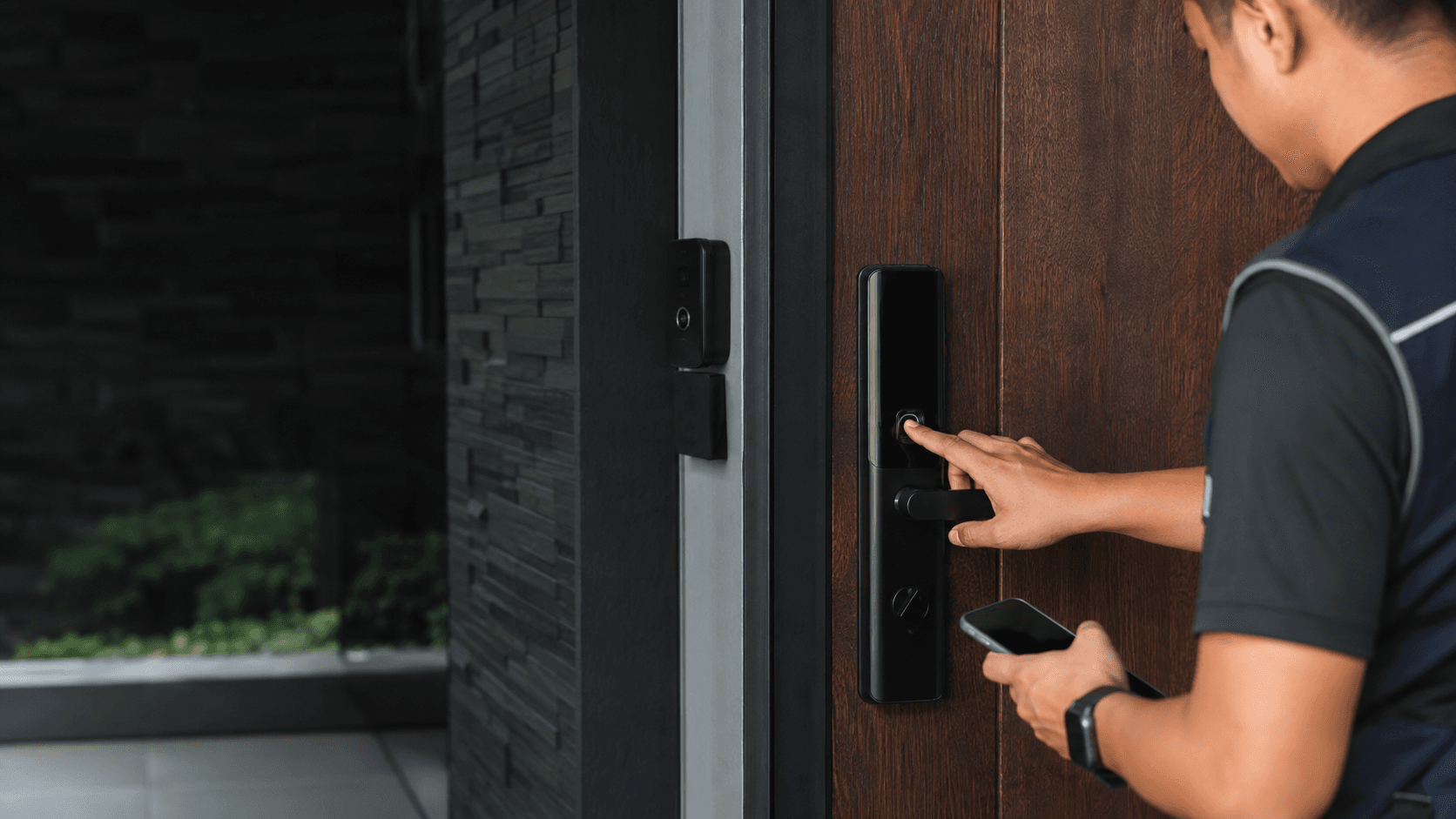
The exact-match query keyless garage door lock describes hardware that opens a garage door or garage entry door without a cut key. In Malaysia, that usually means a keypad mounted outside, a remote held in a car, or a smart lock tied to a phone app. Each option changes who can get in, what happens when a battery dies, and how much control the owner keeps.
Eyonic Sdn Bhd is a security system supplier in Sarawak that plans, supplies, and installs monitoring and access equipment for homes, offices, shops, and industrial sites. Its published product review notes that smart locks work best when door condition, user roles, and backup method are reviewed before installation, and that business use often raises the question of a standalone smart lock versus an access control panel.
Keyless Garage Door Lock. What Changes at the Door
A keyed lock and a keyless one solve different problems. A keyed handle or deadbolt gives one physical object control over entry. Lose the key, lend the key, or copy the key, and control spreads without any record. A keyless garage door lock moves that control into a code, a signal, or a credential that can be changed or withdrawn.
The practical change is administrative rather than mechanical. A code can be deleted when a tenant moves out. A remote can be withheld from a contractor who only needs access for one week. A smart lock can log when the door opened. None of that is possible with a single brass key that has already been duplicated.
The trade-off is dependency. A keyed lock works with no power, no battery, and no network. A keyless lock depends on at least one of those, which is why backup entry is a design decision rather than an afterthought.
Where the Lock Actually Sits
Two different doors get called a garage door. The overhead door is the large panel that rolls or tilts up, driven by an opener motor. The garage entry door is the smaller pedestrian door between the garage and the house or shop interior. A keypad that opens the overhead door does not secure the entry door, and a keyless deadbolt on the entry door does not move the overhead panel. Buyers who assume one device covers both usually end up with a gap at the second door.
Keypad, Remote, and Smart Access Compared
Three access methods dominate residential and small commercial use in Malaysia, and they differ in cost, wiring, and how easily access can be withdrawn.
Keypad entry uses a numbered pad, either wired to the opener or wireless. A shared code opens the door for anyone who knows it. Changing the code is the only way to remove one person's access, which means every change affects every user. Keypads suit households where the same small group uses the door daily.
Remote access uses a handheld transmitter or a vehicle-integrated button. It is the fastest option at the moment of arrival and needs no code entry. The limitation is that a lost remote is a working key until it is removed from the opener's memory, and older fixed-code remotes can be captured by a device that copies the signal. Rolling-code systems reduce that exposure.
Smart lock access ties the door to an app, and often to a code or a phone credential. This is the only one of the three that supports individual user permissions, time-limited access, and an entry history. It also introduces the most dependencies: a power source, a wireless connection, and a device that must stay charged and updated.
For business premises, the choice is not simply which method is convenient. Eyonic's published guidance notes that for business use it usually checks whether a standalone smart lock or an access control panel is more appropriate. A panel makes sense when many people need different access levels, when entry needs to be recorded, or when the door must integrate with a wider system. A standalone smart lock makes sense when a small team needs controlled convenience and the door itself is suitable.
What Each Method Cannot Do
A keypad cannot tell who used it. A remote cannot be time-limited without additional hardware. A smart lock cannot open a door whose frame, alignment, or hardware will not accept it. Matching the method to the door matters more than matching it to a preference.
Keyless Garage Door Lock Checks Before Installation
Most failed installations trace back to a step that was skipped before any hardware was chosen. The sequence below reflects the order Eyonic applies to access work: understand the site, define the users, then select the equipment.
- Confirm the door type and its condition, including panel weight, track alignment, frame material, and whether the existing hardware can accept a new lock body.
- Decide who needs access and at what level, separating daily users, occasional users, and people who should only enter during set hours.
- Choose the access method, weighing keypad entry, remote access, and a smart lock against the number of users and the level of control required.
- Agree a backup entry method before installation, so a flat battery, a power cut, or a network outage does not leave the door permanently closed.
Eyonic's CCTV installation process follows a comparable shape: site survey, system proposal, installation, and handover. The same logic applies to access hardware, because a lock that fits one door frame may not fit the next one.
Door Condition Is the First Filter
A door that sticks, sags, or has a misaligned frame will defeat a well-chosen lock. Motorised openers also have force limits, and a lock that adds resistance can trigger a safety reversal. Checking the door before purchase avoids the situation where the hardware is correct but the door is not ready for it.
Door Condition User Roles and Backup Entry
These three factors decide whether a keyless garage door lock works in daily practice or becomes a recurring problem.
Door condition covers the physical facts: whether the door is a roller, sectional, or tilt type, whether the frame is timber, steel, or masonry, and whether the existing lock cutout can be reused. A door that has never carried a lock may need preparation before any keyless unit will sit correctly.
User roles determine how access should be structured. A household with two adults and a domestic helper needs a different setup from a workshop with rotating shifts. Where roles differ, individual credentials matter more than a shared code, because a shared code cannot be withdrawn from one person without disrupting everyone else.
Backup entry is the constraint that decides whether the installation is safe. Every keyless method has a failure mode. A keypad can lose power. A remote can be lost or left in a vehicle. A smart lock can lose its network connection. A mechanical override, a second entry point, or a retained keyed cylinder gives a way in when the primary method fails.
Eyonic's product review states plainly that smart locks work best when door condition, user roles, and backup method are reviewed before installation. That order is not arbitrary. Reviewing the door first prevents wasted hardware, reviewing users second prevents an access structure that has to be rebuilt, and reviewing backup last confirms the design is complete.
Where Keyless Access Fits Less Well
A keyless lock adds little where a door is already inside a controlled perimeter, or where the door is rarely used and a key is not a burden. It also fits poorly where no reliable power or network is available and no mechanical override is acceptable. In those cases, a conventional lock with a managed key register can be the more honest choice.
Planning for Shops and Offices
Commercial premises change the calculation because access has to be accountable. A shop that opens at a fixed hour, a workshop with deliveries, and an office with staff arriving at different times all need to know who entered and when.
Eyonic's completed work for the Kuching Immigration Office focused on arrival flow, staff areas, visitor movement, and dependable daily operation. That pattern applies directly to access planning: separate the paths different groups take, keep staff areas distinct from visitor areas, and prioritise reliability over novelty because the door has to work every day.
A second Eyonic project, for KTA Sarawak Sdn Bhd, supported staff movement, visitor handling, tidy cabling, and clearer daily site control at an engineering consultancy office in Kuching. Cabling discipline matters for keyless access too, because a wired keypad or an access control panel needs a route to power and to the door hardware.
For a business door, the deciding question is usually whether access needs to be recorded and differentiated. If it does, a standalone smart lock may be too limited and an access control panel becomes the more suitable route. If a small team simply needs to stop carrying keys, a smart lock can be sufficient. Eyonic's published guidance frames that as a check made during review rather than a default recommendation.
Integration With Existing Security
Access hardware rarely stands alone on a commercial site. Cameras covering the door, an alarm system, and an intercom all interact with how the door is used. Eyonic supplies and installs CCTV, alarm, autogate, keyphone intercom, and Starlink internet systems in Sarawak, so door access can be planned alongside the rest of the site rather than added afterwards.
Published package pricing for related Eyonic work is RM 1,599 for a Hikvision CCTV package, RM 1,599 for a Hikvision alarm system, and RM 1,599 for an autogate package. These figures cover those packages only and do not represent keyless lock pricing, which is not published.
Questions Buyers Ask
Does removing the key improve security? It changes the risk rather than eliminating it. A keyless garage door lock removes the risk of a copied key and adds the risk of a shared code, a lost remote, or a device that loses power. Which risk is smaller depends on how many people hold access and how easily access can be withdrawn.
Can a keypad open the overhead door and the entry door? Not by itself. A keypad wired or paired to an opener moves the overhead panel. The pedestrian door between the garage and the interior needs its own lock, which is why the entry door is often the more important of the two.
What happens during a power cut? It depends on the hardware. Some units retain a mechanical override, some run on batteries, and some fail closed. This is why backup entry is agreed before installation rather than after the first outage.
Is a smart lock or an access control panel the better fit? A standalone smart lock suits a small group that needs controlled convenience. An access control panel suits a site where access levels differ, entry needs to be recorded, or the door must work with a wider system. Eyonic's published guidance treats this as a review question for business use.
What should be ready before installation? The door type and condition, the list of people who need access and at what level, the chosen access method, and the agreed backup entry. A site survey confirms what the door can actually accept.
Eyonic's founder, Eric Yong, has worked in the industry for more than ten years and is experienced in technical installation of digital security solutions for commercial businesses in Sarawak. For a property in Sarawak, sharing the location, property type, and required system with Eyonic on WhatsApp at +60 11-5111 7959 is the next practical step.