
Indoor CCTV in Malaysia is usually planned around three things: what needs to be seen, how the room is lit, and where the recorder and cabling can live without disrupting daily use. A camera that looks fine on a product page can still miss a doorway, wash out under a bright window, or leave a blind spot behind a counter. That is why placement and lighting checks come before any model is confirmed.
What indoor cctv covers in a home, office or shop
Indoor cctv is the monitoring of interior spaces rather than the perimeter. In a home, that typically means entry points, living areas and rooms where valuables or family members are present. In an office, it usually means the entrance, reception, corridors, staff areas and any room holding equipment or records. In a shop, the priority shifts to the counter, till area, stockroom and the aisles where shrinkage tends to happen.
The scope is not only the camera. A working indoor system also includes the recording device, the storage that holds footage, the network path that carries video, and the app or client used to view it. Eyonic describes its CCTV work as planning, supplying and installing monitoring systems with camera placement, recording and remote viewing for homes, offices, shops and industrial sites.
Two local projects show how that scope is applied in practice. The Kuching Immigration Office project focused on arrival flow, staff areas, visitor movement and dependable daily operation. The KTA Sarawak Sdn Bhd project covered a practical office setup in Kuching supporting staff movement, visitor handling, tidy cabling and clearer daily site control. Both are described in general terms rather than as indoor-only installations.
Where indoor coverage usually stops
Indoor cameras are generally chosen for interior sightlines, so they are a poor substitute for perimeter coverage. A camera aimed at an interior corridor will not document what happens at a gate or along a fence line. Where a property needs both, the indoor and outdoor requirements are usually planned as one system so the recorder, storage and viewing setup stay consistent.
How Eyonic plans an indoor cctv installation
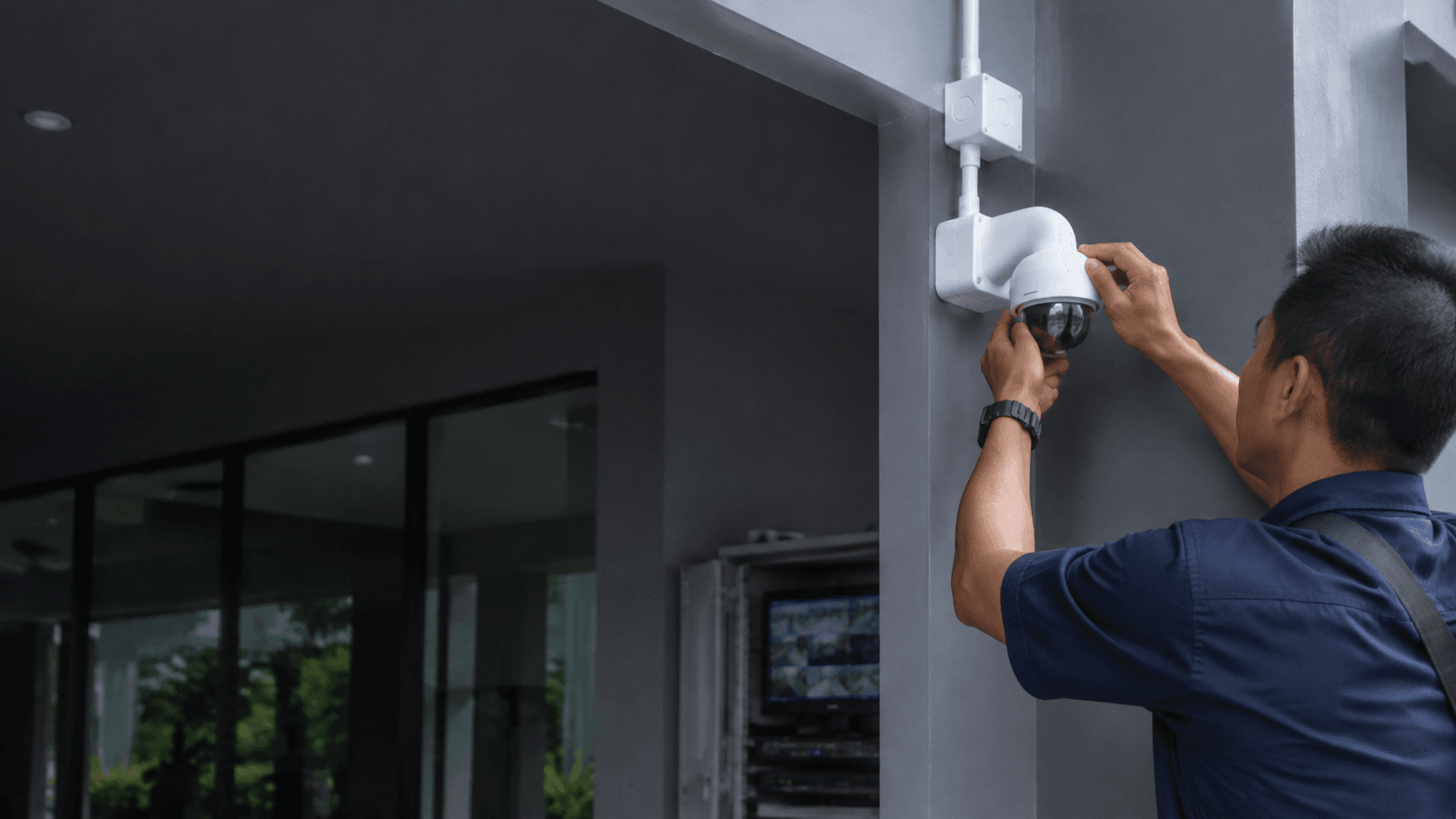
Eyonic's CCTV installation process follows four stages: site survey, system proposal, installation, and handover. The sequence matters because each stage removes guesswork from the next one.
- Site survey — the property is inspected to understand layout, entry points, existing cabling, power availability and the areas that need coverage.
- System proposal — the survey findings are turned into a recommended camera count, placement plan and recording setup.
- Installation — cameras, cabling and the recording device are fitted and configured on site.
- Handover — the recording configuration and mobile viewing are explained so the system can be used day to day.
The survey stage is where most indoor problems are caught early. Ceiling height, wall material, the position of air-conditioning units and the presence of mirrored or glass surfaces all affect where a camera can sit and what it will actually capture. A proposal built without that walkthrough tends to produce either too few cameras or cameras pointed at the wrong part of a room.
Eyonic's founder, Eric Yong, has worked in the industry for more than ten years, with experience in technical installation of digital security solutions for commercial businesses in Sarawak. That background is relevant to indoor work because commercial interiors often combine staff areas, visitor routes and equipment rooms in one building, each with different coverage needs.
What the handover should include
Handover is not just switching the system on. It covers confirming that recording is running, that the storage is holding footage as intended, and that remote viewing works on the devices the owner actually uses. If any of those three are unclear at handover, the system is effectively unfinished.
Indoor cctv placement and lighting checks
Placement decides whether a camera is useful. A camera mounted directly facing a bright window will expose for the daylight and leave the interior dark. A camera placed too high will capture the tops of heads rather than faces. A camera aimed down a narrow corridor may cover the length of it but miss the doorways along the side.
Lighting conditions deserve a separate check before placement is confirmed. Eyonic recommends checking actual lighting conditions before confirming placement for ColorVu-style cameras, which are designed to produce usable colour images in low light. The check matters because a room that looks adequately lit to the eye can still be too dark for a clean image, and a room with strong daylight can overwhelm a camera that is not positioned to handle it.
Practical placement questions for a Malaysian interior usually include:
- Which direction does the main light source come from during the hours the space is used?
- Are there glass partitions, mirrors or display cabinets that will reflect or confuse the view?
- Is the camera position reachable for adjustment, or will it need a ladder and a second visit?
- Does the cable route avoid areas where it will be damaged, pinched or visibly untidy?
Tidy cabling is part of the same decision. A camera position that requires a long surface-run cable may look worse than a slightly different angle that allows a shorter, concealed route. For offices and shops, that trade-off is usually settled during the survey rather than after installation.
Recording, storage and remote viewing
Recording configuration determines how far back footage can be reviewed. The recorder, the number of cameras and the storage fitted all affect that, so the recording setup is normally agreed alongside the camera plan rather than added afterwards. Eyonic lists NVR setup and recording configuration as part of its CCTV service scope.
Remote viewing is the other half of a usable system. It allows the owner or manager to check a room, a counter or an entrance without being on site. Setting it up properly means confirming the network path, the viewing app and the user accounts that should have access. A system that records correctly but cannot be viewed remotely still leaves the owner dependent on being present.
Storage and retention terms are not fixed across every installation, because they depend on the recorder, the storage fitted and the number of cameras running. Those details are confirmed as part of the proposal rather than assumed in advance.
questions before installation
Several questions come up before an indoor system is confirmed, and the answers shape the proposal.
Does an indoor camera need its own power point? Power availability is checked during the survey. Where a suitable point is not already near the intended camera position, that affects both the placement plan and the cabling route.
Can an indoor camera record through a window? No verified statement is available on recording through glass for the systems Eyonic supplies, so this is best treated as a placement question to settle on site rather than an assumption.
Is audio recording covered? No verified guidance is available here on audio recording or privacy obligations in Malaysia, so those points should be raised directly rather than assumed either way.
How many cameras does a shop need? It depends on the counter layout, stockroom access and aisle structure. A single camera covering the till area will not cover a stockroom, and a stockroom camera will not document the shop floor.
What does a package include? Eyonic's Hikvision CCTV Package is listed at RM 1,599 and covers camera supply and setup, basic recording configuration, and mobile viewing handover. It is not described as an indoor-only package, so indoor scope is confirmed against the actual property.
For a public office, the Kuching Immigration Office project carried an approximate budget of RM 12,000 to RM 28,000. The KTA Sarawak Sdn Bhd office project carried an approximate budget of RM 8,000 to RM 18,000. Both figures describe those projects rather than a standard indoor rate.
Share your location, property type and required system with Eyonic on WhatsApp at +60 11-5111 7959 for the next practical step.