
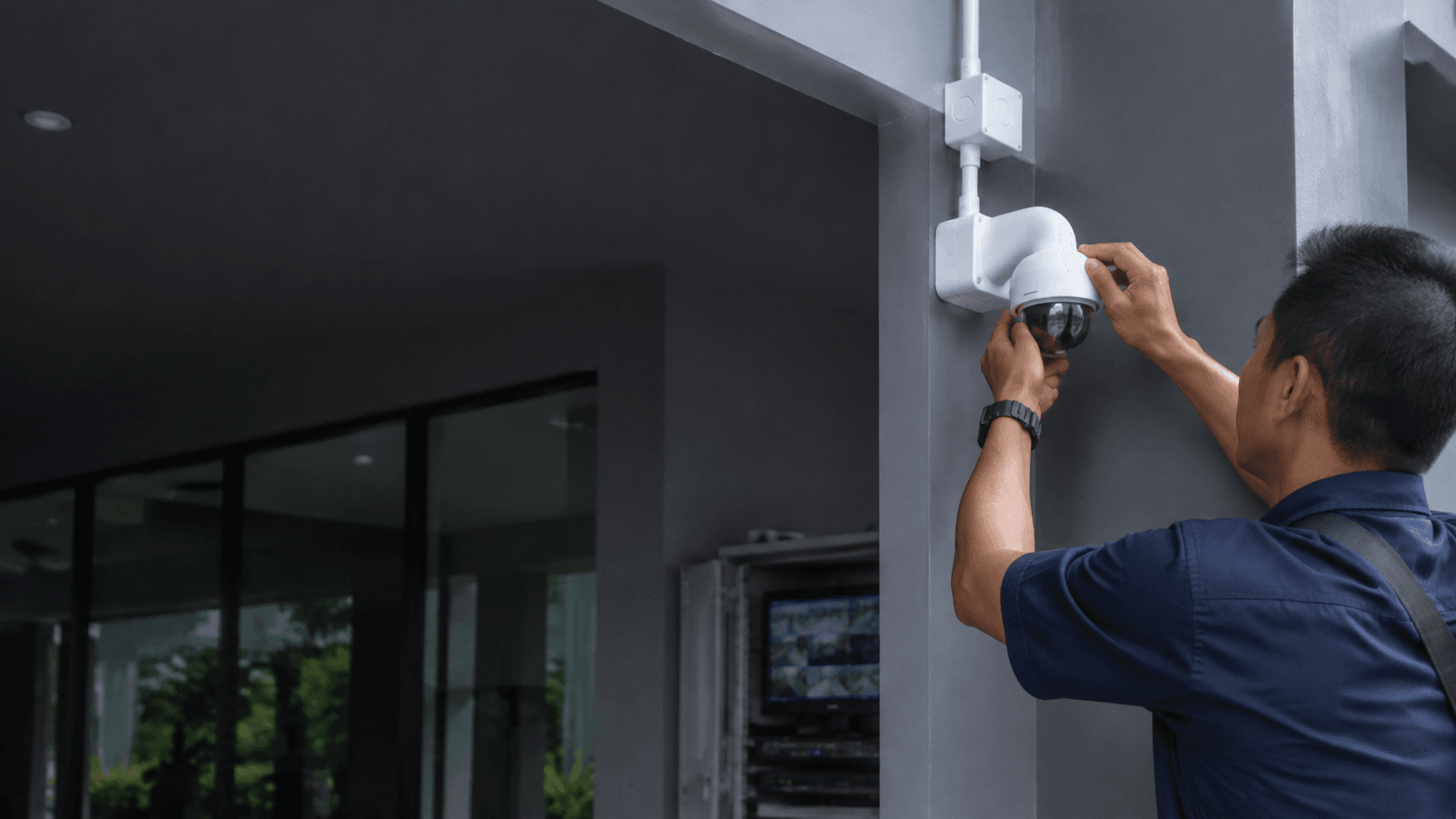
Eyonic Sdn Bhd plans, supplies, and installs CCTV systems for homes, offices, shops, and industrial sites across Sarawak, and the same four-stage sequence applies whether the property is a single-storey terrace house or a larger family home. The work is not a fixed product dropped into a standard box. Placement, cabling routes, recording capacity, and how the footage reaches a phone all depend on the building itself.
Most of the decisions that shape a residential security camera installation are made before anyone drills. That is why the survey matters more than the camera model on the box.
Residential Security Camera Installation: what the work involves
Eyonic's published installation process runs through four stages, and each one produces something the next stage depends on.
- Site survey. The property is walked to identify entry points, sightlines, existing power and network points, and where cabling can run without damaging finishes.
- System proposal. The survey findings become a proposed camera layout, recording arrangement, and viewing setup, with the scope written down before work begins.
- Installation. Cameras are mounted, cable routes are run, and the recorder is installed and configured.
- Handover. Recording is confirmed, mobile viewing is set up, and the system is explained to the people who will use it.
The order is not decorative. A proposal written before the survey tends to miss the awkward parts: the corner where a cable cannot be hidden, the gate that has no power nearby, the wall that faces the afternoon sun. Those details change the plan, and it is cheaper to change the plan than the installation.
Eyonic's founder, Eric Yong, has worked in technical installation of digital security solutions for commercial businesses in Sarawak for more than 10 years, and the survey stage exists because site conditions vary far more than product catalogues suggest.
Camera placement decisions that follow the house, not a template
Camera placement is the single decision that most affects whether a system is useful. A camera pointed at the wrong angle records a wall very clearly.
Placement starts with the routes a person actually takes to reach the property: the gate, the car porch, the front door, the side passage, and any rear access. Coverage is then built around those routes rather than around a fixed count of cameras.
Lighting is the second factor. Eyonic advises checking actual lighting conditions on site before confirming placement for ColorVu-style cameras, because a position that looks well lit during a daytime survey can behave differently after dark. A camera that performs well in daylight may still produce a weak image at night if the only light source is behind the subject.
Practical constraints shape the rest:
- Cable routes need a path that does not require cutting through finished ceilings or tiling where it can be avoided.
- Mounting height affects both the viewing angle and how easily a camera can be reached.
- Neighbouring windows and shared boundaries limit where a camera can reasonably point.
- Existing power and network points determine whether additional cabling work is needed.
These constraints are why two houses on the same street can receive different proposals. The house decides the layout; the layout decides the equipment list.
Recording, storage and remote viewing in a Malaysian home
Recording is handled by a network video recorder, commonly shortened to NVR. The NVR is the box that stores footage and serves it to viewing devices, and it is usually installed out of easy reach rather than beside the router in an open living area.
Storage capacity determines how far back footage can be reviewed. Retention depends on how many cameras are recording, the resolution they record at, and whether recording runs continuously or only when motion is detected. Because Eyonic's published residential package details do not specify camera count or retention length, those figures are settled during the survey and proposal rather than assumed in advance.
Remote viewing is the part most households care about day to day. Once configured, footage can be checked from a phone without returning home. Setup happens at handover, which is also when the people who will actually use the system learn how to review a clip and how to tell a genuine alert from a passing cat.
Two practical points affect how well remote viewing works. The first is the home internet connection: a stable upload speed matters more than a fast download speed, because footage leaves the property rather than arriving at it. The second is the account and permission structure, so that family members or staff can view what they need without full control of the recorder.
What a site survey settles before installation day
The survey converts an open question into a fixed scope. By the end of it, the camera positions, cable routes, recorder location, and viewing setup should all be decided.
It also settles the parts that are easy to overlook. Whether the property has a gate or autogate that should be covered. Whether an alarm system or intercom is being considered at the same time, since running cable once is cheaper than running it twice. Whether the recorder needs a dedicated power point. Whether any existing cabling can be reused.
For a household comparing quotes, the survey is the moment to ask what is included and what is not. A proposal that names camera positions and cable routes is easier to compare than one that lists equipment only.
A worked example. the Kuching Immigration Office project
Eyonic completed a project for the Kuching Immigration Office, providing practical support for a public office in Kuching focused on arrival flow, staff areas, visitor movement, and dependable daily operation. The approximate budget for that type of work was RM 12,000 to RM 28,000.
The project is not a house, and it should not be read as a residential price guide. Its value here is the planning logic. Arrival flow, staff areas, and visitor movement are the same categories a homeowner thinks about as gate, porch, and front door. The difference is scale and the number of people who need to view footage.
A second Eyonic project, for KTA Sarawak Sdn Bhd, covered a practical office setup in Kuching supporting staff movement, visitor handling, tidy cabling, and clearer daily site control, with an approximate budget of RM 8,000 to RM 18,000. Tidy cabling appears in both examples because it is a planning outcome, not an afterthought.
Costs, packages and what to prepare before the visit
Eyonic lists a Hikvision CCTV Package at RM 1,599 covering camera supply and setup, basic recording configuration, and mobile viewing handover. A Hikvision Alarm System and an Autogate Package are listed at the same price. These are package starting points, not quotations for a specific house, and the published listings do not break the CCTV package down by camera count or property size.
What moves the figure beyond a package is scope: the number of cameras, the length and difficulty of cable runs, whether additional cabling or power points are needed, and whether the recorder requires more storage. A single-storey home with accessible cable routes and a straightforward layout sits closer to the package figure than a multi-storey property with tiled finishes and long external runs.
Before the visit, it helps to have four things ready:
- The property address and type, so travel and access can be planned.
- The areas that matter most, such as the gate, porch, front door, or a rear entrance.
- Whether the home already has internet, and where the router sits.
- Whether alarm, autogate, or intercom work is being considered alongside the cameras.
Sharing the location, property type, and required system with Eyonic on WhatsApp at +60 11-5111 7959 is the practical next step, and it gives the survey a starting point rather than a blank page.
One limit is worth stating plainly. Eyonic's published residential material does not specify camera resolution, lens, sensor, night-vision performance, warranty length, or service response times, and no Malaysian regulatory or privacy guidance for home camera placement is published there either. Those questions are best raised directly during the survey, when the answers can be tied to a specific property and a specific layout rather than a general claim.