
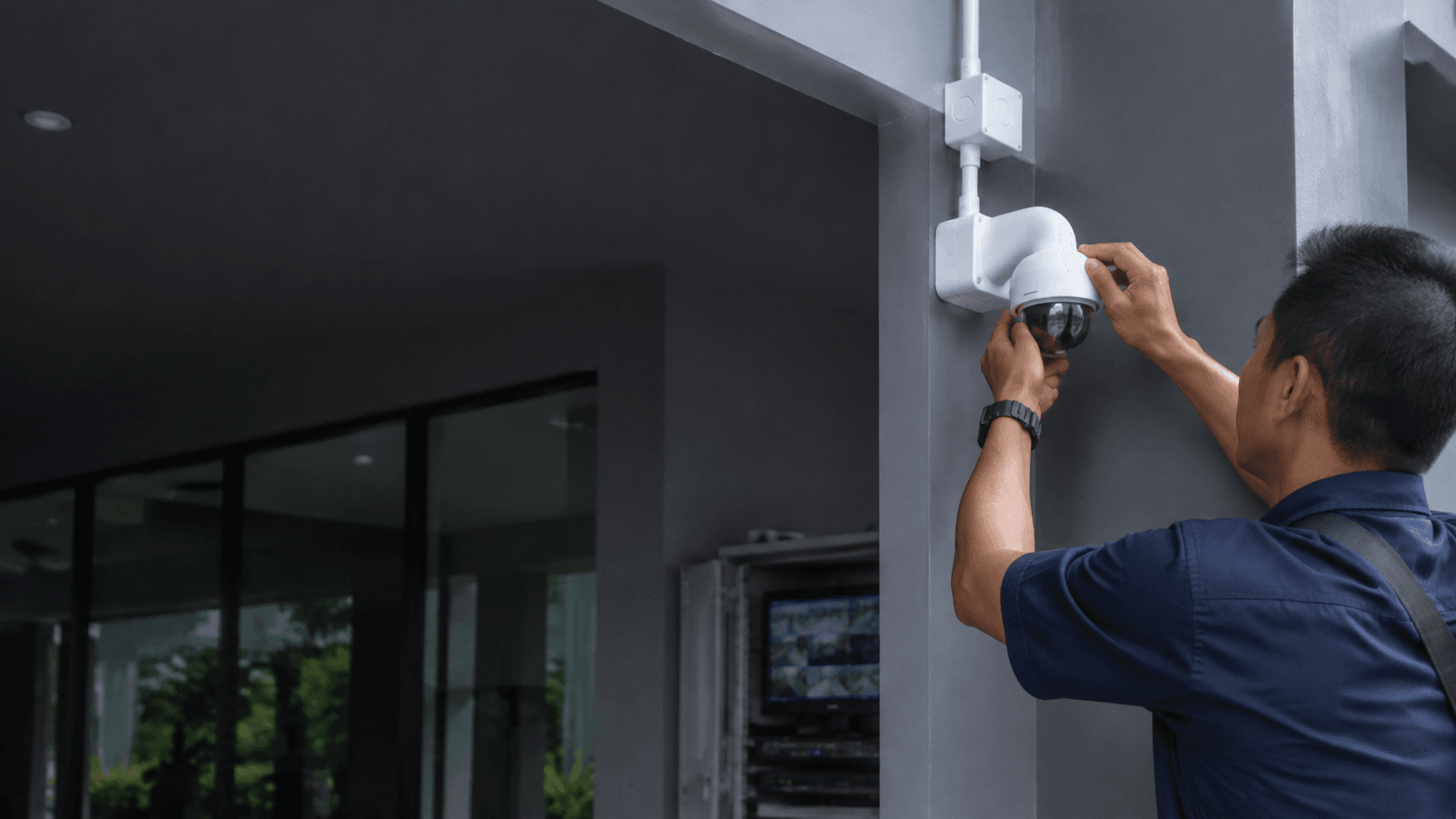
The phrase best home camera system outdoor gets used loosely online. Most ranking pages are American buyer guides that rank brands such as SimpliSafe, ADT, Ring, Nest, Arlo, Wyze, Blink, and Lorex. Those pages are useful for understanding what the category contains. They are not proof of what works on a Malaysian property, and they say nothing about who installs and supports the hardware after the box is opened.
This guide covers what an outdoor camera system actually consists of, how to judge one before buying, and where the practical constraints sit for a Sarawak home.
Best Home Camera System Outdoor: What Matters Before You Choose
An outdoor camera system is not a single product. It is a small stack of parts that must work together, and a weak link in any one of them shows up as a gap in coverage or a recording that cannot be retrieved when it matters.
- Cameras rated for outdoor exposure, positioned to cover entry points, driveways, gates, and perimeter paths.
- A recorder or NVR that stores footage locally and keeps it available for review.
- Cabling and power, whether wired runs, PoE, or another supply method suited to the property.
- Remote viewing configured on a phone so footage can be checked away from the property.
- A handover that confirms recording, playback, and mobile access all work before the job closes.
Eyonic's installation process follows a site survey, a system proposal, installation, and handover. That sequence matters because camera placement decided on a screen rarely survives contact with a real building. Roof overhangs, gate pillars, tree cover, and neighbouring structures all change what a camera can actually see.
What is home camera system outdoor?
It is the outdoor-facing half of a property's monitoring setup: cameras mounted outside the building, connected to recording and viewing equipment inside it. The purpose is to capture what happens at the boundary of a property rather than inside it, which is where most unwanted activity begins.
Indoor cameras and outdoor cameras are not interchangeable. Outdoor units face rain, direct sun, dust, and temperature swings, and their placement is usually higher and further from power and network sources. That is why the outdoor portion of a system tends to drive both the cost and the installation complexity.
Choosing the Right Home Camera System Outdoor for a Specific Property
The right system depends on the property, not on a brand ranking. A single-storey terrace house, a corner lot with two exposed sides, a shop with a back lane, and an industrial yard each need different coverage.
Start with the points that need watching. Main gates, car porches, side passages, back doors, and any blind spot where someone could approach without being seen from the road are the usual priorities. A camera that covers a gate but leaves the side passage open has not solved the problem.
Lighting is the next constraint. Eyonic recommends checking actual lighting conditions before confirming placement for ColorVu-style cameras, because low-light performance depends on what the camera is actually looking at after dark, not on a specification sheet. A streetlight across the road, a porch lamp, or a completely unlit back lane each produce a different result from the same camera.
Recording and storage come next. Local recording keeps footage on the property, which avoids ongoing subscription costs and keeps the footage under the owner's control. The trade-off is that a recorder is another device that needs a safe, ventilated, powered location inside the building.
Practical Considerations for Home Camera System Outdoor
Cabling is the constraint that surprises people most. A wireless camera still needs power unless it runs on battery, and battery cameras need charging or replacement on a schedule. Wired runs are more permanent but require a route from the camera position back to the recorder, and that route may involve drilling, conduit, or trunking.
Weather exposure matters over years, not weeks. Mounting under an eave extends the working life of any camera compared with full exposure to direct rain and afternoon sun. In Sarawak, where rainfall is heavy and frequent, that difference is not cosmetic.
Coverage and privacy need to be balanced deliberately. A camera angled to capture a neighbour's window or a public walkway creates a problem rather than solving one. Placement should stay within the property's own boundary and focus on the property's own entry points.
Maintenance should be planned rather than reactive. Lenses collect dust and water spots, and a blurred image is often a cleaning issue rather than a hardware failure. A short periodic check of image quality, recording status, and mobile access catches most problems before they matter.
How Installation and Handover Work in Practice
A structured process produces a system that can be used, not just a set of mounted cameras. Eyonic's CCTV installation service covers site survey, system proposal, installation, and handover, and the handover step is where the owner learns to check footage and use remote viewing.
Site survey comes first because it determines everything downstream. Camera positions, cable routes, recorder location, and power availability are all decided against the actual building rather than an assumption about it.
The proposal then sets out what will be installed and where. This is the point to confirm which areas are covered, how footage will be stored, and how the system will be viewed remotely.
Installation follows, including camera mounting, cabling, recorder setup, and configuration of remote viewing. The handover closes the job by confirming that recording, playback, and mobile access work as intended.
For larger or more complex sites, the same discipline applies at a bigger scale. Eyonic completed a project for the Kuching Immigration Office focused on arrival flow, staff areas, visitor movement, and dependable daily operation, and a project for KTA Sarawak Sdn Bhd supporting staff movement, visitor handling, tidy cabling, and clearer daily site control. Both show the same principle. coverage is designed around how a site is actually used.
Cost, Packages, and What Drives the Price
Eyonic lists a Hikvision CCTV Package at RM 1,599, which covers camera supply and setup, basic recording configuration, and mobile viewing handover. A Hikvision Alarm System is also listed at RM 1,599, covering a control panel and sensors, siren and zone setup, and user testing and handover. An Autogate Package is listed at RM 1,599, covering motor recommendation, remote-control setup, and safety testing and handover.
Those figures describe entry-level packages. Larger properties with more entry points, longer cable runs, or additional requirements sit above that baseline. For reference, Eyonic's completed project budgets have ranged from RM 8,000 to RM 18,000 for an office setup and RM 12,000 to RM 28,000 for a public office installation, which shows how far scope can move the number.
What drives cost upward is usually straightforward: more cameras, longer cable routes, harder mounting positions, additional recording capacity, and integration with alarms, autogates, or intercoms. What keeps cost down is a property with clear sightlines, accessible mounting points, and a recorder location close to the camera runs.
Making an Informed Choice About
The most useful step is to define the problem before comparing products. A property that needs to see who approaches the gate has a different requirement from one that needs continuous coverage of a yard or a shop front.
It also helps to decide early whether the system will stand alone or connect to other security equipment. Alarms, autogates, intercoms, and access control can all be part of the same setup, and planning them together avoids rework later.
Finally, confirm who will support the system after installation. Hardware that cannot be serviced locally becomes a problem the first time something fails, and a system that nobody knows how to check is not providing much protection.
Eyonic Sdn Bhd is a security system supplier based in Sarawak, Malaysia, specialising in CCTV and ELV systems, with founder Eric Yong working in the industry for more than ten years. The company plans, supplies, and installs monitoring systems with camera placement, recording, and remote viewing for homes, offices, shops, and industrial sites.
For a property in Sarawak, sharing the location, property type, and required system with Eyonic on WhatsApp at +60 11-5111 7959 is the next practical step.