
Search results for this term are dominated by review, pricing and equipment pages, and none of the eight analysed pages used the complete query in an H1 or carried the main entity in the H1 or body counts. That leaves a practical gap. readers in Malaysia want to know what the name refers to, what to check on their own property, and who can survey, supply and install a working system locally.
Eyonic Sdn Bhd is a security system supplier in Sarawak, Malaysia, working on CCTV and ELV systems for homes, offices, shops and industrial sites. The company plans, supplies and installs monitoring systems with camera placement, recording and remote viewing. Founder Eric Yong has worked in the industry for more than 10 years, with a focus on technical installation of digital security solutions for commercial businesses in Sarawak.
What the current Cove Camera System results cover
The pages ranking for this term fall into three groups. The first is the brand's own site, which presents a do-it-yourself home security system with no contracts and a monthly monitoring price. The second is review publishers, which test the equipment, score it, and compare it with other DIY brands. The third is marketplace listings, where the query returns a mix of unrelated camera kits, covers and accessories alongside the named brand.
Two patterns stand out across that set. Coverage centres on subscription monitoring, equipment lists, camera features and pricing tiers rather than on installation in a specific country. And the term itself is treated loosely — marketplace results show that a search for the name can surface generic camera hardware, which means a buyer has to confirm what is actually being sold before comparing anything.
For a Malaysian reader, that creates a specific problem. Review pages describe a subscription model and a self-install process. A property in Sarawak may need cabling, mounting, recording hardware and after-sales support handled by someone local. Those are different purchases, and the decision checks below apply to either route.
Camera placement checks before confirming a Cove Camera System layout
Placement decides whether a camera system is useful or decorative. A camera that covers a gate but not the approach to it records an event without context. A camera aimed at a corridor light records glare for most of the night.
Eyonic recommends checking actual lighting conditions before confirming placement for ColorVu-style cameras, because low-light performance depends on what is really on site rather than on a product description. The same discipline applies to any camera choice: walk the property after dark, note where light falls, and place cameras against that reality.
Four checks carry most of the weight:
- Site survey — walk the property, identify entry points, blind spots, lighting conditions and where cabling can run.
- System proposal — match camera count, recording and viewing requirements to the property rather than to a package size.
- Installation — mount, cable, configure recording and set up remote viewing.
- Handover — test the system with the people who will use it and confirm how footage is reviewed.
Two edge cases deserve attention before a layout is fixed. Rental or leased premises may restrict drilling and cabling, which pushes the decision toward wireless equipment and changes what is realistic. Buildings with shared walls or common areas may need approval before anything is mounted on a boundary, and that approval usually takes longer than the installation itself.
Recording, viewing and the parts that get forgotten
Camera placement is only half the design. Recording capacity determines how far back footage can be reviewed, and remote viewing determines whether anyone can check the property while away. Both need to be settled before installation, because adding storage or reconfiguring viewing afterwards costs more than planning it in.
Network conditions matter as much as hardware. Remote viewing depends on a stable connection at the property, and a weak link at the recorder will make a well-placed camera set frustrating to use. This is worth confirming during the survey rather than after handover.
How Eyonic plans a camera installation in Sarawak
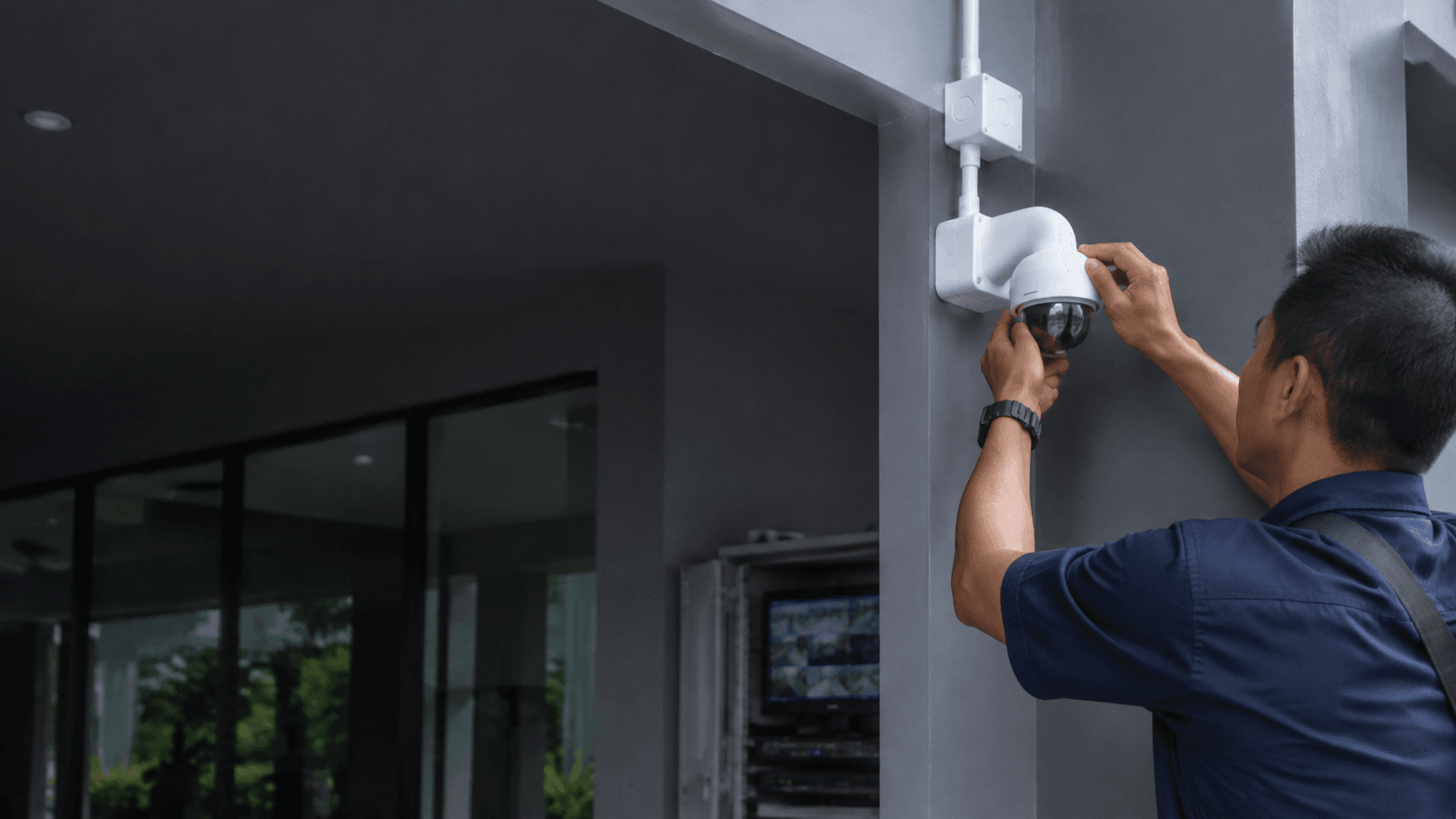
Eyonic's CCTV installation process runs through site survey, system proposal, installation and handover. Each stage produces something the property owner can act on: a survey identifies what needs covering, a proposal sets out equipment and scope, installation puts it in place, and handover confirms the system works for the people using it.
The company's completed work includes the Kuching Immigration Office, where the requirement was practical support for a public office focused on arrival flow, staff areas, visitor movement and dependable daily operation. That kind of brief is instructive for smaller sites too, because it treats coverage as a question of movement through a space rather than a count of cameras.
A second project, for KTA Sarawak Sdn Bhd, covered an engineering consultancy office in Kuching that needed support for staff movement, visitor handling, tidy cabling and clearer daily site control. Tidy cabling appears in both briefs for a reason: it affects reliability, maintenance and how quickly a fault can be traced.
Eyonic also supplies and installs alarm systems, autogate systems, keyphone intercoms and Starlink internet in Sarawak. Those matter to a camera decision because entry control, gate automation and connectivity all interact with surveillance — a gate camera is more useful when the gate itself is managed, and remote viewing is only as good as the internet link behind it.
Costs, packages and project ranges
Eyonic publishes three packages at RM 1,599 each. The Hikvision CCTV Package covers camera supply and setup, basic recording configuration and mobile viewing handover. The Hikvision Alarm System covers a control panel and sensors, siren and zone setup, and user testing and handover. The Autogate Package covers motor recommendation, remote-control setup, and safety testing and handover.
Larger work is priced by project. The Kuching Immigration Office project carried an approximate budget of RM 12,000 to RM 28,000, and the KTA Sarawak Sdn Bhd office project carried an approximate budget of RM 8,000 to RM 18,000. Those ranges reflect scope, camera count, cabling and site conditions rather than a fixed rate.
No Malaysian pricing, warranty or support terms for the Cove Camera System were supplied, so no cost comparison can be made here. Buyers comparing the two routes should ask for written scope, equipment list, recording specification and after-sales terms from whichever supplier they are considering, and should treat a monthly subscription and a one-off installation as different financial commitments rather than competing prices.
Questions to settle before a Cove Camera System decision
Several questions decide the outcome more than brand preference does.
What has to be covered? Entry points, cash or stock areas, staff movement and visitor handling each imply different camera positions. A short written list prevents a system that records everything except the thing that mattered.
Who reviews footage, and how often? A system nobody checks is a cost without a benefit. Remote viewing on a phone suits owners who travel; a monitored setup suits sites with someone present.
What happens when something fails? Ask who attends a fault, how quickly, and whether replacement parts are held locally. This is where a locally supplied and installed system differs most from equipment bought online.
What is the total commitment? Compare one-off installation against recurring monitoring fees over the same period, and include any storage or service charges.
Does the property allow it? Tenancy terms, shared walls and building rules can all constrain mounting and cabling.
For readers in Sarawak, the practical next step is a survey rather than a product decision, because placement, cabling and connectivity are property-specific. Share the location, property type and required system with Eyonic on WhatsApp at +60 11-5111 7959 to move from comparison to a concrete plan.