
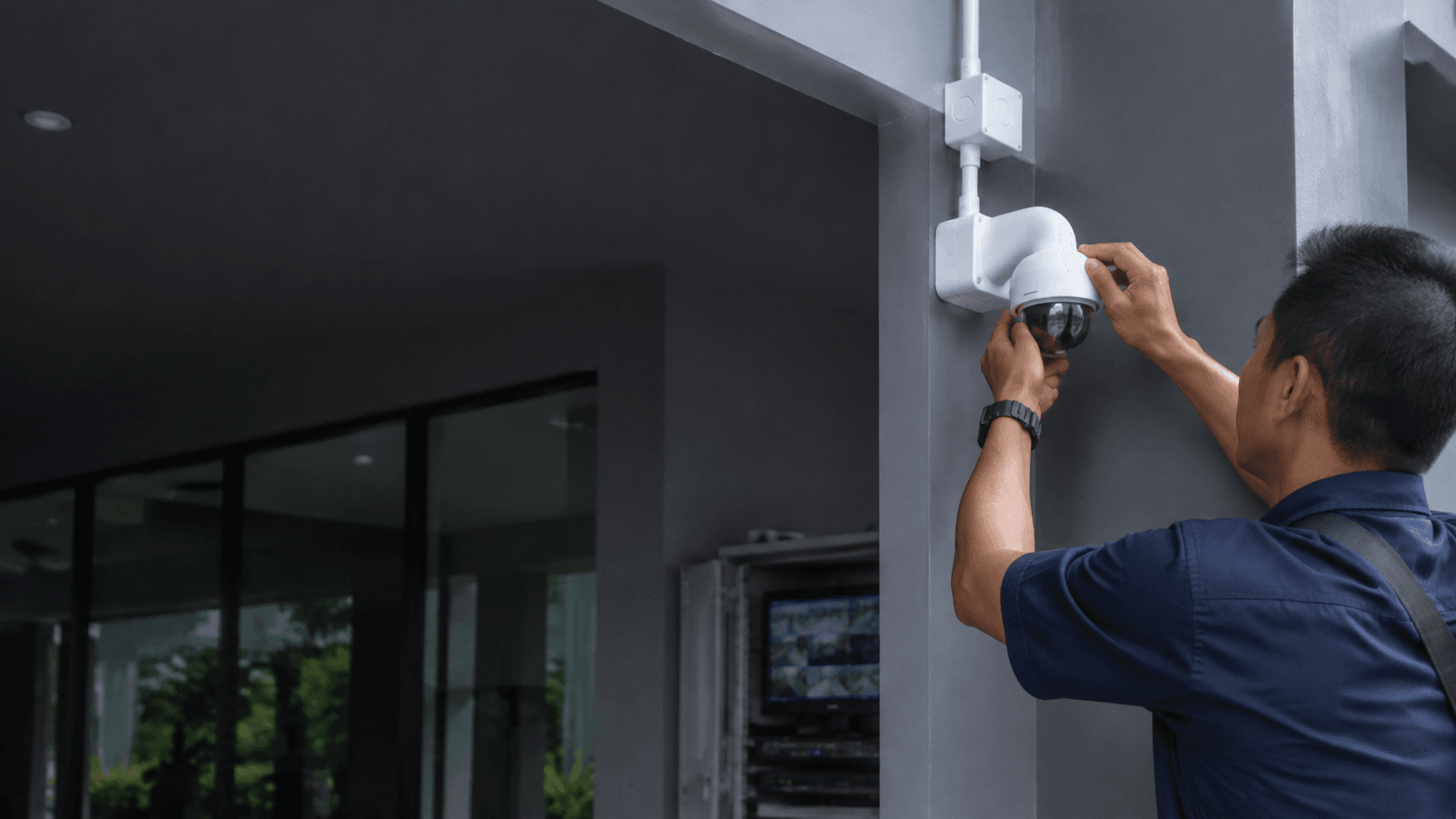
The setup question is rarely about which box to buy. It is about where cameras can actually see, what the light does at night, and who confirms the system works before the installer leaves. Eyonic Sdn Bhd plans, supplies and installs monitoring systems with camera placement, recording and remote viewing for homes, offices, shops and industrial sites in Sarawak.
Outdoor CCTV for Home. What the Setup Actually Involves
A complete outdoor CCTV for home setup covers four working parts: cameras mounted where they can see, a recorder storing the footage, a network path that carries video reliably, and a viewing method the household can actually use. Each part fails differently, which is why the survey matters more than the shopping list.
Eyonic's CCTV installation process runs through site survey, system proposal, installation and handover. That sequence exists because placement decisions made before the survey tend to be wrong once the actual roofline, gate position and street lighting are visible.
- Site survey — the property is walked, entry points identified, and existing lighting and cabling routes checked.
- System proposal — camera positions, recorder location and viewing setup are confirmed against what the survey found.
- Installation — cameras, cabling and the recorder are fitted and configured.
- Handover — recording and remote viewing are tested with the household before the job closes.
The handover step is where most disappointment is prevented. A system that records correctly but cannot be viewed remotely has not been finished, and a system that is viewed remotely but records nothing useful has the same problem in reverse.
Where Outdoor Cameras Usually Go on a Malaysian Home
Placement follows access, not symmetry. Cameras earn their position by covering a route someone would actually take, and Malaysian terrace, semi-detached and bungalow layouts each present different routes.
Common positions include the front gate and car porch, the main entrance, the side passage between neighbouring units, and the rear service area. On terrace housing, the side passage is often the weakest point because it is narrow, poorly lit and screened from the street. On a bungalow, the perimeter is longer and the practical question becomes how many cameras are needed to cover it without leaving gaps between fields of view.
Height matters as much as direction. Mounting too low puts a camera within reach and inside the glare of passing headlights. Mounting too high trades face-level detail for a wide overhead view that identifies clothing rather than people. The survey is where that trade-off gets settled against the actual wall, gate and porch geometry.
Coverage gaps that only show up on site
Two cameras can point at the same gate and still miss the approach to it. Overlapping coverage is deliberate, not accidental, and it is checked by walking the property rather than by reading a specification. Blind spots behind parked cars, under staircases and along boundary walls are the usual findings.
Lighting Conditions Decide More Than the Camera Model
Night performance depends on what light exists at the camera position, not on the model name alone. A position with a porch light, a street lamp or a neighbour's security light behaves very differently from a pitch-dark rear lane.
Eyonic recommends checking actual lighting conditions before confirming placement for ColorVu-style cameras. That guidance matters because a camera chosen for low-light colour performance still needs some ambient light to deliver colour, and a position with none will fall back to infrared and monochrome.
Practical consequences follow from that check. A camera facing a bright wall or a reflective car surface can wash out at night. A camera pointed toward a street lamp can lose detail in the glare. A camera covering a genuinely dark lane may need supplementary lighting at the position rather than a different camera.
Day and night are two different placements
A position that frames the gate beautifully at noon can be unusable after dark if headlights sweep across it or if the only light source sits behind the subject. The survey should confirm both conditions, because adjusting a camera after installation costs another visit.
How the Installation Process Runs From Survey to Handover
The sequence is short and predictable, which is the point. Each stage produces something the next stage depends on, and skipping the survey pushes guesswork into the cabling and mounting work.
During the survey, entry points, existing lighting, cable routes and the recorder position are confirmed. The proposal then sets out camera positions and the viewing setup. Installation fits the cameras, runs the cabling and configures the recorder. Handover tests recording and remote viewing with the household present.
Eyonic's project work shows the same discipline at larger scale. The Kuching Immigration Office project focused on arrival flow, staff areas, visitor movement and dependable daily operation — the same questions a home survey asks, applied to a public building with heavier foot traffic.
What handover should include
Handover is complete when recording is confirmed, remote viewing works on the household's own devices, and the people who will use the system know how to check footage. Anything less leaves the household dependent on a phone call the next time something needs reviewing.
What a Home CCTV Package Typically Covers
Eyonic's Hikvision CCTV Package is priced at RM 1,599 and covers camera supply and setup, basic recording configuration, and mobile viewing handover. Those three items map directly onto the survey, installation and handover stages.
The package price covers the listed scope. It does not automatically cover every property, because cable runs, camera counts and mounting conditions vary between a terrace house and a bungalow. That is why the survey precedes any firm proposal rather than following it.
For comparison, Eyonic's Hikvision Alarm System and Autogate Package are each priced at RM 1,599, covering control panel and sensors with siren and zone setup, and motor recommendation with remote-control setup and safety testing respectively. Households often consider these alongside cameras because gates and entry points are the same areas cameras cover.
What sits outside the package
Additional cameras, longer cable runs and non-standard mounting are quoted against the surveyed property rather than assumed. Households comparing a package price against a bare camera price are comparing different things: one includes placement, configuration and handover, the other does not.
Questions to Settle Before Confirming Placement
Most placement disputes trace back to unanswered questions rather than bad hardware. Settling these before installation avoids a second visit.
Which entry points matter most, and in what order? Is the priority identifying people, or observing vehicles and gates? Does the household want to check footage from a phone while away, and does the property's internet connection support that reliably? Are there existing cables or conduits that can be reused? Is there a power source near each camera position?
Remote viewing deserves particular attention. It depends on the recorder being reachable over the network, and a weak connection at the recorder position undermines the whole feature regardless of camera quality. Confirming this during the survey is cheaper than discovering it at handover.
Households in Sarawak can share the property location, property type and required system with Eyonic on WhatsApp at +60 11-5111 7959 to move from general planning to a surveyed proposal.
Edge cases worth raising early
Rented properties, shared boundary walls and homes under renovation each change what is practical. Renovation is the easiest moment to run cabling; a rented property may limit drilling and mounting options. Raising these during the survey keeps the proposal realistic instead of aspirational.
Outdoor CCTV for home decisions hold up best when placement, lighting and handover are treated as one job rather than three separate purchases.