
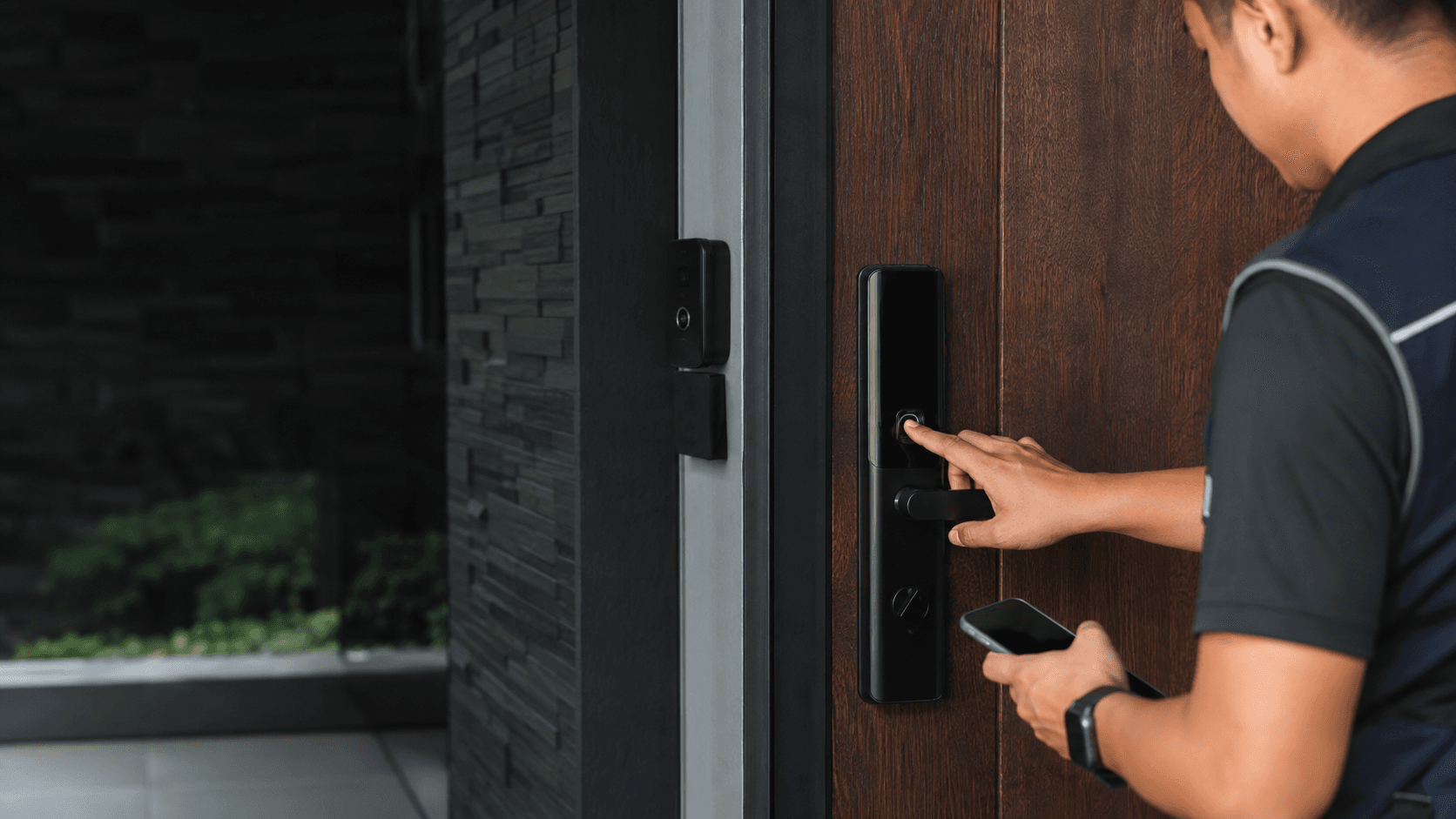
The category sits between two familiar things: the mechanical deadbolt already fitted to most Malaysian doors, and the wider access control systems used in offices and shops. Eyonic Sdn Bhd, a security system supplier in Sarawak, treats smart lock door access as suitable for controlled convenience when user permissions and backup entry are planned properly.
Wireless Deadbolt Lock. What the Category Covers
A wireless deadbolt lock is a locking device that keeps the deadbolt mechanism but changes how the bolt is thrown and released. Instead of a key turning a cylinder, the lock accepts a credential — a numeric code, a card, a fingerprint, or a command sent from a phone — and drives the bolt electronically.
The word "wireless" describes how the lock communicates, not how it is powered. Most units in this category still draw power from batteries inside the interior housing, while the wireless radio handles pairing with a phone app, a hub, or a management platform. That distinction matters because a lock can be wireless and still fail when its batteries run down, which is why backup entry is a planning question rather than an afterthought.
Coverage in this category typically includes:
- Deadbolt replacement locks, where the whole exterior and interior assembly is swapped out.
- Retrofit or adapter locks, which keep the existing deadbolt and motorise the interior thumb turn.
- Keypad and touchscreen models, where the credential is typed rather than carried.
- Reader-based models that accept cards or fobs, often used where several people need access.
What the category does not automatically include is a management system. A standalone lock stores its own user list on the device. A lock connected to an access control platform stores users centrally, which changes how credentials are issued and revoked.
Wireless Deadbolt Lock Compared With a Standard Deadbolt
A standard deadbolt is a purely mechanical device. Its security depends on the bolt, the strike plate, the door frame, and the cylinder. Nothing about it needs power, a network, or a software update, and it will still work in ten years with no maintenance beyond occasional lubrication.
A wireless deadbolt lock keeps the same bolt and strike geometry but adds electronics, a credential reader, and a radio. The mechanical security of the door does not improve. What changes is control. who can enter, when, and how that access is recorded or withdrawn.
That trade-off runs in both directions. Electronic entry removes the problem of lost keys and the cost of rekeying after staff turnover. It also introduces dependencies — batteries, firmware, app accounts, and wireless range — that a mechanical deadbolt never had. A deadbolt has no failure mode beyond mechanical wear. An electronic lock can be defeated by a flat battery, a dropped phone, or a wireless signal that does not reach the door.
For a single home with one regular occupant, the mechanical deadbolt is often sufficient. For a shop with shift staff, a rental unit with changing tenants, or an office where visitor movement needs to be managed, the control layer is the reason to change.
Door and Property Checks Before Choosing a Wireless Deadbolt Lock
Door condition decides whether a wireless deadbolt lock can be fitted at all, and it is the first thing worth confirming. Eyonic's own guidance on smart lock door access notes that smart locks work best when door condition, user roles, and backup method are reviewed before installation.
Several physical questions determine the answer:
- Does the door already have a deadbolt cutout, or would one need to be drilled?
- Is the door solid timber, hollow core, metal, or glass with a narrow stile?
- Does the existing backset and bore spacing match what a replacement lock expects?
- Is the door exposed to direct rain, salt air, or strong afternoon sun?
- Does the frame close cleanly, or does the door need to be pushed to latch?
A door that does not close cleanly is a poor candidate for any electronic lock. Motorised bolts need the door and frame to align, because the lock cannot be persuaded the way a person can push a stiff door shut. Alignment problems that a keyed deadbolt tolerates will show up as repeated jam errors on an electronic one.
Property type changes the requirement as much as the door does. A single-family home in Kuching needs one credential set and one backup method. A shophouse with a front counter, a stockroom, and a rear service entrance needs separate permissions for each door and a way to remove a departed staff member's access the same day. Eyonic's practice for business use is to check whether a standalone smart lock or an access-control panel is the more appropriate choice, because the two solve different problems.
Power and network reach are the other practical constraints. A lock that relies on a phone app for remote access needs a wireless signal at the door, and doors are often the furthest point from a router. Where the signal is weak, the lock may still work locally by code while remote features become unreliable. That is a placement question, not a product fault.
How a Wireless Deadbolt Lock Is Installed and Handed Over
Installation follows the same working sequence Eyonic uses for its security system work in Sarawak:
- Site survey, covering the door, frame, existing hardware, and where the lock will sit in daily use.
- System proposal, setting out the lock type, credential method, user roles, and backup entry.
- Installation, including fitting, wiring where required, and pairing to the app or platform.
- Handover, covering user enrolment, testing, and how to handle a flat battery or a lost credential.
The survey is where most problems are caught. Measuring the door, checking the frame, and confirming the existing cutout takes minutes and prevents a return visit. It is also the point where the backup method gets decided — whether that is a mechanical key override, a second credential, or a physical key kept off site.
Handover matters more than it is usually given credit for. A lock that nobody knows how to administer becomes a lock with one user and no way to remove access when someone leaves. Handover should leave the property with a named administrator, a tested backup entry, and a clear answer on what happens when the battery runs low.
Where a Wireless Deadbolt Lock Fits in a Wider Security Setup
A door lock controls entry at one point. It does not show what happened at that point, and it does not cover a perimeter, a car porch, or a back lane. That is the boundary between a lock and a wider system.
Eyonic's work spans CCTV, alarm systems, autogate, keyphone intercom, and Starlink internet installation across Sarawak, which means door access is usually one part of a larger setup rather than a standalone purchase. A lock records who entered. A camera at the same door records what they carried, who was with them, and what happened at the gate five minutes earlier.
The pairing is not automatic. A lock and a camera are separate systems unless something links them, and linking them is a design decision made at proposal stage. For a shop, the useful combination is often a lock on the staff entrance and a camera covering the counter and the door together, so an access event and a visual record line up.
Eyonic's project work gives a sense of how these decisions get made in practice. At the Kuching Immigration Office, the focus was arrival flow, staff areas, visitor movement, and dependable daily operation. At KTA Sarawak Sdn Bhd, an engineering consultancy site in Kuching, the requirement was a practical office setup supporting staff movement, visitor handling, and tidy cabling. Both are cases where access and visibility were planned together rather than bought separately.
For a home, the wider setup is usually simpler: a lock on the main entrance, a camera at the gate, and an alarm covering the ground floor. The lock is the piece that changes daily habit, because it removes the key from the routine.
What Eyonic Can Confirm and What Still Needs Verification
Eyonic Sdn Bhd plans, supplies, and installs security and ELV systems for homes, offices, shops, and industrial sites in Sarawak, and lists smart lock door access among its product areas. The company's founder, Eric Yong, has worked in the industry for more than ten years, with experience in technical installation of digital security solutions for commercial businesses in Sarawak.
Several details cannot be confirmed from available evidence and should be settled directly before any commitment:
- Which wireless deadbolt lock brands and models Eyonic supplies and installs.
- Technical specifications for any specific model, including wireless protocol, battery life, encryption, and credential types.
- Compatibility with particular Malaysian door thicknesses, mortise types, and existing deadbolt cutouts.
- Supply and installation pricing for door access work.
- Warranty terms and any certification or rating information.
- Local power, network, and backup-entry requirements for a specific property.
Published package pricing exists for other Eyonic work — the Hikvision CCTV package, Hikvision alarm system, and autogate package are each listed at RM 1,599 — but those figures cover different systems and should not be read as a door access price. Project budgets for larger work have ranged from RM 8,000 to RM 18,000 for an office setup and RM 12,000 to RM 28,000 for a public office, which indicates the scale of commercial installations rather than the cost of a single lock.
The practical next step is to describe the property: the door in question, the type of premises, and what the lock needs to do. Share your location, property type and required system with Eyonic on WhatsApp at +60 11-5111 7959 for the next practical step.