
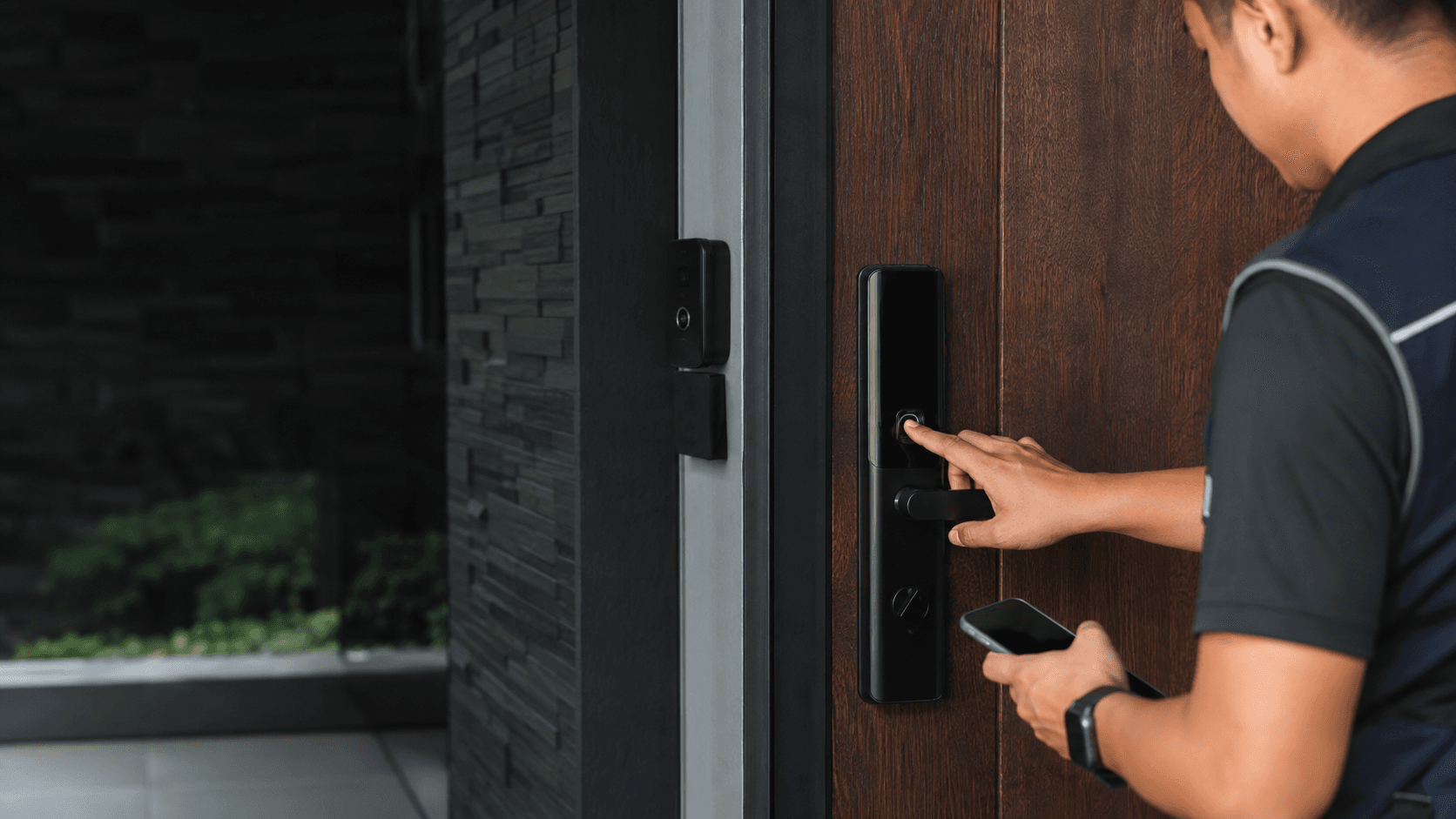
Buyers in Malaysia meet this hardware through imported catalogues, cross-border listings and specialist door-hardware sellers rather than a single local showroom. The useful question is not which model looks best in a photograph, but whether the door, the people using it and the fallback entry method all fit the lock that gets chosen.
What a Lockwood Digital Lock covers
The Lockwood name sits inside the ASSA ABLOY group, and the digital side of the range is built around combination-code entry instead of a key. Published catalogue material describes the Lockwood Digital DX Locksets as a mechanical method of keyless entry, with an inbuilt clutching mechanism that lets the outside knob rotate without operating or damaging the lock when someone applies force.
That clutching detail matters more than it first appears. A fixed knob transfers a lever, a pipe or a hard kick straight into the internal mechanism. A clutching knob spins free, so the attack wastes itself on the handle rather than the latch. It is a mechanical defence, not an electronic alarm, and it works whether or not power is available.
Digital hardware in this family is generally grouped by how the code is checked and by what the lock replaces on the door. Some units are complete locksets with a handle and latch. Others are deadlatches, deadlocks or narrow-stile units intended for specific door constructions. The category also reaches beyond entry doors into cabinet locks and gate locks, which is why two products carrying the same brand name can behave very differently in daily use.
Where the range is used
Residential entry doors, office back doors, staff-only corridors, utility rooms and commercial areas where the combination needs to change when someone leaves a role. The common thread is a door that a small, known group of people needs to pass through without carrying a key.
Mechanical keypad and electronic keypad models
The clearest split in the range is between locks that check the code with mechanics and locks that check it with electronics. Both remove the key. They fail in different ways, and that difference should drive the choice more than appearance.
A mechanical keypad lock uses the button presses themselves to align internal parts and release the latch. There is no battery, no wiring and no firmware. It keeps working in a power cut and in a building with no network. The trade-off is that the code is changed by physically reconfiguring the lock, which is a job for someone with the right tools and instructions, and the number of usable combinations is limited by the mechanism rather than by software.
An electronic keypad lock checks the code in circuitry. That opens the door to user slots, temporary codes, audit trails, time-limited access and integration with a wider access-control system. It also introduces batteries or a power supply, a low-battery warning that someone has to act on, and a dependency on the electronics continuing to function in heat and humidity.
Neither approach is universally better. A mechanical unit suits a gate, a store room or a site where nobody wants to think about batteries. An electronic unit suits a premises where staff change often, where visitor codes need to expire, or where door events should be recorded alongside CCTV and alarm activity.
What the catalogue names show
Public listings and catalogues attach model references to these products, including Lockwood DX, Lockwood 002, Lockwood 530 and Lockwood 002DX, alongside other brands such as Borg, Carbine, Lockey and McGrath that occupy the same shelf. Model references are useful for matching a specification to a supplier, but they say nothing about whether a given unit fits a given door.
Door condition and user roles before choosing a Lockwood Digital Lock
Eyonic's own product review guidance states that smart locks work best when the door condition, user roles and backup method are reviewed before installation, and that for business use the choice between a standalone smart lock and an access-control panel should be checked first. That sequence applies directly to a Lockwood digital lock, because the hardware is only as good as the door it is mounted on.
Door condition covers thickness, material, existing cut-outs, the distance between the latch and the edge, whether the door closes squarely, and whether the frame can take the strike. A door that has already been drilled for a previous lock may not accept a different body without patching and re-cutting. A door that has swollen or dropped will defeat a correctly installed lock, because the latch never lines up cleanly.
User roles cover who needs entry, how often, and whether anyone needs entry only at certain hours. A household with four regular users has different requirements from a shop with rotating staff, a cleaner, a delivery driver and a landlord. Roles determine whether a fixed combination is acceptable or whether individual codes with expiry dates are needed.
Backup entry is the third check and the one most often skipped. Every code-based lock needs a defined answer for a flat battery, a forgotten code, a failed keypad or a departed staff member who was the only person who knew the combination. That answer might be a mechanical override key held off-site, a second entrance, or a documented process for resetting the lock. If no answer exists, the lock is a single point of failure for the whole door.
Questions worth settling before a model is chosen
Does the door open in or out, and is it timber, metal or glass? Is the lock replacing an existing lock or being added alongside one? Will the same door be used by people who are not employees or household members? Who holds the override, and where is it kept? Is the door exposed to direct rain and sun, or is it sheltered? Is there any requirement to record who entered and when?
Those answers narrow the range far faster than a specification sheet. They also reveal when a digital lock is the wrong tool, such as a fire-rated door assembly where the existing hardware cannot simply be swapped, or a main entrance that needs to be tied into a building-wide access-control system rather than operated as a standalone unit.
Installation handover and daily operation
Eyonic's published installation process for its security work runs through site survey, system proposal, installation, and handover. The same four stages apply to door hardware, and the order matters because each stage removes a way the finished job can go wrong.
- Site survey. inspect the door, frame, existing hardware, exposure to weather and the routes people actually use.
- System proposal. match the lock type, user roles and backup entry method to what the survey found.
- Installation. fit the hardware, align the latch and strike, and confirm the door closes and locks cleanly.
- Handover. set the codes, explain battery or maintenance needs, and record who holds the override.
Handover is where most of the long-term value sits. A lock that is fitted correctly but handed over without code management becomes a shared secret within months. A short handover covering who can add or remove users, how the override works and what the low-battery warning looks like prevents most of the calls that follow.
Daily operation then settles into a rhythm. Mechanical units need occasional cleaning and a code change when the user group changes. Electronic units need battery attention, code reviews and a check that any connected system still reports correctly. Neither needs much, but both need someone named as responsible.
Where this fits alongside other systems
Door hardware rarely sits alone. Eyonic's work in Sarawak spans CCTV, alarm systems, autogate, keyphone intercom and Starlink installation, and a door lock is often one part of a wider access picture. A gate lock, a door lock and a camera covering the same entrance should be planned together, because the placement of one affects the usefulness of the others. Eyonic's own review guidance on camera products makes the same point about checking actual conditions on site before confirming placement, rather than deciding from a catalogue.
Completed work includes the Kuching Immigration Office project, which focused on arrival flow, staff areas, visitor movement and dependable daily operation, and the KTA Sarawak Sdn Bhd project, which covered staff movement, visitor handling, tidy cabling and clearer daily site control. Both are examples of access and movement being treated as one design problem rather than a list of separate devices.
Practical next step with Eyonic
Eyonic Sdn Bhd is a security system supplier in Sarawak working across CCTV and ELV systems, with planning, supply and installation for homes, offices, shops and industrial sites. Founder Eric Yong has more than 10 years in the industry, with technical installation experience on digital security solutions for commercial businesses in Sarawak.
Published package pricing covers a Hikvision CCTV package at RM 1,599, a Hikvision alarm system at RM 1,599 and an autogate package at RM 1,599. Larger project work has run in the RM 8,000 to RM 18,000 range for an office setup and RM 12,000 to RM 28,000 for a public office installation. Door hardware is quoted against the door and the site rather than as a fixed package, because the work depends on what the survey finds.
Share your location, property type and required system with Eyonic on WhatsApp at +60 11-5111 7959 for the next practical step.