
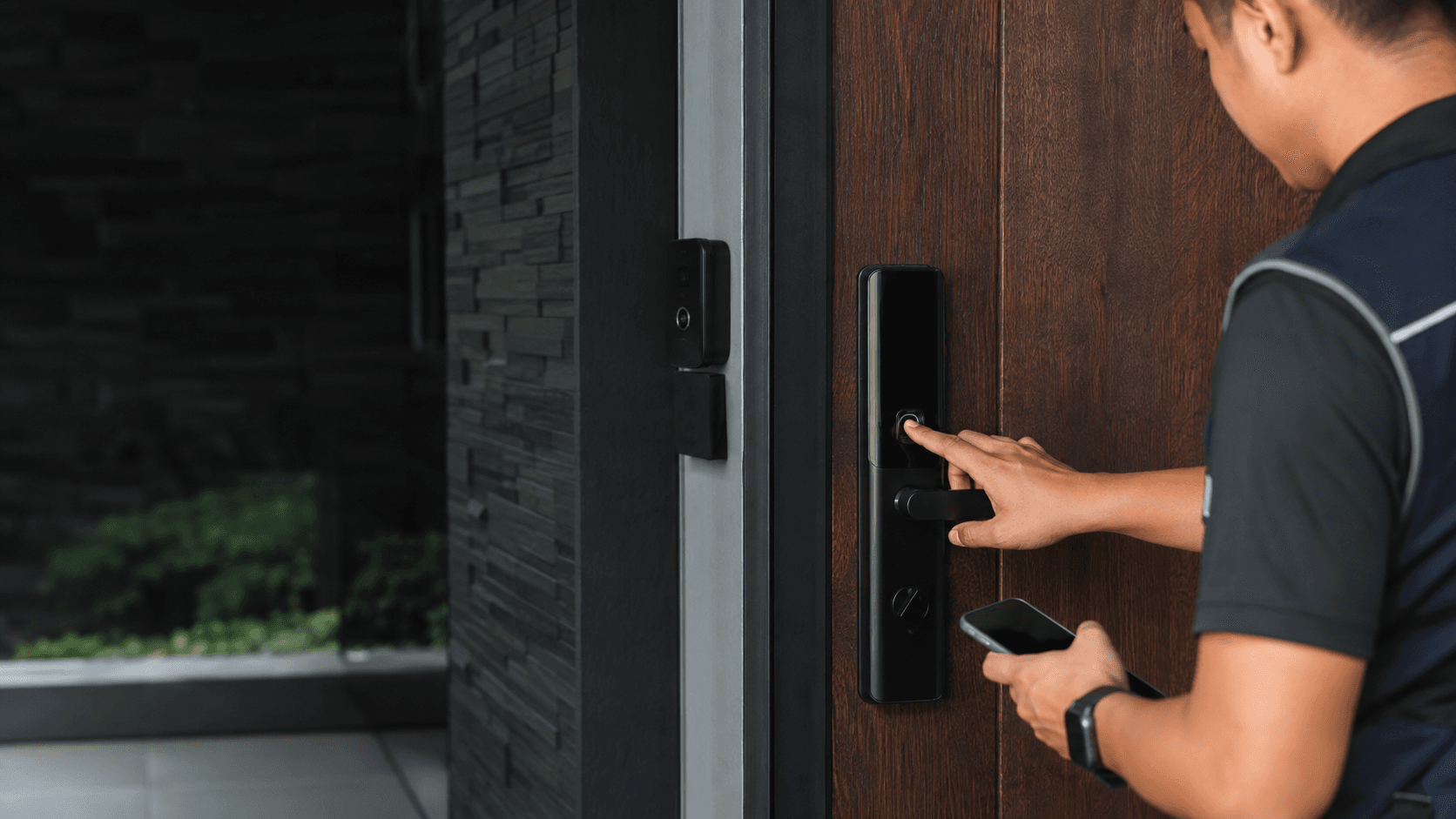
The exact-match query ultraloq smart deadbolt describes a category of keyless deadbolt locks made by ULTRALOQ, a brand of U-tec. Buyers in Malaysia usually meet this term while comparing a keypad deadbolt against a full access-control system for a home, shop, or office door.
Eyonic Sdn Bhd, a security system supplier in Sarawak, stocks smart locks alongside CCTV and ELV work, and reviews door condition, user roles, and backup entry before recommending an installation. That review step matters because a deadbolt that fits one door may not fit another.
What Matters Before Choosing an Ultraloq Smart Deadbolt
Three things decide whether a smart deadbolt works well in daily use: the door itself, the way people need to enter, and what happens when power or connectivity fails.
Door condition comes first. Smart deadbolts replace an existing deadbolt in a standard bore hole, so the door thickness, backset, and existing cutout determine whether a model fits without modification. A door that already holds a mechanical deadbolt is usually the simplest candidate.
Entry method comes second. A keypad suits shared or temporary access because a code can be issued and changed without handing over a key. A fingerprint reader suits regular users who want fast entry without carrying anything. An app adds remote control and access logs, but that control depends on the lock's connectivity option.
Backup entry comes third. Every ULTRALOQ deadbolt in the U-Bolt Series keeps a mechanical key override, and the series lists an emergency power interface for situations where the batteries are flat. Planning that backup before installation avoids a locked-out scenario later.
Choosing the Right Ultraloq Smart Deadbolt
ULTRALOQ sells several deadbolt lines, and the differences between them are mostly about connectivity and entry methods rather than the basic lock body.
The U-Bolt Series is the keypad-focused line. According to U-tec product information, the U-Bolt smart deadbolt offers five ways to unlock a door: fingerprint, keypad, smartphone app, shake to open with an Apple Watch, and a mechanical key. Remote management and low-battery alerts require the ULTRALOQ bridge, which is sold separately.
The U-Bolt Pro adds a fingerprint reader to the same deadbolt format. Review coverage describes the U-Bolt Pro as a feature-rich smart deadbolt with six unlocking methods, and CNET lists the U-Bolt Pro with Wi-Fi as a budget pick among smart locks.
The Bolt line takes a different approach. ULTRALOQ describes the Bolt Fingerprint as a smart lock with fingerprint access, keypad entry, remote control, auto lock, and DIY installation. The Bolt Mission is presented as a smart deadbolt using UWB technology for hands-free auto unlock and tap-to-open convenience.
Connectivity is the deciding variable. A Bluetooth-only model works locally through a phone but cannot be managed from elsewhere. A built-in Wi-Fi model connects directly to a network. A Z-Wave model joins a compatible smart home hub. The U-Bolt Series page notes that the lock works with Alexa, Google Assistant, SmartThings, and IFTTT when a bridge is present.
How to Compare Models in Order
- Confirm the door takes a standard deadbolt bore hole and note the door thickness.
- Decide which entry methods are needed: keypad, fingerprint, app, or a combination.
- Check whether remote access is required, and if so whether the model has built-in Wi-Fi or needs a separate bridge.
- Confirm the mechanical key override and emergency power option are usable from outside.
- Check the smart home platform in use against the lock's compatibility list.
- Plan who holds which code or fingerprint, and how access is removed when someone leaves.
What Is an Ultraloq Smart Deadbolt?
An Ultraloq Smart Deadbolt is a motorised deadbolt that replaces a standard keyed deadbolt and adds electronic entry methods on top of the mechanical lock. The lock body sits inside the door, and the exterior keypad or fingerprint reader replaces the outside cylinder trim.
Inside the lock, a motor drives the bolt when a valid credential is presented. A code entered on the keypad, a matched fingerprint, or a command sent from the paired app all trigger the same motor. The mechanical key still turns the bolt directly, which is why the lock keeps working when the electronics do not.
Access is managed rather than copied. Instead of cutting duplicate keys, the owner issues codes or fingerprints and removes them when access should end. On models with a bridge or built-in Wi-Fi, that management can happen remotely, and the lock can report access logs and low-battery alerts.
Durability claims come from the manufacturer. U-tec states the U-Bolt Series is ANSI Grade 1 certified, carries IP65 weather protection, and uses advanced data encryption. Those are manufacturer statements about the product line, not independent test results.
ULTRALOQ U-Bolt Series Keypad Smart Deadbolt – U-tec
The U-Bolt Series is the most direct answer to a search for an ultraloq smart deadbolt, because it is the line built around keypad entry in a deadbolt format.
U-tec lists the U-Bolt Series in three connectivity versions: U-Bolt WiFi, U-Bolt Z-Wave, and the U-Bolt Pro variants with fingerprint. The series page describes use cases including front door, garage, side entry, office, Airbnb, and multifamily properties, and notes DIY installation.
Battery life is stated by the manufacturer in ranges rather than a single figure. The U-Bolt Series page lists up to 8 months for one configuration and up to 1 year, up to 1 year, and up to 1.5 year for others, depending on model and use.
For a business door, the choice is not always a smart deadbolt. Eyonic's smart lock review notes that smart locks work best when door condition, user roles, and backup method are reviewed before installation, and that for business use the decision is often between a standalone smart lock and an access-control panel. A single office door with a handful of staff fits a standalone deadbolt. A site with many doors, shift patterns, and audit requirements usually fits a panel-based system better.
Practical Considerations for Ultraloq Smart Deadbolt Installation
Installation is a physical task before it is a software one. The existing deadbolt is removed, the new lock body is fitted into the bore hole, and the exterior and interior assemblies are aligned and screwed together. A misaligned strike plate or a door that has swollen with humidity will cause the motor to strain, so the door should close and latch cleanly before the smart lock goes on.
Power is the next consideration. These locks run on batteries, and the emergency power interface exists for the case where they run flat. A low-battery alert only reaches the owner if the lock has the connectivity to send it, which is another reason to decide on the bridge or Wi-Fi question early.
Weather matters in Sarawak. IP65 protection is a manufacturer rating for dust and water resistance, and it applies to the lock as specified. A deadbolt on a door exposed to direct rain still benefits from a porch or awning, and the door itself needs to stay in condition for the bolt to move freely.
Access management is the part that needs a decision, not a product. Codes issued to contractors, cleaners, or short-stay guests should have an end date. Fingerprints should be enrolled per person rather than shared. On models without remote management, removing access means being at the lock or within Bluetooth range.
Where a Smart Deadbolt Fits and Where It Does Not
A smart deadbolt fits a home front door, a side entry, a garage access door, a small office, and a short-term rental where the owner wants to change codes between guests. It also fits a door where the user wants to stop carrying keys.
It fits less well where the door hardware is non-standard, where the door is metal or glass with no deadbolt bore, where many people need different access levels across many doors, or where the site requires integration with an existing access-control or alarm platform. In those cases the deadbolt is one component of a larger system rather than the whole answer.
Eyonic's project work shows the pattern. For the Kuching Immigration Office, the focus was arrival flow, staff areas, visitor movement, and dependable daily operation. For KTA Sarawak Sdn Bhd, the focus was staff movement, visitor handling, tidy cabling, and clearer daily site control. Both are cases where door hardware sits inside a wider plan rather than standing alone.
Making an Informed Choice About an
The decision narrows once three questions are answered: what door the lock goes on, who needs to enter and how, and what happens when the battery or the network fails.
If the door is standard and the users are a household or a small team, a U-Bolt or U-Bolt Pro covers the common cases, with the Pro adding fingerprint entry. If remote management matters, the connectivity choice between built-in Wi-Fi, Z-Wave, and a separate bridge decides the model. If the site has multiple doors and layered permissions, a smart deadbolt is one part of an access-control plan rather than the plan itself.
For buyers in Sarawak, the practical next step is a site check before purchase. Eyonic's installation process runs through site survey, system proposal, installation, and handover, and the same sequence applies to a smart lock: confirm the door, confirm the entry methods, confirm the backup, then install and test. Share your location, property type and required system with Eyonic on WhatsApp at +60 11-5111 7959 for the next practical step.