
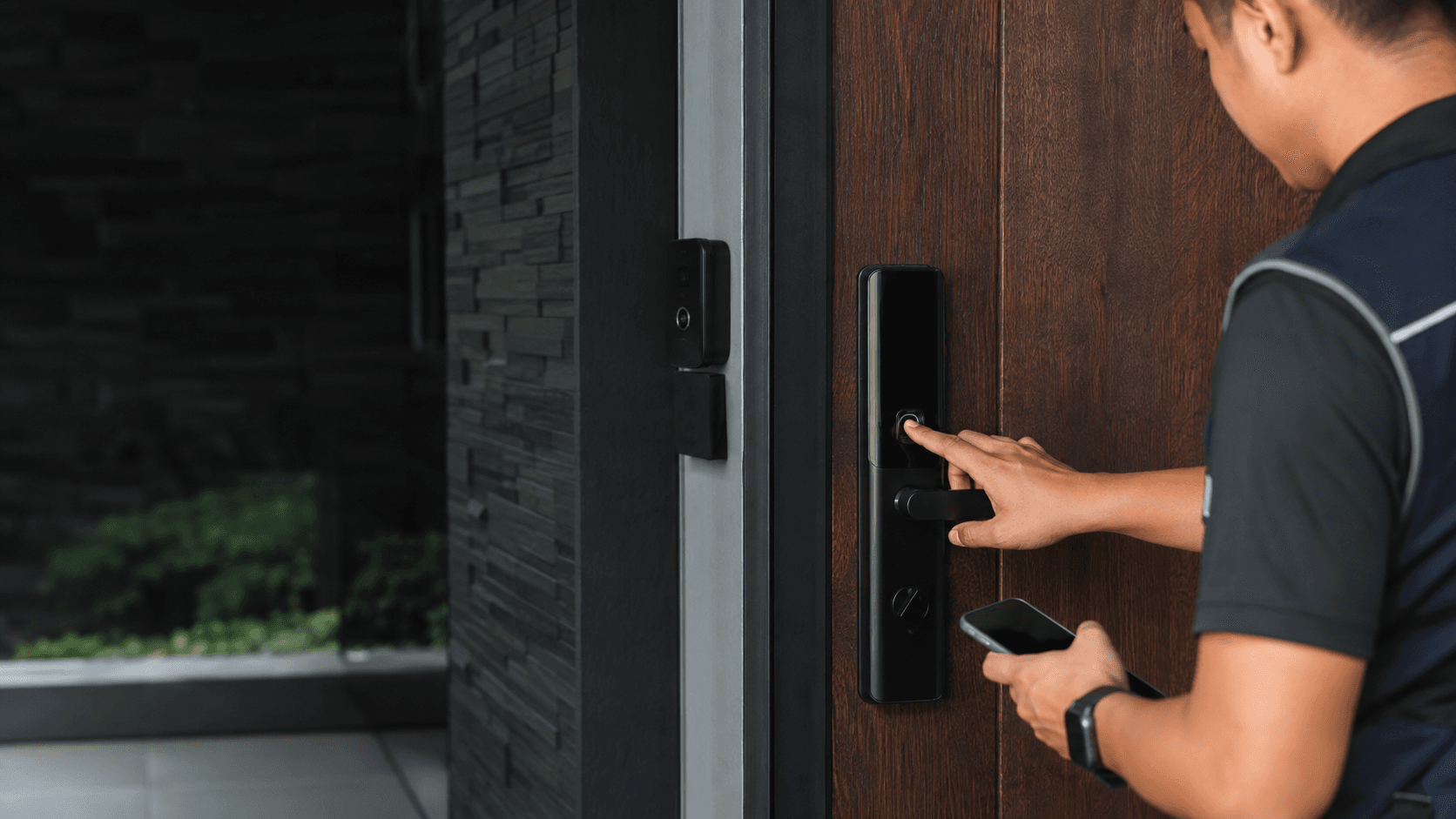
That sequence comes from Eyonic's own review guidance for smart lock door access, which states that smart locks work best when door condition, user roles and backup method are reviewed before installation. The same guidance notes that for business use, the choice between a standalone smart lock and an access-control panel is usually checked first.
Most published material on this topic is a product roundup. The eight competitor pages reviewed for this article are English-language smart lock roundups or retail category pages, and none of them uses the phrase digital door locks for home in the H1 or body. Their median length is 4,355 words with a median of 39 headings, and the recurring subjects are smart home integration, battery life, keyless entry, fingerprint access, Wi-Fi and Bluetooth connectivity, and lock installation. That format answers which model to buy. It does not answer whether a given door will accept the hardware, who gets which credential, or who surveys and installs the unit locally.
Digital Door Locks For Home. what the choice actually turns on
The decision is a fit question before it is a feature question. A lock that matches a household's routine but does not match the door leaf is a return, not an upgrade.
Four variables drive the outcome:
- Confirm door condition, thickness and existing hardware, including whether the current cut-out and deadbolt position can accept the new unit.
- Define user roles, meaning who needs permanent access, who needs temporary access, and who only needs to be logged.
- Decide the backup entry method before installation, so a flat battery or a failed credential does not lock out the household.
- Confirm whether a standalone lock or an access-control panel fits better, which depends on the number of doors and users rather than on the lock itself.
Eyonic's product review page describes smart lock door access as good for controlled convenience when user permissions and backup entry are planned properly. That wording places permissions and backup ahead of hardware selection, and it matches the order above.
Access methods and who needs entry
Access method follows household composition, not preference. A household with regular domestic help, short-stay guests, or adult children moving in and out needs different credential handling from a household where the same two people enter every day.
Three access patterns cover most homes:
Permanent credentials suit residents who enter daily. These are the credentials that should never depend on a phone battery or a network connection.
Temporary or time-bound credentials suit cleaners, contractors, and short-stay guests. The value here is that access expires without a key handover and without a locksmith visit.
Logged access suits households that want a record of arrival and departure rather than control over it. This is the pattern that overlaps most with business use, and it is the point where a standalone lock starts to look thin compared with an access-control panel.
Eyonic's review guidance draws the line at business use specifically: for business use, the company usually checks whether a standalone smart lock or an access-control panel is more appropriate. A home with one entrance and four residents rarely needs the panel. A home being run partly as an office, or a property with a separate entry for staff, is closer to the case where the panel is the better fit.
Door condition, thickness and existing hardware
Door condition is the constraint that most often decides the project before any model is discussed. A lock is installed into an existing door, and the door has already been cut, drilled and finished.
Points worth confirming on site.
The door leaf material and construction matter, because a hollow or lightweight leaf and a solid timber leaf do not present the same fixing conditions. The existing cut-out matters, because a new unit has to align with the bore and the deadbolt position already in the door. The frame and strike side matter, because the lock has to close against something solid. The door swing and clearance matter, because hardware that protrudes can foul a frame or a second leaf.
Eyonic's published installation process for its security work runs through site survey, system proposal, installation, and handover. The survey stage exists precisely because door and site conditions are checked before supply, not after. The same logic applies to a door entry product: the survey is where door condition, thickness and existing hardware get confirmed against the actual leaf rather than against a product listing.
This is also where the competitor roundup format breaks down for a Malaysian reader. A roundup can state that a lock is a retrofit or a full deadbolt replacement. It cannot state whether the door in a specific house in Kuching has the bore depth to accept it.
Power, backup entry and daily reliability
Power and backup entry are the two items that decide whether the lock is still usable on its worst day. Both should be settled before installation, because the backup method affects what gets installed and where.
Backup entry options in general use include a mechanical key override, an external power contact, and a second independent credential path. Which of these is available depends on the specific unit, and no verified specification for any model is available for this article, so the practical step is to confirm the backup method for the exact unit being supplied rather than assume one exists.
Daily reliability follows from the same review. A lock that depends on a phone app for every entry adds a failure point that a keypad or a physical credential does not. A lock that depends on a network connection for remote management adds a second one. Neither is wrong, but both should be a deliberate choice rather than a discovery.
Eyonic's published guidance on camera placement makes a comparable point in a different product category: actual conditions should be checked before confirming placement, rather than assumed from a specification. The same principle applies to lock power and backup. The conditions on site, including how the household actually enters and exits, determine whether the chosen backup method is adequate.
Digital Door Locks For Home. planning permissions and user roles
User roles are the part of the plan that outlives the installation. A lock with no defined roles becomes a lock with one shared credential, which defeats most of the reason for installing it.
A workable role plan answers three questions. Who can enter at any time. Who can enter only within set hours or dates. Who can enter but should generate a record. Once those three groups are named, the credential type for each group follows, and the question of whether a standalone lock or an access-control panel fits becomes answerable rather than theoretical.
Permissions also determine the handover. If a household has temporary users, the handover has to cover how those credentials are issued and revoked, not only how the lock is operated. That is a training item, and it belongs in the handover stage rather than in a manual.
Eyonic's project work for the Kuching Immigration Office focused on arrival flow, staff areas, visitor movement and dependable daily operation. That is a public-office context rather than a home, but the structure is the same one that applies to a household with mixed user types: separate the people who arrive constantly from the people who visit, and design the access around that separation.
Installation, handover and local support in Sarawak
Installation support is the difference between a boxed unit and a working entry point. A lock supplied without a survey carries the risk that the door does not accept it, and that risk lands on the buyer.
Eyonic's published process for its security installations covers site survey, system proposal, installation, and handover. The handover stage is where the household learns the credential structure, the backup method, and the routine for adding or removing a user. For a door entry product, that handover is the point at which the role plan from the planning stage becomes operational.
Local support matters for a practical reason. A lock is a daily-use item, and a fault means the entrance is affected immediately. Support that is reachable in the same region shortens that window compared with support that has to be coordinated across a distance.
Eyonic Sdn Bhd is a security system supplier based in Sarawak, Malaysia, working on CCTV and ELV systems with planning, supply and installation for homes, offices, shops and industrial sites. Its founder, Eric Yong, has been in the industry for more than ten years, with experience in technical installation of digital security solutions for commercial businesses in Sarawak. The company's published project work includes the Kuching Immigration Office and KTA Sarawak Sdn Bhd, both in Kuching.
For a household weighing digital door locks for home in Malaysia, the practical next step is to have the door and the household routine reviewed together, so the access method, the backup entry and the installation scope are settled before a unit is chosen. Eyonic can be reached on WhatsApp at +60 11-5111 7959 with the property location, property type and the required system.