
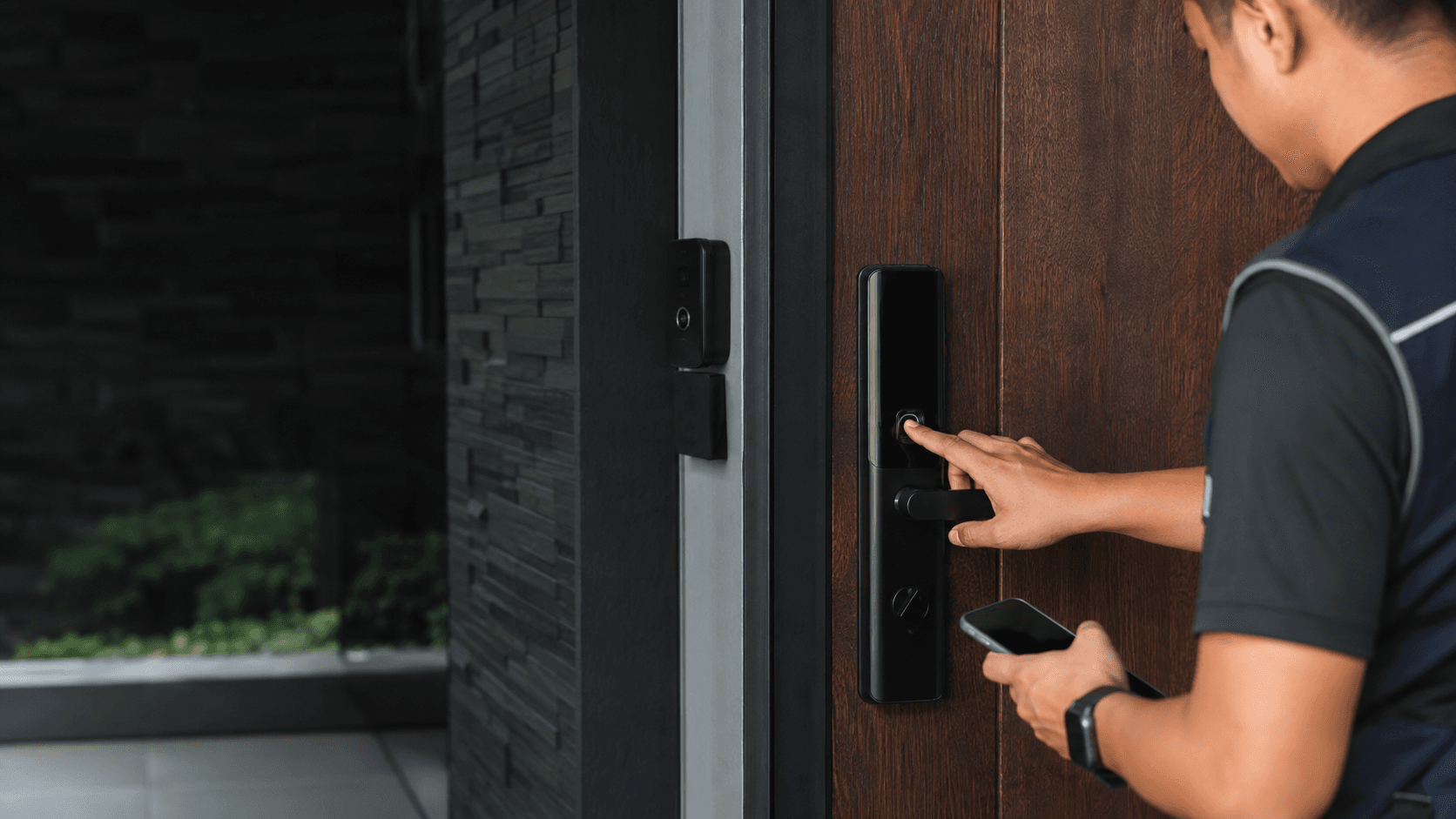
The exact-match query tuya door lock covers a wide product family rather than one device. Tuya supplies the modules, cloud services and app layer that lock manufacturers build on, so two locks sold under different brand names can run the same firmware and the same phone app. That is why the same search returns budget fingerprint deadbolts, Wi-Fi video locks with built-in cameras, and commercial access-control panels.
Eyonic Sdn Bhd is a security system supplier in Sarawak that plans, supplies and installs CCTV and ELV systems, and its product reviews cover smart lock door access alongside cameras and alarms. The company's own guidance is that smart locks work best when door condition, user roles and backup entry are reviewed before installation.
Tuya Door Lock. What Matters Before Choosing
Three things decide whether a Tuya door lock suits a property: how the lock connects, who needs entry, and what happens when power or network fails.
- Confirm the door type and existing cutout, because mortise, rim and deadbolt bodies are not interchangeable.
- Decide the connection method. Bluetooth for phone-only entry, Wi-Fi for remote control without a hub, Zigbee for hub-based mesh setups.
- List every person who needs routine entry, then decide whether each gets a fingerprint, PIN, card or app credential.
- Agree a backup entry method before installation, such as a mechanical key or a second independent lock.
- Check the power source and expected battery life, and confirm how a low-battery warning reaches the owner.
- Test the lock on the actual door before final handover, including latch alignment and closing force.
Connection method is the decision most buyers get wrong. A Bluetooth-only Tuya door lock works without a hub and without Wi-Fi, but remote unlocking and remote status checks are not available when nobody is within Bluetooth range. A Wi-Fi model connects directly to the router, which suits a single door in a home or small office. A Zigbee model needs a hub, which adds a device but usually improves battery life and mesh reliability when several locks or sensors are involved.
Choosing the Right Tuya Door Lock
Match the lock to the door and the people using it, not to the feature list. A rental unit with short stays has different needs from a family home with one main entrance.
For a single home entrance, a fingerprint and PIN lock with a mechanical key override covers most daily use. For a small office, a model that logs which credential opened the door at what time is more useful than one with extra unlock methods. For a gate or a door exposed to rain, the housing rating matters more than the app features.
Eyonic's smart lock door access review notes that for business use, the choice between a standalone smart lock and an access-control panel is usually the first question. A standalone lock is simpler and cheaper per door. A panel-based system handles more doors, more users and central permissions, but costs more and needs more planning.
What Is a Tuya Door Lock?
A Tuya door lock is a lock built on Tuya's smart lock platform, which combines a hardware module, cloud services and a mobile app so the lock can be controlled from a phone. Manufacturers use Tuya's modules and development tools to add smart features to conventional lock bodies.
Tuya's published smart lock material describes support for Wi-Fi, Bluetooth, Zigbee and NB-IoT communication, integration with Amazon Alexa and Google Assistant, and linkage with video doorbells and other devices in the same ecosystem. Tuya has also announced a smart door lock solution with Matter support and home key in Apple Wallet, which would allow entry by holding an iPhone or Apple Watch near the lock.
The practical consequence is that "Tuya door lock" describes a platform, not a single product. Two locks from different sellers may share the same app, the same pairing process and the same automation options, while differing in body material, unlock methods and build quality. Buyers comparing models should compare the hardware and the seller's support, because the software layer is often identical.
R/homeautomation on Reddit. Tuya Smart Door Locks. Are They Safe?
That question appears in the r/homeautomation community, where owners discuss whether inexpensive Tuya smart door locks are safe to use. The thread itself could not be read for this article because the site's crawl restrictions block automated analysis, so no claim is made here about what individual commenters said.
The safety question splits into two parts that are often mixed together. The first is physical security. whether the lock body resists forced entry and whether a mechanical override exists. The second is digital security. how credentials are stored, whether the app account is protected, and what happens if the network or cloud service is unavailable.
On the digital side, Tuya's own material references secure encryption and live alerts as platform features. On the physical side, no platform feature substitutes for a lock body that fits the door properly and a backup entry method that does not depend on electronics. A Tuya door lock with a working mechanical key and a charged battery behaves predictably in a power cut; one without either does not.
Home Assistant users have discussed local control for Tuya devices through community projects, which matters to owners who want the lock to keep working without a cloud connection. That is a real trade-off. cloud-dependent control is simpler to set up, while local control needs more configuration and depends on community-maintained integrations.
Practical Considerations for Tuya Door Lock Installation
Installation quality decides more outcomes than the model number. A lock that fits badly will jam, drain batteries and generate false low-battery warnings regardless of how good the firmware is.
Eyonic's installation process for security systems runs through site survey, system proposal, installation and handover. The same sequence applies to smart locks: the survey confirms door thickness, cutout dimensions and latch alignment; the proposal sets out which doors get which lock and how users are managed; installation fits and configures the hardware; handover covers credentials, app access and battery expectations.
Eyonic's completed work includes the Kuching Immigration Office project, which focused on arrival flow, staff areas, visitor movement and dependable daily operation, and the KTA Sarawak Sdn Bhd project, which covered staff movement, visitor handling, tidy cabling and clearer daily site control. Both are examples of the same principle: access hardware is planned around how people actually move through a building.
Two constraints are worth stating plainly. First, a smart lock does not fix a door that is already misaligned or a frame that has moved; the door has to be serviceable before the lock is fitted. Second, user permissions need an owner. If nobody is responsible for removing a departed staff member's fingerprint or PIN, the lock's audit trail becomes misleading.
Making an Informed Choice About Tuya Door Lock Hardware
A sensible decision sequence starts with the door, moves to the people, and only then reaches the product. Buyers who start with the product usually end up replacing it.
For a home in Sarawak, a fingerprint and PIN lock with a key override on the main entrance covers most needs, and a Wi-Fi model avoids the cost of a hub. For a shop or office with several doors and staff turnover, a planned access setup with logged entry and central permissions is usually the better fit, even though it costs more upfront.
Eyonic's published packages for related systems are RM 1,599 for a Hikvision CCTV package, RM 1,599 for a Hikvision alarm system and RM 1,599 for an autogate package, each covering supply, setup and handover. Smart lock pricing depends on the door and model, so it is quoted per site rather than as a fixed package.
Share your location, property type and required system with Eyonic on WhatsApp at +60 11-5111 7959 for the next practical step.