
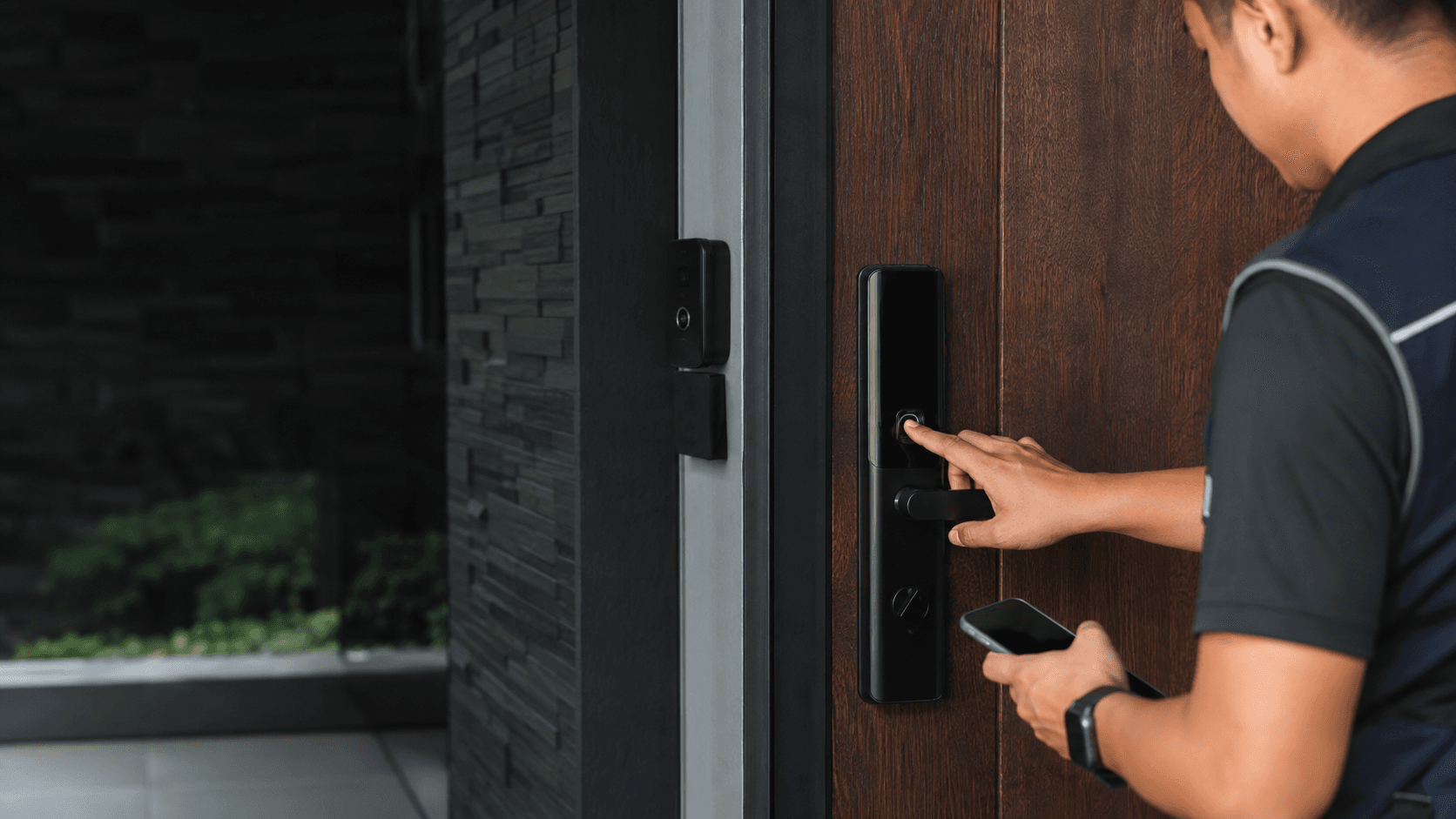
The term covers a family of electronic locks rather than one product. Kwikset's electronic lock range is operated by a keypad or touchscreen, and the company's support library groups programming instructions, re-keying manuals, and compatibility notes under separate topics. Buyers in Malaysia usually meet the term while comparing keyless entry hardware for a house, an office, or a shop front, and the practical questions are about the door, the people who need entry, and what happens when the electronics fail.
Kwikset Programmable Lock. what the term covers
A Kwikset programmable lock stores one or more user codes in the lock itself. Entry happens at the door through a keypad or touchscreen, and the lock decides whether the entered code is accepted. That is the whole mechanism, and everything else is detail around it.
Kwikset's support documentation for programming codes notes that user codes must be unique and that codes can be disabled. Those two points matter more than they first appear. A unique code means the lock can tell one person's entry from another's. A disabled code means access can be withdrawn without changing the hardware.
The range also carries SmartKey re-keying, which Kwikset documents separately from code programming. Re-keying changes which physical key turns the cylinder. Code programming changes which numbers open the lock. They are different jobs on the same product, and a lock can support one, the other, or both.
Some models in the wider range connect to smart home systems. Kwikset publishes a compatibility page for electronic smart locks, and product listings in the competitor set reference Z-Wave, Bluetooth, and Wi-Fi across different models. Connectivity is model-specific, so it cannot be assumed from the brand name alone.
How code entry works on a Kwikset programmable lock
Code entry follows a fixed sequence at the door. The user wakes the keypad or touchscreen, enters the assigned code, and the lock releases. The lock then re-locks on its own schedule or when the door closes, depending on the model.
Programming happens at the lock, not at a central server, on standalone models. Someone with the programming code or the master credential adds, changes, or removes user codes. That person is the practical administrator of the door, and the choice of who holds that role is a management decision rather than a technical one.
Two failure paths deserve attention before purchase. A forgotten user code is recoverable through the programming credential. A lost programming credential is a bigger problem, because it controls every code on the lock. Kwikset's support material covers reset and programming procedures for specific models, and the exact procedure varies by product.
Battery or power failure is the other path. Electronic locks need a power source, and the backup method determines whether a dead lock means a locked-out building or a two-minute inconvenience. The backup method is model-specific and should be confirmed against the actual product documentation rather than assumed.
Door, user role and backup checks before installation
Smart locks work best when the door condition, user roles, and backup method are reviewed before installation. That order matters, because a lock that suits the door but not the people using it will be replaced within a year.
- Check the door and frame condition, including whether the existing preparation matches the lock being considered.
- Decide who holds which user code, and who holds the programming credential that controls all of them.
- Confirm the backup entry method, so a dead battery or failed keypad does not seal the door.
- Establish power or battery expectations, including who replaces the batteries and how often the lock reports low power.
- Decide whether a standalone lock is enough or whether the site needs an access-control panel instead.
The door check is the one most often skipped. Door thickness, backset, and existing bore holes determine whether a lock fits without modification. Kwikset publishes installation instructions for its products, and those instructions state the door preparation requirements for each model. A lock specified for a different preparation will not fit, regardless of how well it performs elsewhere.
The user-role check is the one most often underestimated. A home with four residents needs four codes and one administrator. A shop with rotating staff needs a way to add and remove codes as people join and leave. An office with visitors needs a decision about whether visitors get a code at all, or whether they are met at the door.
For business use, the choice between a standalone smart lock and an access-control panel is a real fork. A standalone lock is simpler and cheaper to install. A panel gives central control, audit trails, and integration with other systems. The right answer depends on how many doors are involved and how much record-keeping the site needs.
Kwikset programmable lock in Malaysian homes, offices and shops
Malaysian buyers face a specific constraint that does not appear in most overseas reviews: local availability and support. No supplied evidence confirms which Kwikset programmable lock models are sold in Malaysia, what they cost locally, or what warranty and spare-part support applies. Those questions need answers from a local supplier before a purchase decision, not after.
Door hardware is the second local variable. Malaysian homes and shops use a range of door types, and the preparation on an existing door may or may not match what a given lock expects. A site survey resolves this in person, which is why the survey step exists in the first place.
For a home, the appeal is straightforward. Residents stop carrying keys, and a lost key no longer means a re-key. For an office, the appeal is control over who enters and when. For a shop, the appeal is limiting after-hours access to named staff rather than everyone holding a copy of the same key.
Eyonic's own review of smart lock door access notes that the technology suits controlled convenience when user permissions and backup entry are planned properly. That is a fair summary of where the value sits. The lock is not the security system. It is one controlled point of entry within a wider setup.
Where a Kwikset programmable lock fits alongside CCTV and alarm systems
A programmable lock controls entry at one door. It does not record what happens after entry, and it does not detect an intrusion through a window. Those jobs belong to cameras and alarm sensors.
The practical combination for a shop or office is a lock at the main entrance, cameras covering the entrance and the areas behind it, and an alarm system for out-of-hours detection. Each covers a different failure mode. A lock alone tells nothing about who entered and when they left. A camera alone does not stop entry. An alarm alone does not manage daily access.
Eyonic's project work shows the pattern. The Kuching Immigration Office project focused on arrival flow, staff areas, visitor movement, and dependable daily operation. The KTA Sarawak Sdn Bhd project covered staff movement, visitor handling, tidy cabling, and clearer daily site control. Both are about movement through a building, which is the same question a programmable lock answers at a single door.
Eyonic's installation process runs through site survey, system proposal, installation, and handover. A lock fitted as part of a wider system goes through the same sequence, and the handover step is where user codes and administrator roles get settled.
Eyonic's published packages cover a Hikvision CCTV package, a Hikvision alarm system, and an autogate package, each at RM 1,599. Those are separate from lock hardware and are listed here as the surrounding system options rather than as lock pricing.
Questions to settle before choosing a Kwikset programmable lock
Four questions decide most of the outcome. Does the existing door accept the lock without modification? Who administers the codes, and how are they removed when someone leaves? What is the backup entry method if the electronics fail? And does the site need a standalone lock or a wider access-control setup?
Two more follow. Is the specific model available locally with support behind it? And does the lock need to connect to anything else, or is it fine as a standalone unit?
A site survey answers the door question directly. The user-role question is answered by whoever manages the property. The backup question is answered by the product documentation for the specific model. The standalone-versus-panel question is answered by counting doors and deciding how much record-keeping the site actually needs.
Where the answers point to a wider setup, the next practical step is to share the location, property type, and required system with Eyonic on WhatsApp at +60 11-5111 7959. Eric Yong founded Eyonic Security Systems and has worked in the industry for more than 10 years, with a focus on technical installation of digital security solutions for commercial businesses in Sarawak.