
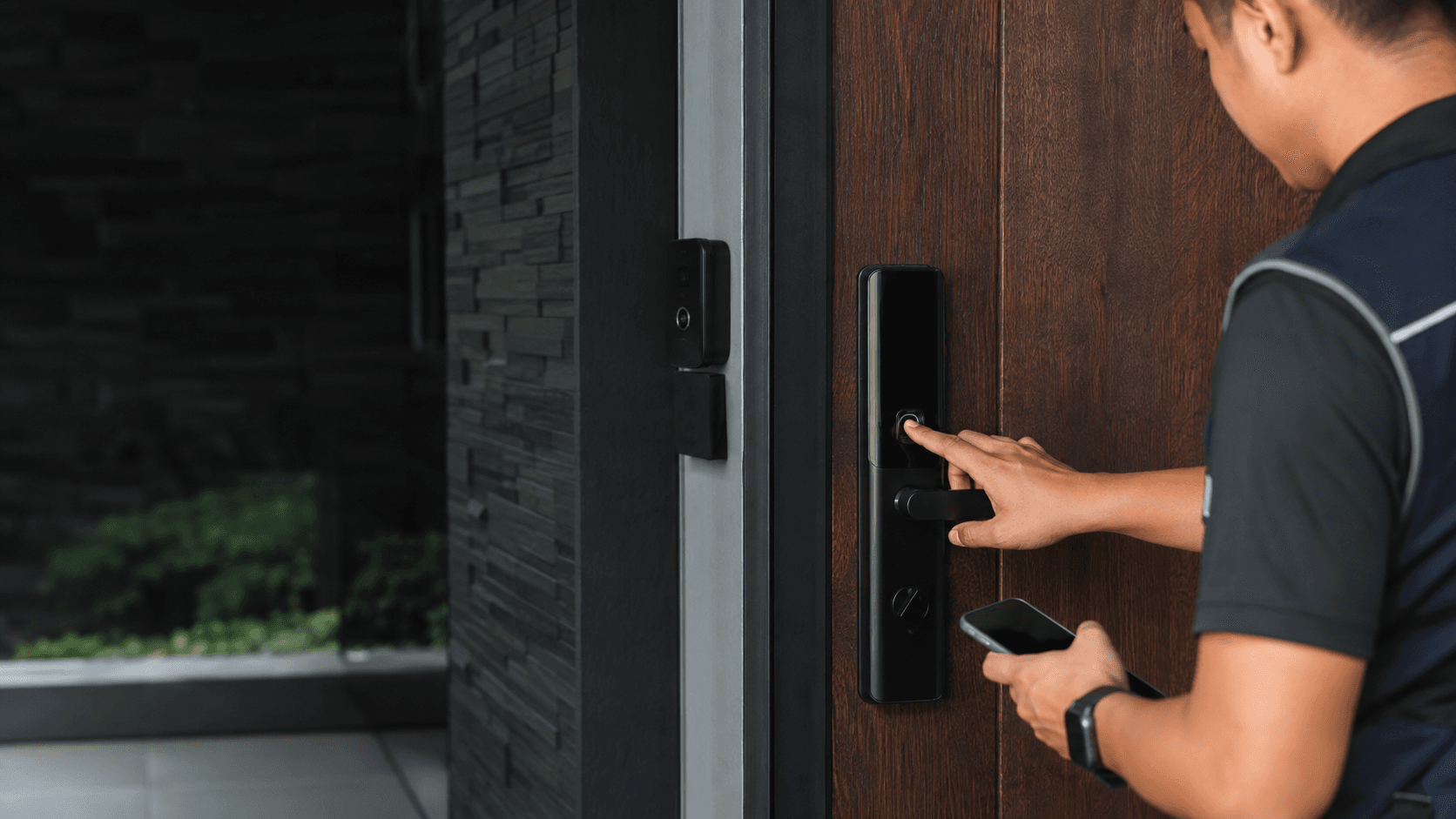
The lock sits in the same family as other smart locks: a keypad or touchscreen replaces the key turn, and a radio module lets a controller check lock status or send a lock command. Kwikset builds these locks around its Home Connect technology, and the company also sells a conversion kit that turns an existing deadbolt into a connected one rather than replacing the whole assembly.
For readers in Malaysia, the practical questions are narrower than the product catalogue. Door condition, hub compatibility, user roles and a backup entry method decide whether a Kwikset Z Wave Lock works as intended, and those four checks matter more than finish or branding.
What a Kwikset Z Wave Lock does at the door
At the door, the lock replaces a mechanical deadbolt with a motorised one. Entry happens through a keypad code, a touchscreen, an app command routed through the hub, or the physical key where the model keeps a keyway. The bolt still throws and retracts the same way, so the door preparation and strike plate position stay relevant.
Kwikset's own product pages describe the lock as communicating wirelessly with other devices in the home, which is the core of the value: the lock becomes one device in a wider system rather than a standalone keypad. That matters for anyone who wants a single place to see whether a door is locked, or who wants a lock event to trigger something else.
Two limits are worth stating plainly. A Z-Wave lock is not a Wi-Fi lock, so remote access depends on a hub or panel that bridges Z-Wave to the internet. And a smart lock is not an access control system: it controls one door, not a building's worth of doors, users and audit trails.
Z-Wave pairing and hub compatibility
Pairing is the step most likely to cause trouble, and the sequence is consistent across Z-Wave locks. The controller enters inclusion mode first, then the lock is put into its own pairing state, usually by pressing a button on the interior assembly. Kwikset's support documentation for its Z-Wave models describes pressing a button on the lock while the smart system is in Add Mode, and notes that the process may need to be repeated if the first attempt does not take.
Alarm Grid's guidance on including a Kwikset Z-Wave lock adds a detail that explains many failed attempts: most Kwikset Z-Wave locks have a learn button labelled "A", and that button is pressed while the system is in Z-Wave inclusion mode. The same source notes that a lock which has previously been paired elsewhere may need to be excluded from its old network before it will join a new one.
That exclusion step is the edge case worth planning for. A lock bought second-hand, or moved from a previous home, can appear faulty when it is simply still registered to a controller that is no longer present.
Which controller is on the other end
Compatibility is decided by the controller, not by the lock alone. A Z-Wave certified hub or alarm panel that supports the lock's device class should be able to include it, but the specific hubs, panels and controllers sold in Malaysia are not covered by the evidence available here, so the controller's own compatibility documentation is the document that settles the question. Checking that before purchase avoids buying a lock that pairs with nothing on site.
Door, deadbolt and power checks before buying
Kwikset's support material for its connected deadbolts points to door and bolt condition as the first thing to verify. Its troubleshooting guidance covers lock handing, a jammed bolt, bolt hole depth, door alignment and mounting screw tension, which is a useful signal about where installation problems actually come from.
The checks below are worth completing in order, because each one can change the decision that follows it.
- Confirm the door and deadbolt condition, including bolt hole depth, door alignment and whether the existing bore matches the lock being considered.
- Confirm the hub, alarm panel or controller supports Z-Wave and can include the lock, using that controller's own compatibility documentation.
- Confirm user roles and permissions, so each person who needs entry has an appropriate code or credential and the ability to remove it later.
- Confirm a backup entry method, whether that is a physical key, a second door, or a documented procedure for when the battery or the network fails.
- Confirm who installs the lock and who hands over the codes, the app access and the recovery steps at the end of the job.
Power is the constraint that catches people out. A battery-powered deadbolt is convenient because no wiring is needed at the door, but a flat battery is a lockout risk unless the backup method is real and known to everyone who uses the door. The evidence available here does not state battery life or wireless range for these locks, so those figures should come from the specific model's documentation rather than from assumption.
Smart lock or access control panel for a business
For a home, a Kwikset Z Wave Lock is usually the whole solution. For a business, the decision is different. Eyonic's own review of smart lock door access notes that smart locks work best when door condition, user roles and backup method are reviewed before installation, and that for business use the usual question is whether a standalone smart lock or an access control panel is more appropriate.
The trade-off is scope against complexity. A standalone smart lock is quick to fit and easy to manage for one entrance. An access control panel handles multiple doors, scheduled access and a record of who entered where, at the cost of more infrastructure and more planning. A single-office door with a handful of staff rarely needs the panel. A site with a staff entrance, a visitor door and a storeroom usually does.
Eyonic's project work in Sarawak has centred on movement through a building rather than on a single door. The Kuching Immigration Office project focused on arrival flow, staff areas, visitor movement and dependable daily operation, and the KTA Sarawak Sdn Bhd project covered staff movement, visitor handling, tidy cabling and clearer daily site control. Both are the kind of brief where door hardware is one part of a wider access picture.
Installation and handover in Sarawak
Installation quality decides whether a connected deadbolt feels reliable or erratic. A bolt that binds because the door has moved, or a strike plate that is a millimetre out, produces the same symptoms as a pairing fault, and the fix is mechanical rather than digital.
Eyonic's installation process runs through site survey, system proposal, installation and handover, which is the sequence that suits a lock as much as a camera system. The survey is where door condition, existing deadbolt, controller and user roles get checked together, and the handover is where codes, app access and the backup procedure get passed to the people who will actually use the door.
Eyonic Sdn Bhd is a security system supplier in Sarawak working on CCTV and ELV systems for homes, offices, shops and industrial sites, and its product range includes smart locks. The evidence available here does not confirm whether Eyonic supplies, installs or supports Kwikset Z Wave Lock hardware specifically, so that question is best settled directly rather than assumed from the wider service list.
Where a lock is part of a larger job, the budget range for comparable office work in Eyonic's project record sits between RM 8,000 and RM 18,000 for an engineering consultancy office setup and between RM 12,000 and RM 28,000 for the Kuching Immigration Office work. Those figures cover whole projects, not a single lock, and no pricing for a Kwikset Z Wave Lock in Malaysia is available here.
For a straightforward next step, share the location, property type and required system with Eyonic on WhatsApp at +60 11-5111 7959.