
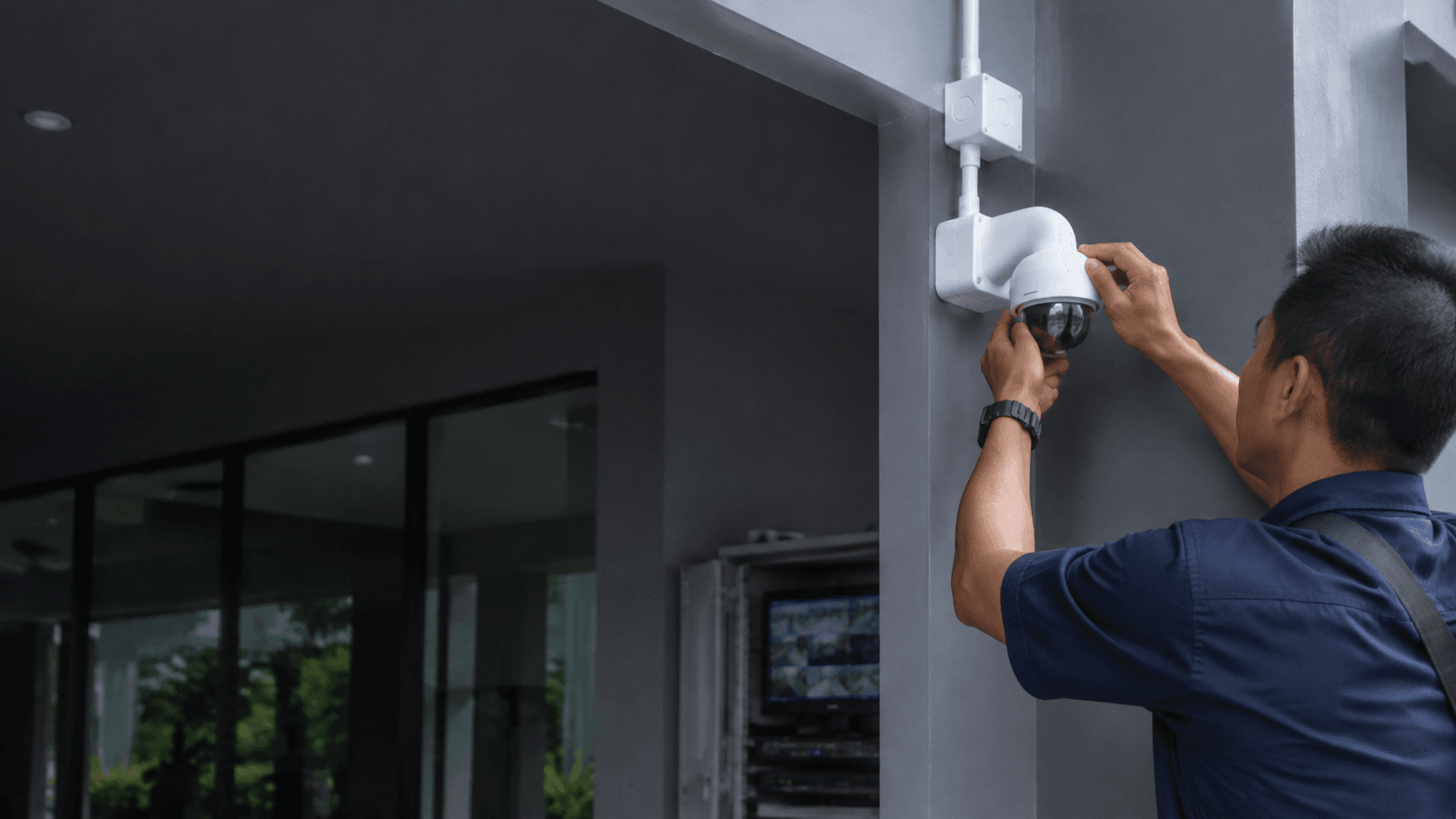
The phrase high quality security camera gets used loosely in marketing. In practice it describes a camera that captures usable detail in the conditions where it is actually mounted, not one that wins a specification contest on paper. Resolution matters, but so do lighting, lens choice, recording hardware, and whether the footage can be reviewed quickly when something happens.
Eyonic Sdn Bhd is a security system supplier based in Sarawak, Malaysia, working on CCTV and ELV systems for homes, offices, shops and industrial sites. The company's founder, Eric Yong, has worked in the industry for more than ten years, with a focus on technical installation of digital security solutions for commercial businesses in Sarawak.
High Quality Security Camera. What Matters Before You Choose
Four properties decide whether footage is useful after an incident: resolution, low-light behaviour, coverage angle, and recording continuity. A camera that fails any one of these produces video that looks impressive in a demo and proves nothing in a review.
Resolution sets the ceiling on detail. Higher pixel counts let a viewer zoom into a face, a plate, or a doorway without the image dissolving into blocks. That ceiling is only reachable when the lens, sensor and recording settings support it, which is why two cameras with the same headline resolution can perform very differently at night.
Low-light behaviour is where most real incidents happen. A camera that produces clean colour images after dark is more useful than one that switches to grainy infrared, because colour helps identify clothing, vehicle paint and objects. Eyonic advises checking actual lighting conditions at the intended position before confirming placement for ColorVu-style cameras, since ambient light, street lamps and reflective surfaces all change the result.
Coverage angle determines how many cameras a site needs. A wide lens covers more ground per unit but stretches detail at the edges. Narrower lenses concentrate detail where it matters, such as an entrance or a cash counter. The right answer depends on what the site is trying to observe.
Recording continuity is the quiet requirement. A camera is only as good as the recorder behind it, and a system that drops frames, overwrites footage too quickly, or loses power without warning will fail at the moment it is needed.
Choosing the Right High Quality Security Camera
The practical sequence below reflects how a professional installation is scoped, from first walkthrough to handover. Eyonic's own installation process follows site survey, system proposal, installation, and handover.
- Survey the site and note where incidents are most likely, where lighting is weakest, and where cabling can run cleanly.
- Match camera type to location. bullet or turret cameras for outdoor perimeters, dome cameras where tampering or aesthetics matter, and pan-tilt models where one unit must cover a wide area.
- Confirm resolution and lens against the distance to the target, not against the size of the room.
- Check night-time performance at the exact mounting height and angle, ideally after dark.
- Size the recorder and storage so footage is retained for the period the site actually needs.
- Plan remote viewing and user access so the people who need footage can reach it without calling an installer.
- Test the finished system, then hand over with a walkthrough of live view, playback and mobile access.
Step two deserves more attention than it usually gets. A dome camera mounted low on a shopfront invites tampering; a bullet camera pointed across a bright road at night will flare. These are placement problems, not product problems, and they are cheaper to solve before drilling begins.
What is high quality security camera?
A high quality security camera is one that records identifiable detail in the lighting and distance conditions where it is installed, and stores that footage reliably enough to be reviewed later. Resolution, sensor sensitivity, lens choice, and the recorder behind the camera all contribute, which is why the same camera can perform well on one site and poorly on another.
This definition is deliberately practical. A 4K camera aimed at a dark alley with no supplementary light will produce worse evidence than a lower-resolution camera with a brighter lens and a well-chosen angle. Buyers who compare only resolution figures are comparing the least reliable part of the specification.
Security Cameras & Systems | Lorex USA
Competitor catalogues in this category, including Lorex USA's security camera and systems collection, organise products by indoor and outdoor use, wired and wireless connection, and resolution tier. That structure reflects how buyers actually shop: they start with where the camera goes, then narrow by how it connects, then compare resolution and storage.
The same logic applies to a site in Sarawak. A shophouse with existing network cabling can use Power over Ethernet cameras that draw power and data from a single cable. A standalone gate or a rented unit may suit a wireless or battery-powered model instead. Industrial sites often need weatherproof housings and longer cable runs, which changes both the camera choice and the installation cost.
Storage is the other dividing line. Local recording on a network video recorder keeps footage on site and avoids recurring cloud fees, while cloud storage offers off-site copies if equipment is stolen or damaged. Many sites run local recording as the primary method and treat cloud as a secondary option.
Practical Considerations for High Quality Security Camera
Budget, cabling, and maintenance decide whether a good design survives contact with a real building. These are the constraints that most often force a compromise between what a site wants and what it can install.
Eyonic's published package pricing gives a concrete starting point. The Hikvision CCTV Package is RM 1,599 and covers camera supply and setup, basic recording configuration, and mobile viewing handover. The Hikvision Alarm System is also RM 1,599, covering a control panel and sensors, siren and zone setup, and user testing and handover. The Autogate Package is RM 1,599 as well, covering motor recommendation, remote-control setup, and safety testing and handover.
Larger or more complex sites sit well above package level. Eyonic's Kuching Immigration Office project, which covered arrival flow, staff areas, visitor movement and dependable daily operation, had an approximate budget of RM 12,000 to RM 28,000. The KTA Sarawak Sdn Bhd project, an office setup in Kuching supporting staff movement, visitor handling, tidy cabling and clearer daily site control, had an approximate budget of RM 8,000 to RM 18,000.
Cabling is the constraint that surprises people most. Tidy routing takes time, and retrofitting cable into a finished building can cost more than the cameras. Sites that plan cable routes during renovation or fit-out consistently get better results for the same spend.
Maintenance is the last consideration and the easiest to forget. Lenses collect dust and insects, recorder drives have finite lives, and firmware needs occasional attention. A system that nobody checks will eventually fail quietly, which is worse than failing loudly.
Where a high quality security camera earns its cost
Cameras pay for themselves in situations where a clear record resolves a dispute or prevents a loss. A shop counter camera that identifies a transaction, a warehouse camera that shows how goods left the building, or an office entrance camera that records who arrived and when all serve that purpose.
They are less useful where the goal is vague. A camera pointed at nothing in particular produces footage nobody reviews. Deciding what the system needs to prove, before choosing hardware, is the step that separates a useful installation from an expensive one.
Making an Informed Choice About
A sensible decision process starts with the site, not the product. Identify what needs to be observed, at what distance, in what light, and for how long footage must be kept. Those four answers narrow the field faster than any specification table.
From there, the trade-offs become manageable. Higher resolution costs more in storage and bandwidth. Wider coverage reduces the number of cameras but softens detail. Local recording avoids subscription fees but puts footage at risk if equipment is removed. Each choice has a cost, and the right balance depends on what the site is protecting.
For sites in Sarawak, working with an installer who surveys first and proposes second reduces the risk of buying hardware that does not fit the building. Eyonic's process runs site survey, system proposal, installation, and handover, which keeps the specification tied to the actual site rather than to a catalogue.
Share your location, property type and required system with Eyonic on WhatsApp at +60 11-5111 7959 for the next practical step.