
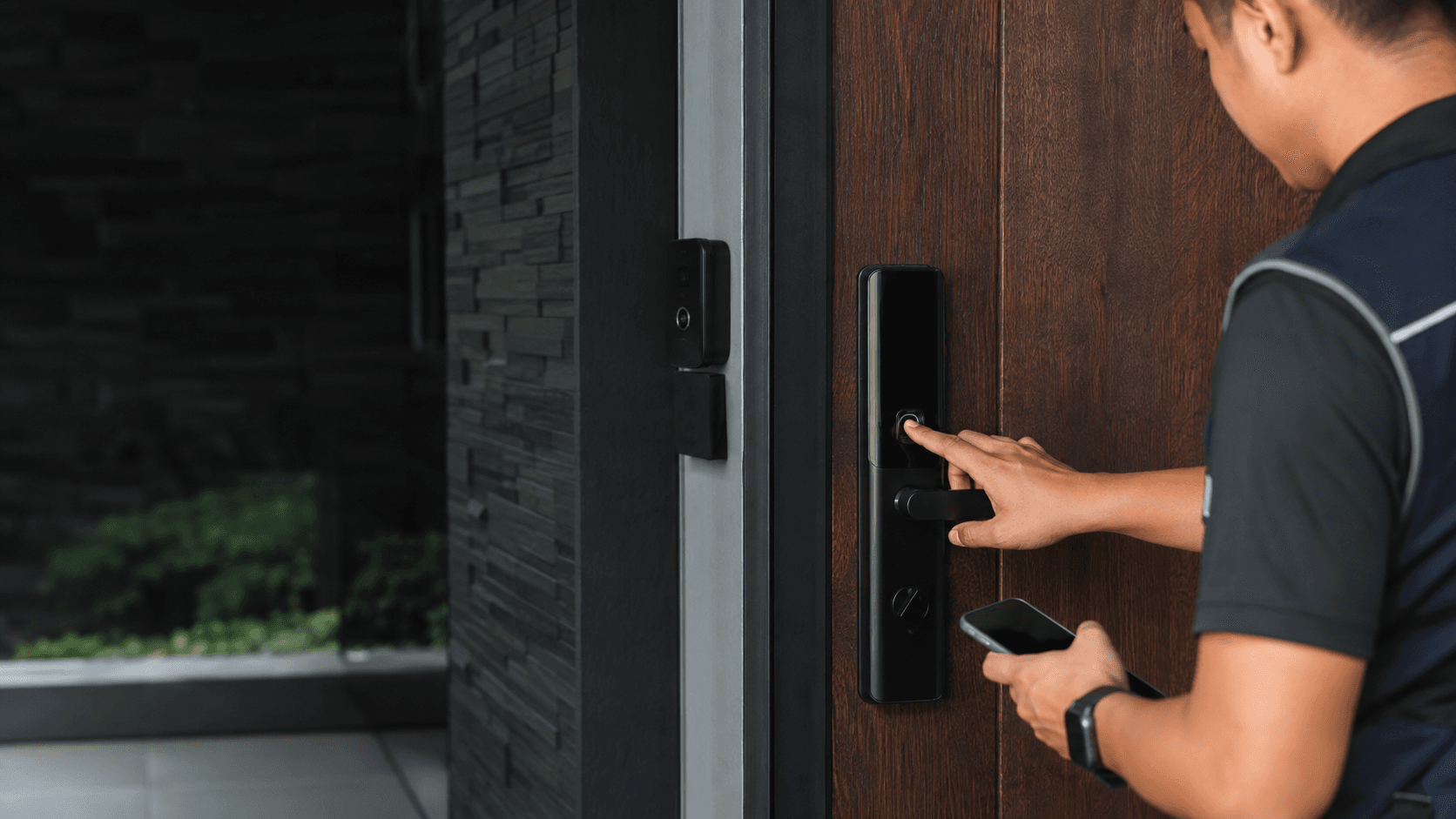
The term covers a small family of products rather than one standard design. Some are knob-shaped handles with the radio and electronics inside the knob body. Others are deadbolt or lever sets that a supplier or retailer groups under the same Bluetooth label. The practical question is not what the radio does, but what the fitting replaces on the door and who is expected to pass through that door each day.
Bluetooth Door Knob. What It Controls and What It Does Not
A Bluetooth door knob controls the latch or bolt on one door. It does not control a gate, a shutter, a lift lobby turnstile or a car park barrier. Those belong to different product families, and mixing them into one purchase usually produces a system nobody can operate consistently.
What the fitting does control is the moment of entry. A phone pairs with the lock, the lock releases, and the door opens. What it does not control is who is standing at the door, whether the door frame is square, whether the door closes fully behind the person, or whether anyone records the event. A Bluetooth door knob is an entry device, not a monitoring system.
That distinction matters most when a property already has cameras or an alarm. A Bluetooth door knob adds a controlled way through one opening. It does not replace recorded coverage of the corridor, the lift lobby or the perimeter, and it does not tell anyone that a door was left ajar.
Where the Bluetooth part actually sits
Bluetooth is a short-range radio link between the lock and a phone or a nearby hub. It is the channel used to send the unlock instruction, not the mechanism that holds the door shut. The mechanical part still does the security work: the latch, the bolt, the strike plate and the frame.
This is why a well-built door with a poorly fitted lock performs worse than a modest lock on a solid door. The radio can be working perfectly while the door itself is the weak point.
How a Bluetooth Door Knob Fits a Malaysian Home, Shop or Office Door
Malaysian properties present a wide spread of door types, and the fitting has to match the door rather than the other way round. A terrace house in Kuching, a shoplot in a commercial row and an office suite inside a managed building rarely share the same door construction, frame condition or traffic pattern.
For a home, the usual candidates are the main entrance, an internal door to a study or store room, and a rental unit where the owner wants to change access without changing keys. For a shop, the back door and the staff entrance are common candidates because they are used by a small, known group. For an office, the door between a public reception area and the working floor is the one that usually needs controlled entry rather than a key.
Eyonic's smart lock door access review notes that smart locks work best when the door condition, user roles and backup method are reviewed before installation. For business use, the same review checks whether a standalone smart lock or an access-control panel is more appropriate. That check is the difference between a fitting that lasts and one that gets bypassed within a month.
Home, shop and office fit
A home door usually has one household passing through it, so a standalone fitting is often enough. A shop door has staff arriving and leaving at different times, so temporary access matters more than permanent access. An office door often sits between a public area and a restricted area, which is where the standalone-versus-panel decision becomes a real question rather than a preference.
Rental property adds a fourth case. When tenants change, the owner needs a way to remove access without collecting a key. That is one of the clearest practical arguments for a keyless fitting, and it is also the case where a documented backup entry method matters most.
Door Condition, User Roles and Backup Entry Before Installation
These three checks decide whether a Bluetooth door knob is the right purchase. They are also the checks most often skipped when a lock is bought online and fitted without a site visit.
- Confirm the door thickness and whether the existing cut-out matches the replacement body.
- Check that the frame is square and that the door closes fully without lifting or dragging.
- List every person who needs routine entry, and separate them from people who need entry once or twice.
- Decide how temporary access will be issued and how it will be withdrawn.
- Agree the backup entry method before the fitting is installed, not after a phone is lost.
- Confirm whether the door is single-occupancy or shared, because shared doors need a different access model.
Door condition is the first constraint because a lock cannot compensate for a door that does not sit correctly in its frame. A door that needs to be pushed, lifted or held to close will put load on the latch every time it is used. That is a mechanical problem, and no radio link solves it.
User roles are the second constraint. A door used by two people is a convenience decision. A door used by rotating staff, contractors or short-stay guests is an access management decision, and the fitting has to support issuing and withdrawing access without a physical key handover.
Backup entry is the third constraint, and it is the one that causes the most trouble when it is ignored. A phone can be lost, left at home, run flat or be out of range. The backup method has to be decided in advance and it has to be usable by someone who is not the person who set the lock up.
What happens when a phone is lost, flat or out of range
Bluetooth is a short-range link, so a phone that is out of range cannot send an unlock instruction. A flat phone cannot send one either. A lost phone is a different problem again, because the access it carried may still be valid until it is removed.
The practical answer is that the backup entry method carries the risk. If the backup is a physical key, the key has to be stored somewhere that is not the door itself. If the backup is a second credential, that credential has to be held by someone who is not always on site. Whichever route is chosen, the decision belongs before installation.
Compared With Keypad Fingerprint and Panel Access
Four options come up in the same conversation, and they solve different problems. A Bluetooth door knob suits a person who wants entry through a phone and does not want to carry a key. A keypad suits a door where several people need entry and issuing a code is simpler than issuing a phone credential. A fingerprint reader suits a door where the same small group uses it constantly and speed matters. An access-control panel suits a building where entry has to be recorded, restricted by time, or managed across more than one door.
The trade-off is management effort against hardware cost and complexity. A standalone fitting is simpler to buy and simpler to fit. A panel-based system does more, but it needs cabling, a controller and someone to administer it. Choosing the panel when a standalone fitting would do adds cost and maintenance. Choosing the standalone fitting when the door needs recorded, time-restricted access produces a system that gets worked around.
Eyonic's own position on smart lock door access is that it is good for controlled convenience when user permissions and backup entry are planned properly. That wording is deliberately narrow. The value comes from the planning, not from the radio.
When a standalone fitting is the wrong choice
A standalone fitting is the wrong choice when more than one door has to open under the same rule, when entry has to be restricted to certain hours, when a record of who entered is required, or when the door is a shared building entrance used by people the property does not control. In those cases the requirement is access control, and a single door fitting cannot deliver it.
What to Confirm Before Ordering a in Malaysia
Malaysian buyers face a market where listings are often thin on the details that decide fit. The safest approach is to confirm the physical facts about the door first and treat the product listing as secondary.
Confirm the door thickness, the existing cut-out, the frame condition and the closing action. Confirm who needs entry and how often. Confirm the backup entry method and where the backup credential will be kept. Confirm whether the door is shared or single-occupancy. Confirm who will administer access after handover, because a lock that nobody can manage becomes a lock that gets left unlocked.
Where a property already runs cameras, an alarm or an intercom, the new fitting should be considered alongside those systems rather than in isolation. Eyonic's installation work follows a site survey, system proposal, installation and handover sequence, and the survey stage is where door condition and user roles are established. The same discipline applies to a single door fitting as to a larger system.
Public and commercial premises show why the planning stage matters. Eyonic's project for the Kuching Immigration Office focused on arrival flow, staff areas, visitor movement and dependable daily operation. Those four concerns apply directly to any door that separates a public area from a working area, and they are the reason a door fitting is chosen against a traffic pattern rather than against a product photo.
Practical next step with Eyonic
Share the location, property type and required system with Eyonic on WhatsApp at +60 11-5111 7959. A site survey establishes the door condition, the user roles and the backup entry method before any fitting is proposed, which is the point at which a Bluetooth door knob can be confirmed as suitable or ruled out in favour of a wider access-control approach.