
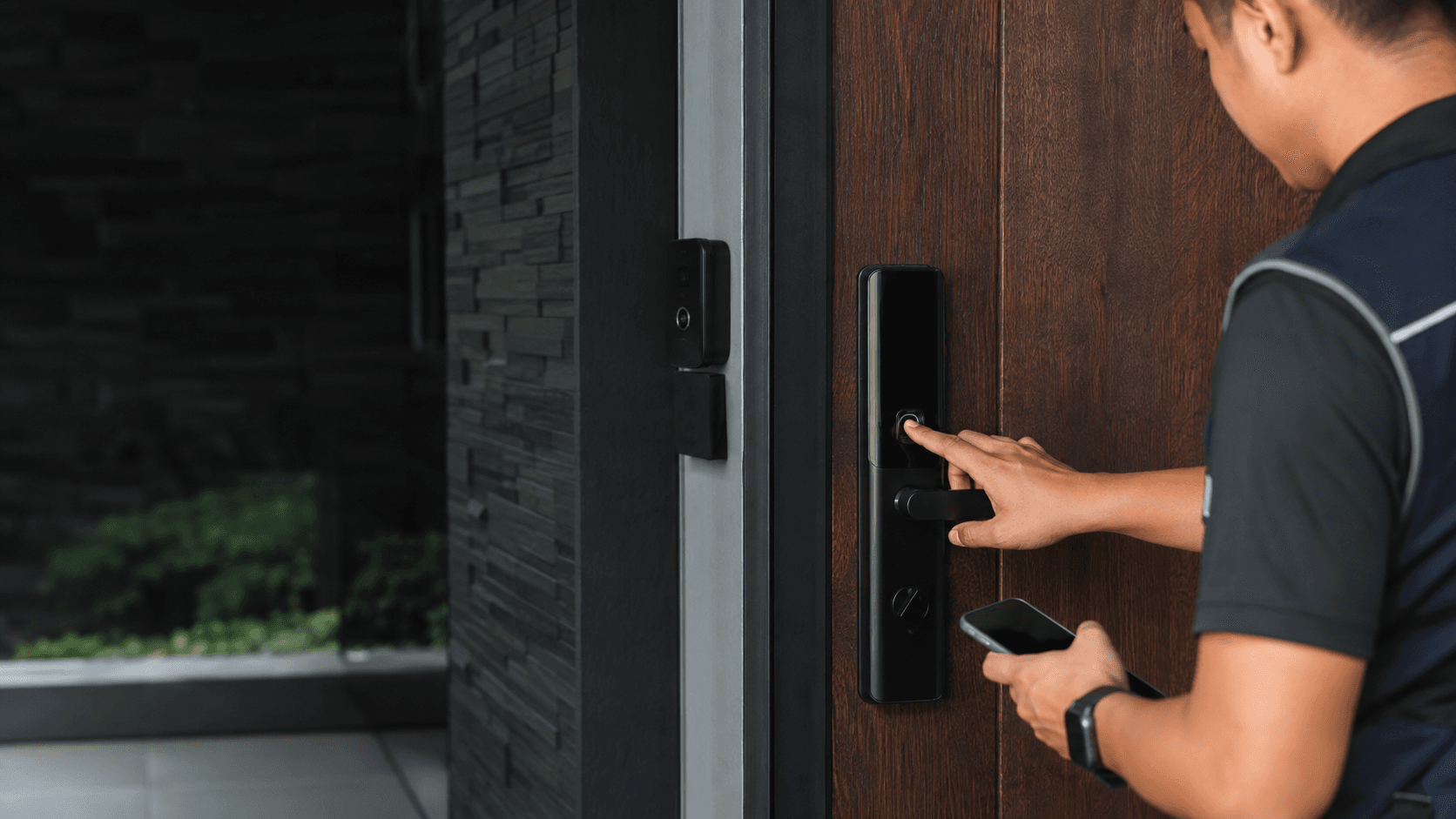
That combination is the core of remote-controlled door entry. The lock itself holds the motor and the credential reader; the remote or keypad sends the instruction. What changes between one door and the next is how that instruction travels, who is allowed to send it, and what happens when the power, the network, or the battery is not cooperating.
Eyonic Sdn Bhd plans, supplies, and installs security and ELV systems in Sarawak, and its smart lock door access work is reviewed against door condition, user roles, and backup method before anything is mounted. That order matters, because a lock that suits a single shop shutter rarely suits an office with staff, visitors, and deliveries moving through the same doorway.
Wireless Door Lock With Remote. What Remote Entry Actually Controls
A wireless door lock with remote controls one action: releasing the locking mechanism. Everything else attached to it — logging, scheduling, permissions, alerts — is a separate layer that may or may not exist depending on the unit.
Remote-controlled door entry usually reaches the lock through one of a few routes. A radio fob talks directly to the lock or to a receiver wired to it. A keypad sends a code over the same short-range link. A phone app reaches the lock through Wi-Fi, Bluetooth, or a hub, which is why app control often depends on a network that a fob does not need.
The practical difference shows up in daily use. A fob works from a pocket at close range with no phone, no app, and no login. App control adds remote viewing of lock status and the ability to issue or revoke access for other people, but it also adds a dependency: if the network or the phone is unavailable, the app route is unavailable too.
For a Malaysian home, the fob is often the everyday method and the keypad is the fallback for family members or a helper without a phone. For a shop or office, the same hardware is usually judged on whether access can be limited by person and by time, which pushes the decision toward a lock that supports user permissions rather than a plain remote receiver.
How a wireless door lock with remote handles entry, exit, and backup access
Entry and exit are not symmetrical, and that asymmetry is where most installations get uncomfortable. A lock that opens easily from outside still has to let people leave quickly from inside, and it still has to let someone in when the electronics are not responding.
Three access paths normally sit alongside the remote:
- Remote or fob entry for the people who hold the transmitter.
- Keypad, card, or app entry for people who need access without carrying a fob.
- Mechanical key or manual override for the case where the battery, the network, or the reader fails.
Backup entry is the part worth confirming before purchase. A mechanical key cylinder, an external power terminal, or a documented manual release all serve the same purpose, but they are not interchangeable in practice. A key cylinder left inside the building is not a backup. An external power point that nobody has the matching battery for is not a backup either.
Exit is usually mechanical. a handle, a thumb turn, or a push bar that releases the lock without any credential. That is deliberate, because exit should not depend on a battery. Where a door is also a fire escape route, the exit hardware has to satisfy the building's requirements, and that is a constraint the lock choice has to fit around rather than override.
Remote viewing of lock status is a separate feature from remote unlocking. Some units report whether the door is locked, and some report who opened it and when. Those records are useful for a shop or office, but they depend on the lock having a logging function and on that log being reachable, which again ties back to the network.
Door condition, user roles, and backup method before installation
Eyonic's own review of smart lock door access states that smart locks work best when door condition, user roles, and backup method are reviewed before installation, and that for business use the usual question is whether a standalone smart lock or an access-control panel is more appropriate. Those three checks are the ones that decide whether a wireless door lock with remote will behave well after handover.
Door condition covers more than appearance. The door leaf has to be thick enough and solid enough to carry the lock body, the frame has to close consistently, and the existing cutout has to match or be modified cleanly. A door that has swollen, dropped, or been patched before will fight a motorised lock every day, and no amount of configuration fixes a misaligned strike.
User roles decide the credential mix. A household needs a handful of fobs and a keypad code. A shop needs a code that can be changed when staff leave. An office needs access limited by person and by time, plus a record of who came through. The same lock can serve all three, but only if the unit supports the number of users and the permission structure each case requires.
Backup method is the third check, and it is the one most often deferred. The question to settle early is what happens on the day the battery is flat, the Wi-Fi is down, or the reader stops responding — and who holds the means to get in when that day arrives.
Where a wireless door lock with remote fits in a wider access-control setup
A standalone lock is a self-contained unit: it reads the credential, decides, and releases. An access-control setup splits those jobs. A panel or controller holds the permissions and the records, and the door hardware simply follows the instruction.
The split matters at scale. One door with a handful of users is well served by a standalone lock. Several doors, a shared user list, time-based rules, and a single record of movement are better served by a controller, because permissions are managed in one place instead of being re-entered at each door.
Remote-controlled door entry can sit inside either arrangement. A lock with a remote receiver works on its own; the same door can also be wired to a controller that decides when the release is allowed. The choice is not about which is more advanced — it is about how many doors and how many people have to be managed together.
This is also where a lock decision meets the rest of a building's systems. Eyonic's project work at the Kuching Immigration Office centred on arrival flow, staff areas, visitor movement, and dependable daily operation, and its KTA Sarawak Sdn Bhd project covered staff movement, visitor handling, and tidy cabling. Both are the kind of environment where door access is judged by how it handles a queue at the start of the day, not by how it looks on a spec sheet.
Practical checks for homes, shops, and offices in Malaysia
Malaysian doors vary more than product listings suggest. Metal grille doors, glass shopfronts, timber office doors, and roller shutters each need different hardware, and a lock sold for a timber residential door will not simply transfer to a grille.
For a home, the usual concerns are whether the lock fits the existing door without weakening it, whether family members can get in without a phone, and whether the remote still works from inside the car at the gate. For a shop, the concerns are staff turnover, a code that can be changed quickly, and whether the door is also the main shutter that has to open for deliveries. For an office, the concerns are visitor handling, staff movement at peak times, and a record that can be checked after an incident.
Two constraints apply across all three. The first is power and network. a lock that depends on Wi-Fi inherits every Wi-Fi problem in the building, so a fob or keypad path is worth keeping available. The second is the door itself — if the frame does not close cleanly, the lock will report faults that are really alignment faults.
Eyonic's installation process for its security work runs through site survey, system proposal, installation, and handover, and the same sequence applies to smart lock door access. The site survey is where door condition and the credential mix get settled; handover is where the backup method and the everyday routine get explained to the people who will actually use the door.
Costs, handover, and the next practical step
Pricing for a wireless door lock with remote unit and its installation in Malaysia is not published in a form that can be quoted here, and it varies with the door, the credential mix, and whether a controller is involved. Eyonic's published package pricing covers other systems — the Hikvision CCTV package, the Hikvision alarm system, and the autogate package are each listed at RM 1,599 — and those figures do not represent lock supply or installation.
Larger access and security work is budgeted by scope rather than by unit. Eyonic's Kuching Immigration Office project carries an approximate budget range of RM 12,000 to RM 28,000, and the KTA Sarawak Sdn Bhd project carries an approximate range of RM 8,000 to RM 18,000. Both are project-level figures for wider security work, not a price for a single lock.
Handover is where the installation either holds up or does not. It should cover the backup entry method, how to add or remove a user, what the lock does when the battery runs low, and who to contact when the door will not release. A lock that nobody on site can administer becomes a call-out waiting to happen.
Share your location, property type and required system with Eyonic on WhatsApp at +60 11-5111 7959 for the next practical step.