
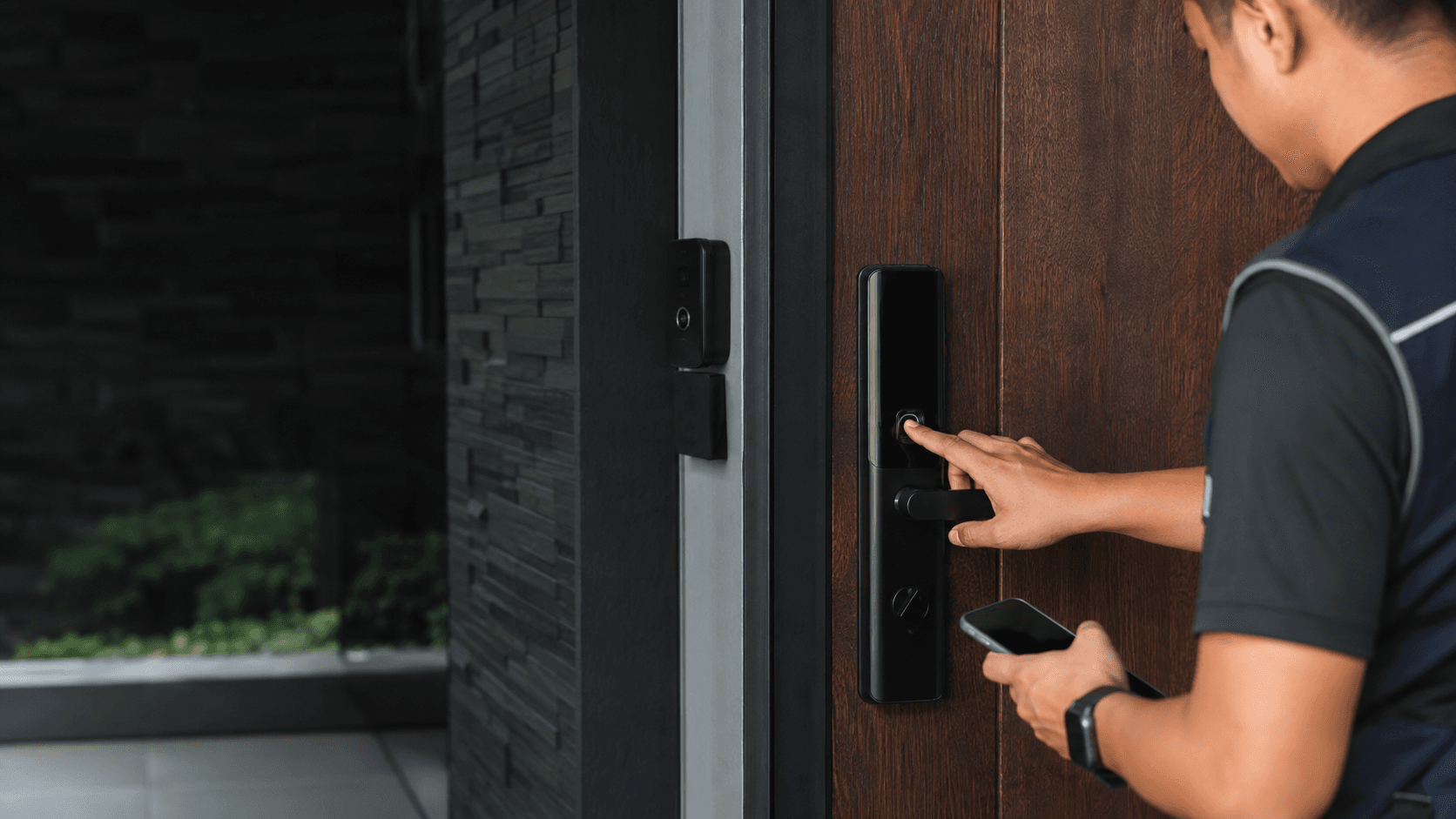
Eyonic Sdn Bhd supplies and installs security and ELV systems in Sarawak, and its product review guidance places smart locks in the same planning conversation as CCTV, alarm, autogate and intercom work. That matters because a deadbolt is only one part of how a door is used each day.
Anyone weighing the ultraloq u bolt pro wifi smart lock for a Malaysian property is really answering three questions at once: how the door gets opened, who is allowed to open it, and what happens when the network, the batteries or the phone app are not cooperating.
What the Ultraloq U Bolt Pro Wifi Smart Lock is built to do at the door
The lock is a deadbolt replacement, not an add-on that sits over an existing knob. It takes the place of the mechanical deadbolt on the door, which means the door itself becomes part of the decision.
Eyonic's own product review position is that smart locks work best when the door condition, user roles and backup method are reviewed before installation. Those three checks come before brand or model preference, because a lock that fits badly or locks out the wrong person is a daily problem rather than a one-off installation issue.
For business use, Eyonic usually checks whether a standalone smart lock or an access-control panel is more appropriate. A single door with a handful of regular users sits comfortably in the standalone category. A site with shift changes, visitor logging requirements or multiple controlled doors usually points toward an access-control panel instead.
Unlock methods and app control in daily use
Unlock methods are the part of the ultraloq u bolt pro wifi smart lock that most buyers research first, and they are also the part where published specifications should be read from the manufacturer rather than assumed from a retailer listing.
What can be said with confidence is structural. A keyless deadbolt of this type is designed so that entry does not depend on carrying a physical key, and app control is what allows access to be managed remotely rather than only at the door. The practical value of app control shows up in three situations:
- A household member arrives while nobody is home and needs entry without a shared key.
- A short-term rental or office needs a code that can be changed after a guest or staff member leaves.
- A property owner wants to know whether a door was opened, and roughly when.
Each of those depends on the lock staying connected and powered. Wi-Fi smart locks rely on a network and on batteries, so the failure case is not hypothetical. When the network drops, local entry methods still matter. When batteries run down, a backup entry path matters. Those two fallbacks are the difference between a lock that is convenient and a lock that is a liability.
App behaviour also varies by region. Whether an app is available in a given country, whether it needs a subscription, and where its servers sit are all questions worth confirming before purchase rather than after installation.
Door condition, user roles and backup entry before installation
This is the part of the ultraloq u bolt pro wifi smart lock decision that cannot be settled from a product page. Eyonic applies a short pre-installation check to smart lock work, and the same sequence applies here.
- Check the door condition. Confirm the door thickness, the existing deadbolt bore, the door material and whether the frame is square enough for the bolt to throw cleanly.
- Define the user roles. Decide who needs permanent access, who needs temporary access, and who should only be able to enter during set hours.
- Confirm the backup method. Agree on how the door is opened if Wi-Fi is down, the app is unavailable or the batteries are flat.
- Decide between a standalone lock and an access-control panel. A single door with a small user group suits a standalone smart lock; multiple doors, visitor logging or staff shift patterns usually suit a panel.
- Plan the handover. Test every entry method, confirm the app is working on each user's phone, and record what was configured.
Door condition is the most common reason a smart lock installation changes shape mid-job. Malaysian doors vary in thickness and in how the existing deadbolt was fitted, and a lock specified for one door standard may need additional preparation on another. That is a site question, not a catalogue question.
User roles are the second common gap. A lock that gives everyone the same access is easy to set up and hard to manage later. Separating permanent, temporary and time-limited access at the start avoids reissuing credentials every time someone leaves.
Backup entry is the third. A physical key, a keypad code or a mechanical override all serve the same purpose: entry that does not depend on the network or the phone. Whichever is chosen, it should be tested before the installer leaves.
Where a smart lock fits in a Sarawak property
Eyonic's project work in Sarawak has centred on movement through a building rather than on a single door. The Kuching Immigration Office project focused on arrival flow, staff areas, visitor movement and dependable daily operation. The KTA Sarawak Sdn Bhd project covered staff movement, visitor handling, tidy cabling and clearer daily site control.
Those two projects describe the same pattern a smart lock sits inside. A main entrance lock controls who comes through the front door. CCTV covers what happens at that door and around it. An alarm system covers what happens when nobody is there. An intercom handles the conversation before the door opens. An autogate handles vehicles.
For a Sarawak home, a smart lock is usually a convenience and access-management decision on one or two doors. For a shop, office or small industrial site, it is more often an access-control decision, and the question becomes whether a standalone lock is enough or whether the door should be part of a wider system.
Eyonic's published packages start at RM 1,599 for a Hikvision CCTV package, a Hikvision alarm system and an autogate package. Those figures cover different systems, not the lock itself, and they are useful mainly as a reference point for how a single-door device compares with a wider installation.
Practical next step with Eyonic
Eyonic Sdn Bhd is a security system supplier in Sarawak working across CCTV and ELV systems, with planning, supply and installation for homes, offices, shops and industrial sites. The founder, Eric Yong, has been in the industry for more than 10 years, with a focus on technical installation of digital security solutions for commercial businesses in Sarawak.
For a lock decision, the useful information to bring is the door itself: its thickness, its current deadbolt, how many people need access, and whether any of them need time-limited or temporary entry. That is enough to say whether a standalone smart lock fits or whether the door belongs in a wider access-control plan.
Share your location, property type and required system with Eyonic on WhatsApp at +60 11-5111 7959 for the next practical step.