
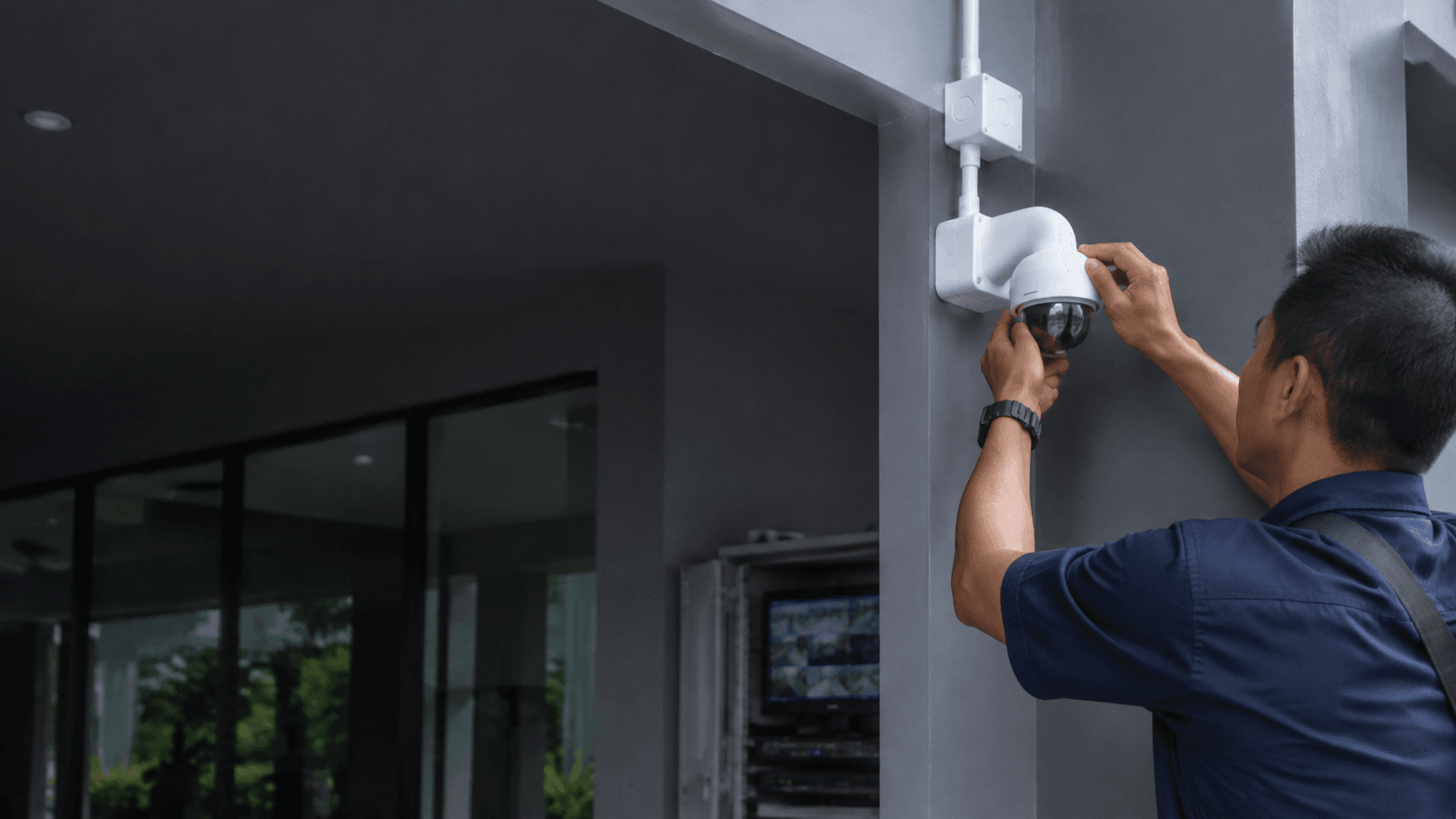
The exact-match query comcast security cameras describes a specific hardware family tied to one internet provider, not a general category of surveillance equipment. That distinction matters because the cameras depend on Xfinity service, the Xfinity Gateway, and the Xfinity app to function as designed. Buyers comparing options in Malaysia often weigh provider-locked systems against open-platform CCTV that works with any broadband connection and any recorder.
This guide covers what the cameras are, how they are identified, where they are typically placed, and which practical constraints decide whether they suit a given property.
Comcast Security Cameras. What Matters Before Choosing
Comcast security cameras sit inside a closed ecosystem. The hardware is sold or bundled by Xfinity, activated through an Xfinity account, and managed through the Xfinity app or Xfinity Home app. Nothing about that arrangement is unusual for a telecom-bundled camera line, but it does shape every downstream decision.
Three constraints dominate early planning:
- Confirm the property has an active Xfinity Internet service and a compatible Xfinity Gateway, since the cameras are designed to connect through that gateway rather than a third-party router.
- Identify which camera model is in hand or under consideration, because features such as 24/7 video recording, motion notifications, two-way audio, and camera area settings vary by model.
- Decide whether recording should be continuous or event-triggered, since 24/7 video recording is typically an add-on rather than a default behaviour.
Each of those checks is cheap to run before purchase and expensive to discover afterwards. A camera that supports live viewing but not continuous recording will still meet some needs and fail others.
What is comcast security cameras?
The phrase refers to the camera hardware marketed under the Xfinity brand by Comcast. The current line includes indoor cameras, indoor/outdoor cameras, and a video doorbell. Older models such as the xCam1, iCam1, iCam2, and iCam1000 remain in circulation, and their supported features differ from the newest units.
Because the naming has changed across generations, the practical question is rarely "what is this category" but "which model is this, and what does it support." Xfinity publishes a support article specifically for identifying a camera or video doorbell, which suggests model confusion is common enough to warrant its own reference page.
Home Security Cameras and Surveillance Cameras | Xfinity
Xfinity positions its cameras around remote live video monitoring, weather resistance for outdoor units, and night vision through infrared illumination. The marketing emphasis falls on checking in from anywhere rather than on forensic-grade recording.
Feature coverage across the line includes:
- Live video viewing through the Xfinity app
- Motion detection with notifications
- Two-way audio on supported models
- AI-assisted detection of people, vehicles, and pets on newer hardware
- 24/7 video recording as a separate capability
- Cloud video history storage
- Camera area and rules settings
Not every model carries every feature. The xCam3, for example, is described as the newest indoor camera, while the xCam2 covers indoor and outdoor use. Older iCam units support a narrower set of functions. That generational spread is the single most common source of mismatched expectations.
Identify your Xfinity Camera or video doorbell
Model identification can be done in three ways. The Xfinity app and the Xfinity Home app both surface the connected camera list, and the physical label on the device provides a fallback when the app is unavailable.
Within the app, the sequence is straightforward:
- Open the app and sign in to the Xfinity account.
- Scroll down to the desired camera and select the camera thumbnail.
- On the camera screen, select the gear icon on the upper right.
From that settings view, supported features become visible. If a feature expected from marketing material is absent, the model generation is usually the reason.
Choosing the Right Comcast Security Cameras
Selection comes down to matching camera capability to the actual job. A single indoor camera covering a hallway has different requirements from an outdoor unit watching a gate or driveway.
Four variables drive the decision:
- Location type. Indoor-only units should not be mounted where rain, direct sun, or temperature swings will reach them. Outdoor-rated models exist for that reason.
- Lighting conditions. Infrared illumination handles darkness, but image quality at night depends on how much ambient light the scene retains. Checking actual lighting before confirming placement avoids surprises.
- Recording expectation. Continuous recording and event-triggered recording serve different purposes. Continuous coverage suits high-traffic entries; event recording suits low-traffic areas where storage efficiency matters.
- Notification tolerance. Motion alerts on a busy street or a swaying tree generate noise. Camera area settings exist to reduce that, but they need configuring.
Placement deserves more attention than camera count. A well-placed single camera covering an entry point often delivers more usable footage than three poorly aimed units. The same principle applies to any camera system, whether provider-bundled or independently installed.
Whether you have one Xfinity Camera or several, placement is everything
Placement determines what the footage actually shows. Common failure modes include aiming into direct light sources, mounting too high to capture faces, and covering a wide area at the cost of detail.
Practical placement rules that hold across camera brands:
- Aim cameras slightly downward so faces are captured rather than the tops of heads.
- Avoid pointing directly at the sun's path or at reflective surfaces.
- Cover entry and exit points first, then circulation routes.
- Keep the field of view tight enough that identifying details remain legible.
For properties in Sarawak and similar climates, weather exposure and night-time lighting conditions both affect outcomes. Eyonic, a security system supplier in Sarawak, recommends checking actual lighting conditions before confirming placement for ColorVu-style cameras, and the same discipline applies to any low-light camera decision.
Practical Considerations for
The most consequential consideration is availability and support geography. Xfinity service is tied to Comcast's operating footprint, which does not extend to Malaysia. A buyer in Kuching or Kuala Lumpur cannot activate an Xfinity-dependent camera through a local internet plan.
That single fact reframes the comparison. For readers in Malaysia, the realistic question is not whether Comcast security cameras are good, but what equivalent capability looks like on locally available hardware.
Locally installed systems typically offer:
- Camera hardware that works with any broadband connection
- Local recording on an NVR rather than cloud-only storage
- Remote viewing through a mobile app without a provider subscription
- On-site installation, cabling, and handover by a local installer
- Service support in the same time zone and language
Eyonic's CCTV installation process follows a four-stage sequence: site survey, system proposal, installation, and handover. That structure exists because placement, cabling routes, and recording configuration all depend on the physical site, not on a product specification sheet.
Project evidence illustrates the range. Eyonic completed work for the Kuching Immigration Office focused on arrival flow, staff areas, visitor movement, and dependable daily operation, with an approximate budget range of RM 12,000 to RM 28,000 for that type of work. A separate project for KTA Sarawak Sdn Bhd addressed staff movement, visitor handling, tidy cabling, and clearer daily site control, with an approximate budget range of RM 8,000 to RM 18,000.
Those figures show how widely scope varies. A single-camera residential setup and a multi-zone office installation sit at very different points on the cost curve, and the difference comes from camera count, cabling distance, recording capacity, and site complexity rather than from brand alone.
Shield Select from Xfinity Home
Shield Select bundles camera and sensor hardware with cloud storage and 24/7 urgent response, layered on top of WiFi Shield features already present in the Xfinity Gateway. It also supports integration with third-party smart home devices such as locks, lights, and thermostats through the gateway, without a separate smart hub.
That integration model is convenient inside the Xfinity ecosystem and irrelevant outside it. The value depends entirely on already having Xfinity Internet and a compatible gateway.
Making an Informed Choice About
The decision reduces to two questions: is Xfinity service available at the property, and does the required capability match what the camera line provides?
If both answers are yes, the cameras offer tight integration with the Xfinity app, straightforward setup for supported models, and a single support relationship. If either answer is no, the same budget directed at open-platform hardware delivers equivalent or better coverage without provider dependency.
For properties in Malaysia, the second path is the practical one. A locally specified system using cameras such as Hikvision units, paired with an NVR and remote viewing, achieves the same functional goals: live monitoring, recorded evidence, motion alerts, and mobile access. Eyonic's Hikvision CCTV package covers camera supply and setup, basic recording configuration, and mobile viewing handover at RM 1,599, which gives a concrete reference point for entry-level scope.
Two final checks apply regardless of path. First, verify that night-time image quality is adequate for the actual lighting at each camera position, since this is where most installations underperform. Second, confirm who handles configuration and handover, because a camera that records but cannot be viewed remotely has not solved the problem it was bought for.
Readers weighing a local installation can share the property location, property type, and required system with Eyonic on WhatsApp at +60 11-5111 7959 to move from comparison to a concrete plan.