
The exact-match query "consumer reports security cameras" describes a body of independent testing rather than a single product line. Consumer Reports evaluates home security cameras in its own labs, publishing ratings, reliability data and buying guides that cover video quality, data privacy, motion alerts and subscription costs. The organisation's published pages name specific models, including the Arlo Essential, Blink Mini 2, Eufy SoloCam S340, Lorex 4K Spotlight Outdoor Wi-Fi 6, TP-Link Tapo C310 2K Outdoor and Wyze Cam v3 Pro, and its buying guide sets out camera types, power sources, WiFi coverage, cloud storage plans and privacy considerations.
That structure matters because the query is a research query. A reader searching consumer reports security cameras is usually trying to understand how independent testing works, which camera categories exist, and what the ratings actually measure before committing to a purchase. The sections below explain the testing framework, the camera categories, the storage and subscription trade-offs, and how to translate a rating into a decision for a specific property.
What Consumer Reports Security Cameras Testing Actually Measures
Consumer Reports tests cameras in controlled conditions and reports on video quality in daytime and nighttime settings, motion detection and alert response time, data privacy and data security, and the cost of optional cloud storage. Its published buying guide also covers how the organisation evaluates home security cameras, which gives the ratings context beyond a simple score.
The testing scope is broad. Published coverage spans indoor cameras, outdoor cameras, floodlight cameras and video doorbells, and the organisation has separately published guidance on cameras without a mandatory subscription. That separation is useful because a camera that performs well on video quality may still require a monthly plan to unlock the features a buyer expects.
Consumer Reports also surveys its members on home security systems, with one published article drawing on responses from more than 11,000 members to rate professionally monitored systems on satisfaction, value for price paid and technical support. That survey work sits alongside the camera lab testing and reflects a different evidence type: owner experience rather than bench measurement.
Choosing the Right Consumer Reports Security Cameras Category
Camera category drives almost every other decision, because power source, mounting position and storage method follow from it. The sequence below reflects the order used in Consumer Reports' own buying guide, which moves from camera type through power source, WiFi coverage, storage plans and privacy.
- Decide the camera type first. indoor, outdoor, floodlight or video doorbell. Each type has a different mounting position and a different set of practical constraints.
- Choose the power source. Wired, battery, solar and cellular options each change installation effort and long-term maintenance.
- Check WiFi coverage at the intended mounting point, not at the router. Signal strength at the camera position determines whether live viewing and alerts remain reliable.
- Compare storage plans. Local storage on a microSD card or base station and cloud subscription storage carry different recurring costs and different retention periods.
- Review privacy settings before installation. Activity zones, privacy modes and account security settings are configured after mounting, and some are easier to set before the camera is fixed in place.
Working through that sequence in order avoids the common mistake of buying on video resolution alone. A 4K camera with weak signal at the mounting point will deliver worse practical results than a lower-resolution model with a stable connection.
What is consumer reports security cameras coverage built around?
Coverage is built around four recurring themes: lab-tested video and alert performance, data privacy and security, storage cost and retention, and category-specific buying guidance. The organisation publishes separate articles for outdoor cameras, wireless cameras, cameras without a subscription, floodlight cameras and video doorbells, and each article applies the same testing framework to a narrower product set.
9 Best Outdoor Security Cameras of 2026, Lab-Tested and Reviewed - Consumer Reports
That headline is the title of a Consumer Reports article, not a product recommendation from this page. The article covers outdoor models from Arlo, Blink, Eufy, Lorex, TP-Link and Wyze, and its scope is weather resistance, video quality, motion detection and subscription requirements. Readers who want the specific rankings should read the original article, because the ordering depends on test results that change as new models are released.
What the article's structure reveals is more durable than any single ranking. Outdoor cameras are judged on how they perform through rain and temperature variation, how clearly they capture detail at night, how quickly alerts arrive, and how much the optional cloud plan costs per month or per year. Those four dimensions recur across the organisation's camera coverage.
How do the ratings translate into a real installation?
A high rating confirms that a camera performed well in controlled testing. It does not confirm that the same camera will perform well at a specific address, because lighting, mounting height, WiFi signal and cable routing are site-specific. Eyonic, a security system supplier in Sarawak, Malaysia, notes that actual lighting conditions should be checked before confirming placement for ColorVu-style cameras, which is the same principle applied at the installation stage rather than the testing stage.
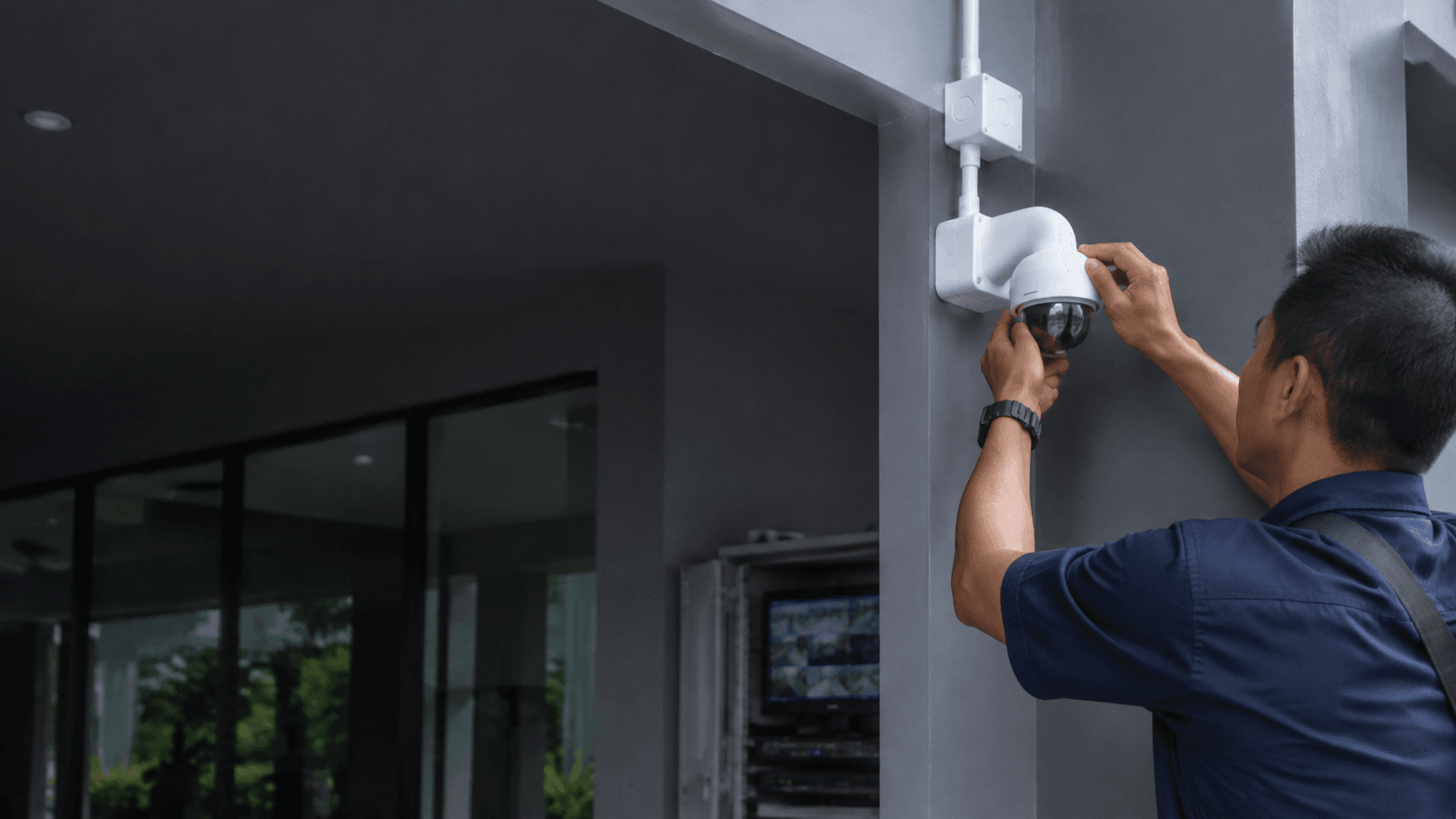
Eyonic's CCTV installation process runs through site survey, system proposal, installation and handover, and the company has completed work for the Kuching Immigration Office covering arrival flow, staff areas, visitor movement and dependable daily operation. That project illustrates the gap between a product rating and a working system: the rating covers the camera, while the installation covers coverage angles, recording configuration and remote viewing access.
Practical Considerations for Consumer Reports Security Cameras Buyers
Three constraints tend to decide whether a well-rated camera works out in practice: storage cost over time, network capacity, and the difference between consumer and commercial requirements.
Storage is the most common source of surprise. Consumer Reports has published dedicated guidance on cameras without a mandatory subscription, which signals how often buyers discover that the features they wanted sit behind a recurring fee. Local storage on a microSD card or a base station avoids the monthly cost but introduces a different risk: if the camera or card is removed, the footage goes with it. Cloud storage protects against that but adds a recurring charge for as long as the system is in use.
Network capacity is the second constraint. Multiple cameras streaming simultaneously place sustained load on a home network, and the practical symptom is dropped frames or delayed alerts rather than a complete failure. Checking WiFi coverage at each mounting point before purchase is cheaper than adding access points afterwards.
The third constraint is scale. A single home camera and a multi-camera commercial installation have different requirements for recording retention, user permissions and backup entry. Eyonic's product guidance notes that smart locks work best when door condition, user roles and backup method are reviewed before installation, and that for business use the choice between a standalone smart lock and an access-control panel should be assessed first. The same logic applies to camera systems: a residential package and a commercial deployment are not interchangeable.
What do the numbers look like in practice
Published project budgets give a sense of scale for commercial work. Eyonic lists an approximate budget of RM 12,000 to RM 28,000 for the Kuching Immigration Office project and RM 8,000 to RM 18,000 for the KTA Sarawak Sdn Bhd office project. Eyonic's published packages for camera, alarm and autogate work are each listed at RM 1,599. These figures describe Eyonic's own projects and packages in Sarawak and are not derived from Consumer Reports testing.
Making an Informed Choice About
The most useful way to use the ratings is as a shortlist filter rather than a final answer. Start with the category that matches the property, narrow to models that performed well on the dimensions that matter most for that position, then check the storage model and the recurring cost before committing.
Two questions resolve most remaining uncertainty. The first is whether the camera's best features require a subscription; if they do, the total cost over the intended ownership period is the relevant figure, not the purchase price. The second is whether the mounting position supports the camera's power and network requirements; if it does not, the rating is irrelevant until those constraints are solved.
For readers in Sarawak who want the installation side handled alongside the product choice, Eyonic can be reached on WhatsApp at +60 11-5111 7959 with the property location, property type and required system. The company's founder, Eric Yong, has worked in the industry for more than 10 years, with a focus on technical installation of digital security solutions for commercial businesses in Sarawak.
Consumer Reports remains the reference point for independent camera testing, and its buying guide is the most efficient starting document for anyone working through camera type, power source, WiFi coverage, storage plans and privacy in sequence. The ratings answer which cameras performed well under test. The installation answers whether a given camera performs well at a given address.