
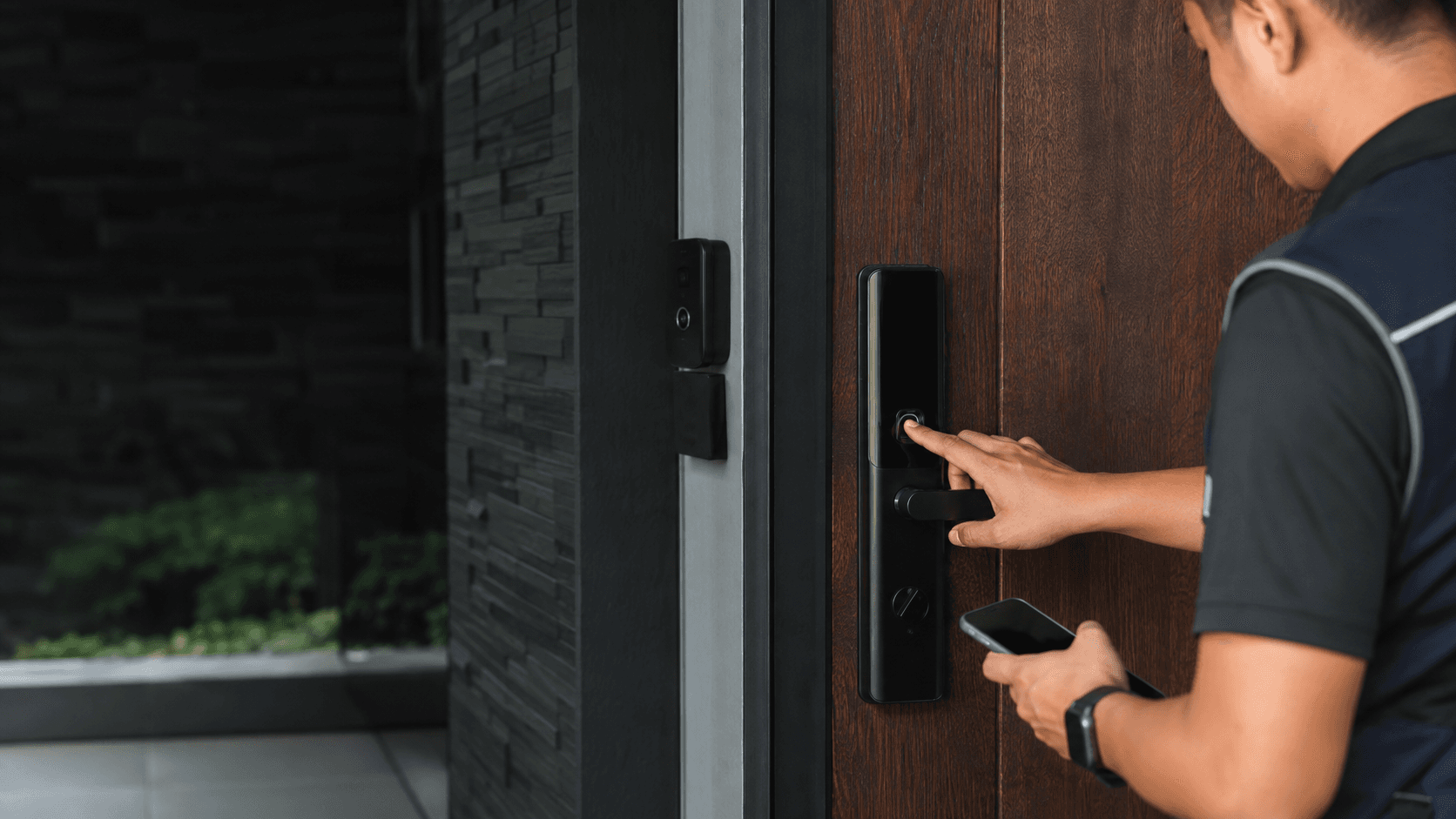
A lock with deadbolt is a primary security upgrade for exterior doors in Malaysian homes and offices. Unlike a standard spring latch that can be shimmied open, the deadbolt's hardened bolt extends deep into the strike plate, making kick-in attempts and lock manipulation considerably harder. This article explains how a lock with deadbolt works, the main types available, what security grades mean, and what to check before installation.
How a Lock With Deadbolt Works
The core mechanism is simple. Turning the key or thumb turn rotates a cylinder, which drives a rectangular bolt out of the door edge and into a recessed strike plate mounted on the frame. When fully extended, the bolt typically protrudes about 25 mm, which is enough to resist prying tools and physical force.
The main security advantage over a spring latch is that the bolt has no angled surface. A credit card or thin tool cannot push it back because the bolt face is flat and moves only when the cylinder rotates. This makes a lock with deadbolt the standard recommendation for perimeter doors where break-in resistance matters.
Types of Deadbolt Locks
Deadbolts fall into several categories based on how they are operated and where they are used.
**Single cylinder deadbolt.** This is the most common residential type. It has a key cylinder on the outside and a thumb turn on the inside. The thumb turn allows quick exit without a key, which is important for fire safety. This type suits most home entry doors where no glass is within arm's reach of the thumb turn.
**Double cylinder deadbolt.** This type requires a key on both sides. It eliminates the thumb turn, so a burglar who breaks a nearby window cannot reach in and unlock the door. The trade-off is slower exit during an emergency, and some fire safety regulations restrict double cylinder use on residential egress doors. This type fits doors with glass panels or sidelights where the thumb turn would be accessible.
**Keyless and smart deadbolts.** These replace the key cylinder with a keypad, fingerprint reader, or mobile app control. A smart deadbolt still uses the same bolt mechanism but adds convenience for managing access. Eyonic's product review notes that smart locks work best when the door condition, user roles, and backup method are reviewed before installation. For business use, Eyonic usually checks whether a standalone smart lock or an access-control panel is more appropriate.
**Mortise deadbolts.** These are built into a larger lock body recessed into the door edge. They are common on commercial doors and heavier residential doors. The mechanism is more complex and typically requires professional installation.
Security Grades and Standards
Deadbolt security is commonly rated using the ANSI/BHMA grading system, which tests locks for durability, strength, and security.
**Grade 1** is the highest residential and commercial grade. It is rated for heavy use and offers the strongest resistance to forced entry. Grade 1 deadbolts are recommended for exterior doors in commercial settings and high-security homes.
**Grade 2** is rated for light commercial or heavy residential use. It provides good security at a lower cost than Grade 1.
**Grade 3** is the minimum standard for residential deadbolts. It meets basic security needs but offers less resistance to physical attack and wear over time.
The grade affects both the bolt strength and the internal mechanism's durability. A Grade 1 lock with deadbolt typically uses a heavier bolt and a reinforced housing, which matters for doors that see frequent use or face higher security risks.
Installation Considerations
Proper installation determines whether a lock with deadbolt performs as intended. A high-grade lock fitted to a weak door or a poorly aligned strike plate will not stop a determined intruder.
- Measure the door thickness and the existing bore hole diameter to confirm the new deadbolt matches the door preparation.
- Check the backset, which is the distance from the door edge to the center of the bore hole; standard backsets are 60 mm or 70 mm.
- Align the deadbolt body with the latch hole on the door edge and secure it with the mounting screws.
- Install the exterior and interior cylinders, ensuring the bolt retracts and extends smoothly when the key or thumb turn is operated.
- Close the door and mark the bolt position on the frame, then chisel out the strike plate recess so the bolt seats fully.
- Install the strike plate with long screws that reach into the wall framing, not just the door frame trim.
- Test the lock several times, checking that the bolt enters the strike plate without rubbing and that the door closes without forcing.
The strike plate is often the weakest point. Standard strike plates come with short screws that pull out under force. Replacing them with longer screws that anchor into the wall stud significantly improves kick-in resistance. Eyonic's installation process for security systems includes a site survey before any work begins, which is a useful model for assessing door condition before committing to a lock upgrade.
Maintenance and Troubleshooting
A lock with deadbolt needs periodic attention to keep operating smoothly in Malaysia's climate. Humidity and dust can affect the cylinder and bolt movement.
Lubricate the cylinder and bolt mechanism once or twice a year with a dry graphite or PTFE lubricant. Avoid oil-based sprays, which attract dust and can gum up the mechanism over time. If the key becomes hard to turn, the issue is often dirt inside the cylinder rather than a worn lock.
A sticking bolt usually means misalignment between the bolt and the strike plate. Check whether the door has sagged on its hinges, which shifts the bolt position. Tightening hinge screws or adjusting the strike plate position usually resolves this. If the thumb turn feels loose, the internal spindle may need replacement, which is a straightforward repair for most standard deadbolts.
For smart deadbolts, battery life is the main maintenance concern. Low batteries can cause intermittent failures, so replacing batteries on a fixed schedule is more reliable than waiting for a warning. Eyonic's guidance on smart locks emphasizes reviewing the backup method before installation, which applies here: a physical key override is essential if the electronic mechanism fails.
Choosing a Lock With Deadbolt in Malaysia
Selecting the right lock with deadbolt depends on the door type, the security risk, and how the property is used. Malaysian residential doors are commonly made of timber or metal, and the door construction affects which deadbolt can be fitted.
For a standard timber home door, a Grade 2 single cylinder deadbolt offers a good balance of security and cost. For doors with glass panels or sidelights, a double cylinder or a keyless deadbolt removes the risk of someone reaching through broken glass to turn the thumb lock. For office or shop entrances, a Grade 1 deadbolt or a mortise lock provides the durability needed for frequent daily use.
Eyonic's project experience includes practical security setups for the Kuching Immigration Office and KTA Sarawak Sdn Bhd, an engineering consultancy. Both projects focused on staff movement, visitor handling, and dependable daily operation. These priorities mirror what a lock with deadbolt must deliver: reliable access control for the people who use the door regularly, without creating bottlenecks or security gaps.
The door frame condition matters as much as the lock itself. A solid lock with deadbolt is only as strong as the frame it mounts into. Check for soft timber, rusted metal, or gaps between the door and frame before installation. If the frame is weak, reinforcing it with a security plate or replacing the frame section should happen at the same time as the lock installation.
Eyonic's CCTV installation process follows a sequence of site survey, system proposal, installation, and handover. A similar approach applies to deadbolt selection: assess the door and its surroundings, decide on the lock type and grade, install it correctly, and test the finished result. For properties that already have a security camera or alarm system, a deadbolt complements these measures by addressing the physical entry point directly.