
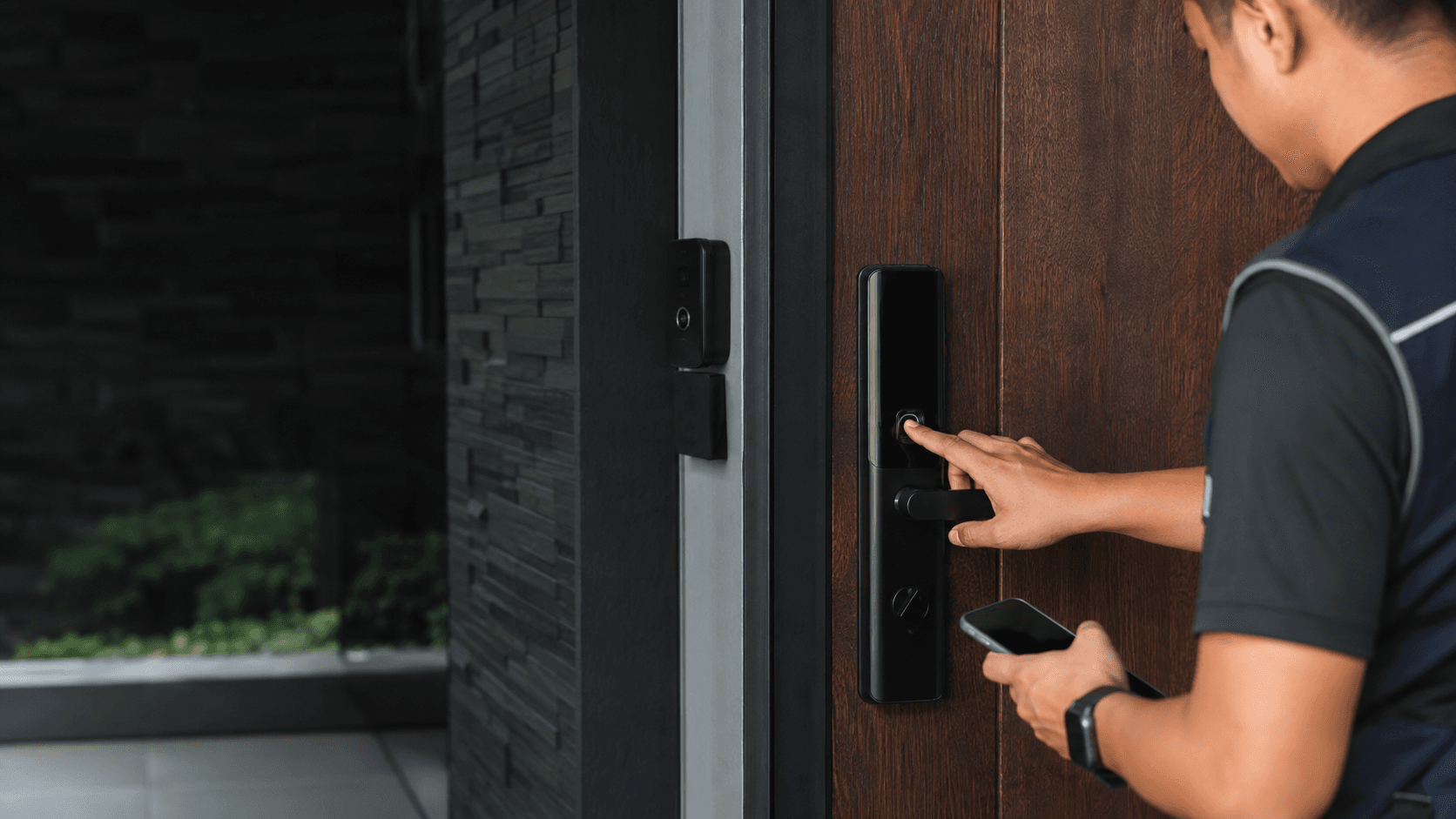
Wi-Fi is the part that lets a lock talk to an app or a smart home platform without a separate hub in the room. The lock itself still does the physical work: it reads a credential, decides whether that credential is valid, and drives the bolt. Everything else — notifications, remote unlock, temporary codes for a cleaner or a tenant — depends on that network link staying alive.
That distinction matters when comparing units. A lock can be excellent at fingerprint access and keypad entry and still be a poor fit for a particular door, or a poor fit for a shop with rotating staff. The sections below work through the connection, the door, the people who need access, and what happens when power or network drops.
Digital Door Lock Wifi. What the Connection Actually Does
Wi-Fi connectivity changes three things in practice. It removes the need for a bridge device plugged into a router, it allows the lock to report events to an app while the property is empty, and it allows a credential to be issued or revoked without standing at the door.
Remote lock control is the headline feature, but the more useful daily function is usually the record. A lock that logs which credential opened the door, and when, gives a shop or office a simple account of movement. That is the same reason access control matters on commercial sites, where staff movement and visitor handling need to be visible rather than assumed.
Smart home integration sits on top of this. Whether a specific unit works with a particular platform is a per-model question, and the honest answer is that it has to be checked against that model's own documentation before purchase. Platform support is not a category-wide guarantee.
Where Wi-Fi helps and where it does not
Wi-Fi earns its place on a rental unit where the owner is not on site, on a shop where the person opening up changes week to week, and on an office where the last person out should not be carrying a physical key. It adds less on a single interior door inside an occupied home, where a keypad or fingerprint reader alone covers the same need without a network dependency.
The trade-off is dependency. A lock with no network link still opens with a code or a finger. A lock whose main convenience is remote control loses that convenience the moment the router or the internet connection fails, which is why backup entry is a planning item rather than an afterthought.
How a Wi-Fi Digital Door Lock Fits Malaysian Doors
Door condition decides more installations than lock features do. A digital door lock wifi unit is built for a specific door preparation, and a door that does not match that preparation cannot be made to match by adjusting settings in an app.
Three physical questions come before any model comparison. What is the door made of — solid timber, metal, glass, or a hollow-core panel? How thick is the door leaf at the point where the lock body sits? And what is already cut into the door edge: an existing mortise pocket, a cylindrical bore, or nothing at all?
A door that already carries a mortise lock has a pocket and a backset that a replacement body may or may not match. A door with a cylindrical bore suits a different family of hardware. A metal gate or grille is a separate category again, and often pairs better with an autogate or intercom arrangement than with a domestic lock body.
Rental properties add a constraint that owners feel later: any cutting is permanent. A lock installed on a door that must be returned to its original state at the end of a tenancy is a different decision from one installed on an owned home.
What to measure before choosing a unit
Door thickness at the lock position, the distance from the door edge to the centre of the existing hole, and the width of the door stile all matter. So does the frame. a lock that throws a bolt needs a strike plate that lines up, and a frame that has already been cut for a different lock may need work.
These are the numbers a supplier needs before quoting anything meaningful. Without them, a recommendation is a guess about a door nobody has seen.
Access Methods and User Roles on a Digital Door Lock Wifi
Access methods are the ways a person proves they are allowed in. Most Wi-Fi locks combine several, and the useful question is not which method is best but which combination matches the people who actually use the door.
- Fingerprint access, which suits a small fixed group such as a household or a two-person office.
- Keypad entry with a shared or individual PIN, which suits staff who change over time.
- Mobile app unlock, which suits remote granting for a visitor or a delivery.
- Physical key or mechanical override, which suits the day the electronics do not cooperate.
- Card or tag access, which suits higher traffic where speed at the door matters.
User permissions are the layer above the methods. A household needs everyone to have full access. A shop needs a manager who can add and remove staff codes, and staff who can only open during working hours. A rental needs a code that expires. A lock that cannot separate these roles pushes the owner back to changing one shared code every time someone leaves, which defeats much of the point.
For business use, the choice between a standalone smart lock and a fuller access-control panel is worth settling early. A standalone lock is simpler and cheaper to run. A panel handles more doors, more roles, and more reporting, and is the better fit once the site has several controlled openings.
Backup entry as a design decision
Every electronic lock needs a way in when the electronics are unavailable. That may be a mechanical key, an external power point, or a second entrance that is not electronically controlled. The method matters less than the fact that it exists and that the right person can reach it at the wrong hour.
Backup entry also has a security side. A mechanical key left in a drawer under the counter is a weaker link than the lock it backs up. Where the backup is kept, and who knows about it, belongs in the same conversation as the user roles.
Power Network and Backup Entry Planning
Two supplies have to hold. electricity at the lock and a working network path to the app. Both fail eventually, and the plan should assume they will.
Battery-powered locks avoid a cable run to the door, which is often the difference between a straightforward installation and a disruptive one. The cost is a maintenance routine — someone has to notice the low-battery warning and act on it before the lock stops responding. Mains-powered units remove that routine but add a cable and a point of failure that a power cut will find.
On the network side, the lock needs a signal at the door, not at the router. A door at the far end of a shop, behind a metal frame, or in a basement is a different radio environment from a door beside the router. Signal strength at the exact lock position is worth checking rather than assuming.
What a specific lock does during an outage is a per-model behaviour and should be confirmed against that model's documentation. The general planning principle holds regardless: the door must remain usable, and the people who need to get in must know how.
Choosing between a lock and a wider system
A single Wi-Fi lock is a reasonable answer for one door with a small, stable group of users. Once a site has several controlled doors, mixed user types, or a need to review movement across entrances, a lock-by-lock approach becomes harder to administer than a system designed for it.
That is the same judgement that applies to other entry points on a property. A gate, a lobby intercom, and a main door each solve a different part of the same problem, and treating them as one plan usually produces a tidier result than adding devices one at a time.
Installation Sequence
Installation is not a single visit. The sequence below reflects how a security installation is normally run, from the first look at the site through to the point where the people using the door know how to use it.
- Site survey, covering the door, the frame, the power available, the network signal at the door, and the people who need access.
- System proposal, setting out the recommended unit or units, the access methods, the user roles, and the backup arrangement.
- Installation, including any door preparation, mounting, wiring where required, and configuration of credentials and permissions.
- Handover, where the users are shown how to open the door, add or remove a user, and what to do when the lock does not respond.
The survey is the step that prevents most problems. A lock chosen before the door has been measured is a lock chosen on hope. The same principle applies across security work: checking actual conditions on site before confirming a placement or a specification is what keeps the installed result close to the plan.
Handover is the step most often skipped. A lock that nobody has been shown how to administer tends to drift back to a single shared code within a month, which removes the reporting and role separation that justified the purchase.
Costs Handover and Next Practical Step
Pricing for a digital door lock wifi unit and its installation in Malaysia varies with the unit, the door work required, and whether the site needs one door or several. Published package pricing exists for other security work — a Hikvision CCTV package, a Hikvision alarm system, and an autogate package are each listed at RM 1,599 — but those figures cover different systems and should not be read as lock pricing.
For larger access and monitoring work, completed projects give a sense of scale. A public office project in Kuching carried an approximate budget of RM 12,000 to RM 28,000, and an engineering consultancy office project in Kuching carried an approximate budget of RM 8,000 to RM 18,000. Both covered wider security scope than a single door lock.
What a buyer can control is the quality of the brief. Door measurements, the number of users and their roles, whether the property is owned or rented, and whether the door must stay usable during a power or network failure are the inputs that turn a vague enquiry into a workable recommendation.
Eyonic Sdn Bhd plans, supplies and installs security and ELV systems in Sarawak, including smart lock door access, and has completed projects for government and engineering consultancy clients. Smart locks work best when door condition, user roles and backup method are reviewed before installation, and for business use the choice between a standalone lock and an access-control panel is worth settling at that stage.
Share the location, property type and required system with Eyonic on WhatsApp at +60 11-5111 7959 for the next practical step.