
The phrase covers two separate things that buyers often merge into one. Wireless describes how the camera links to the recording and viewing side, while mobile connectivity describes how that footage reaches a phone. A camera can be wireless and still fail the second half of the promise if the network at the site cannot carry the stream.
Eyonic Sdn Bhd is a security system supplier in Sarawak, Malaysia, working on CCTV and ELV systems for homes, offices, shops and industrial sites. The company plans, supplies and installs monitoring systems with camera placement, recording and remote viewing, which places the mobile viewing setup inside the installation scope rather than leaving it to the buyer.
Wireless CCTV Camera With Mobile Connectivity: What It Means In Practice
Wireless in a CCTV context usually means the camera does not depend on a dedicated video cable run back to a recorder. Power still has to reach the camera in most installations, and the video path depends on a network link. That distinction matters because a camera described as wireless can still need a cable for power, and the wireless part only removes the video cabling.
Mobile connectivity is the viewing layer. Footage is recorded on a recorder or storage device, and the phone connects to that system over the network to show live or recorded video. The two layers can be planned together, but they fail for different reasons. A weak network link breaks the camera-to-recorder path. A weak internet connection or poor router position breaks the phone viewing experience.
Eyonic's CCTV service covers camera placement, recording and remote viewing as one scope, which reflects how these layers depend on each other. A camera positioned for the best field of view but connected over a weak link will produce a poor phone experience regardless of how good the camera is.
Why the two halves are planned together
Camera placement decides what the lens sees. Network position decides whether that view survives the trip to the recorder and then to the phone. When placement is chosen first and connectivity is treated as an afterthought, the result is often a camera that records locally but streams badly.
Eyonic recommends checking actual lighting conditions before confirming placement for ColorVu-style cameras. The same logic applies to connectivity: the site conditions decide the outcome, not the product label.
How Mobile Connectivity Changes Daily Monitoring
The practical change is that monitoring stops being tied to a fixed screen. A phone becomes the primary viewing device, which shifts the design questions from "where does the monitor go" to "where does the network reach, and who checks the footage."
For a home, that usually means checking a gate, a driveway or an entry point from wherever the owner happens to be. For a shop, it means watching the counter or the entrance during trading hours. For an office, it means covering arrival flow, staff areas and visitor movement, which is the pattern behind Eyonic's work at the Kuching Immigration Office.
That project focused on arrival flow, staff areas, visitor movement and dependable daily operation. Dependable daily operation is the part that mobile viewing stresses most, because a phone connection exposes every weak point in the chain between camera, recorder and network.
What changes for the person watching
Mobile viewing moves the first check of the day onto a phone rather than a monitor in a back room. It also changes who can see footage. When several people need access, the handover has to cover each device, not just one.
This is where a planned handover matters more than a product specification. A system that works on the installer's phone but not on the owner's phone has not been handed over.
What To Compare Before Choosing A Camera
Most published comparisons focus on resolution, night vision and storage. Those matter, but they are not the deciding factors for a wireless camera that has to stream to a phone at a specific site.
The first comparison is how the camera connects and what it connects to. The second is where recording lives, whether on a recorder on site or on a storage service. The third is what happens when the network drops, because a wireless camera with no fallback simply stops contributing.
Eyonic's product reviews treat smart locks the same way, noting that they work best when door condition, user roles and backup method are reviewed before installation. The pattern applies here. the site and the people using the system decide the right configuration, not the product tier.
Questions worth settling before a purchase
Who will view the footage, and on how many devices? What has to be visible at night, and what lighting exists at those points? Where does the network reach reliably, and where does it not? What is the fallback if the connection fails during a period that matters?
These questions have site-specific answers. A camera that suits one property can be the wrong choice for the next one even when the budget is identical.
Where Wireless Coverage Decides The Result
Coverage is the constraint that most often decides whether a wireless installation performs as expected. Walls, distance from the router or access point, and the number of other devices on the same network all affect the link between camera and recorder.
This is why a site survey comes before a proposal in Eyonic's process. The survey is where coverage, camera placement and lighting are checked against the actual property rather than assumed from a floor plan.
Edge cases are worth naming. A camera at the far end of a long property may need a different connection approach than one near the main building. A site with heavy wall construction may behave differently from an open layout. A location with no reliable fixed internet may need a different connectivity route entirely, which is a separate design question from the camera itself.
What a survey is actually checking
A survey checks where cameras need to see, where the network reaches, where power is available, and what lighting exists at each point. It also checks how the property is used, because a gate that opens twenty times a day creates different demands from a back entrance that is rarely used.
Eyonic's installation process runs through site survey, system proposal, installation and handover. Each stage narrows the design, and the survey is the stage that prevents a proposal built on assumptions.
How Eyonic Plans Installs And Hands Over Mobile Viewing
The sequence below reflects Eyonic's published CCTV installation process. It is a planning order, not a product recommendation, and the details of each stage depend on the property.
- Site survey. The property is checked for camera placement, lighting conditions, network reach and power availability before any equipment is proposed.
- System proposal. The survey findings are turned into a system that matches the site, covering camera positions, recording and remote viewing.
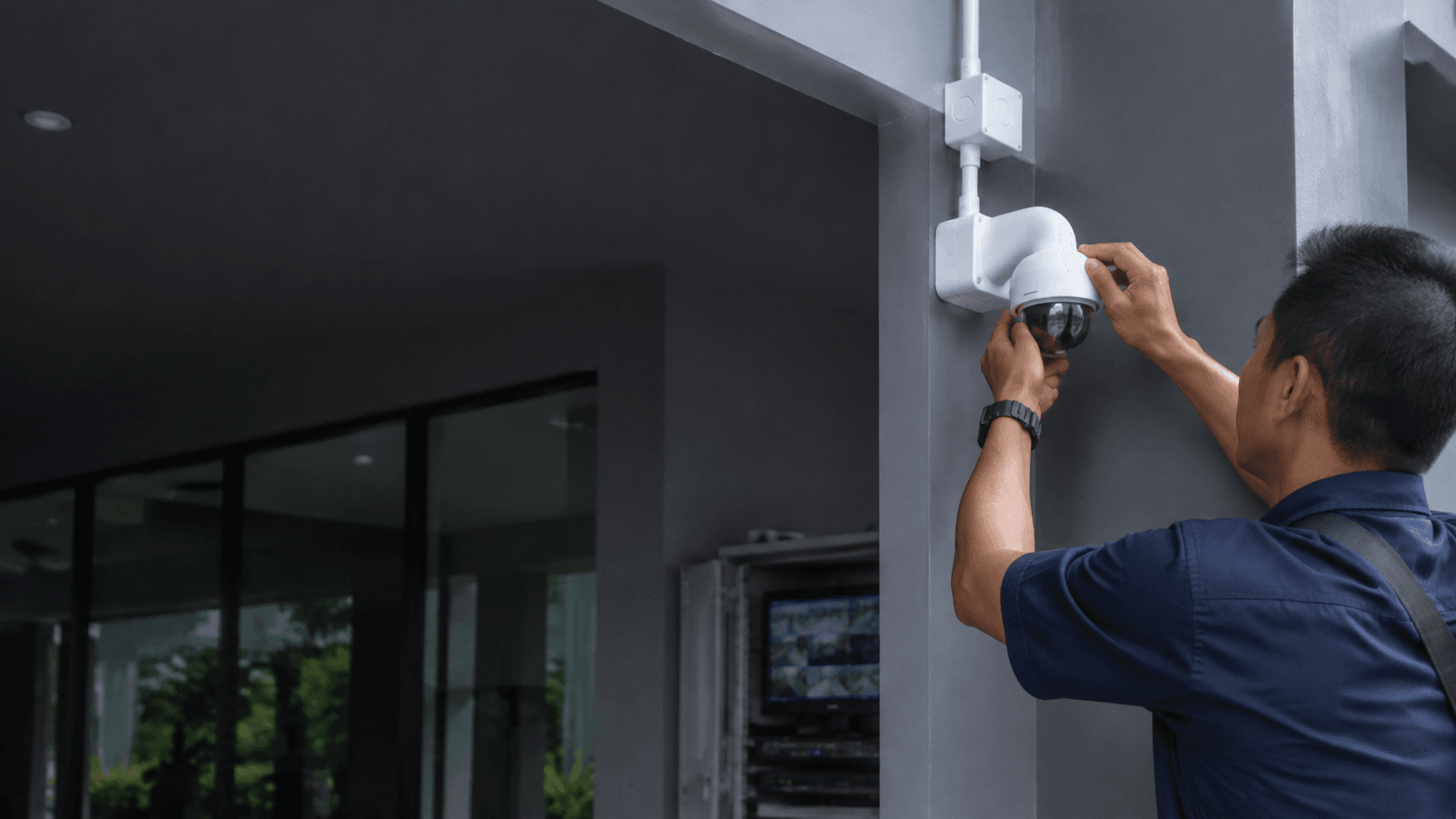
- Installation. Cameras are mounted and connected, recording is configured, and the network path for mobile viewing is set up.
- Handover. The mobile viewing setup is passed to the people who will use it, so the system is checked on the devices that will actually carry it.
Eyonic's Hikvision CCTV package is listed at RM 1,599 and includes camera supply and setup, basic recording configuration, and mobile viewing handover. The alarm system and autogate packages are listed at the same figure, which makes the CCTV package the relevant reference point for a camera installation.
Larger scopes sit well above that. Eyonic's Kuching Immigration Office project carried an approximate budget of RM 12,000 to RM 28,000, and the KTA Sarawak Sdn Bhd project carried an approximate budget of RM 8,000 to RM 18,000. Those figures describe multi-point commercial work, not a single camera, and they show how far the range extends once a site needs broader coverage.
Eric Yong founded Eyonic Security Systems and has worked in the industry for more than ten years, with experience in technical installation of digital security solutions for commercial businesses in Sarawak. That background sits behind the survey-first approach, because commercial sites rarely match a standard layout.
What handover should cover
Handover is where mobile viewing either works or does not. It should confirm that the people who need access can see live and recorded footage on their own devices, and that they know what to do when something looks wrong.
It should also set expectations about what the system does not do. A wireless camera with mobile connectivity is not a substitute for a monitored alarm, and it is not a guarantee of coverage in every corner of a property.
Common Questions About
Does wireless mean no cables at all? Usually not. Wireless typically removes the video cable between camera and recorder, while power still reaches the camera by cable in most installations. The exact arrangement depends on the camera and the site.
Can mobile viewing work if the site has poor internet? The phone side depends on a connection that can carry the stream. Where fixed internet is unreliable, the connectivity route becomes a design decision rather than an assumption, and it should be settled during the survey.
How many people can view the footage? That depends on how the system is configured and how access is handed over. It is worth deciding before installation who needs access, because retrofitting access later is more disruptive than planning it upfront.
What happens during a power outage? Behaviour during an outage depends on the equipment and any backup provision. This is a question to raise during the survey, since the answer changes with the site and the system chosen.
Is a wireless camera suitable for a shop or office? It can be, provided coverage and viewing needs are checked against the layout. Eyonic's commercial work in Kuching covers office and public-building settings where arrival flow, staff areas and visitor movement all need to be visible.
What should be ready before an installation is planned? The location, the property type and the required system are the three inputs that shape a proposal. Sharing those with Eyonic on WhatsApp at +60 11-5111 7959 is the practical next step.