
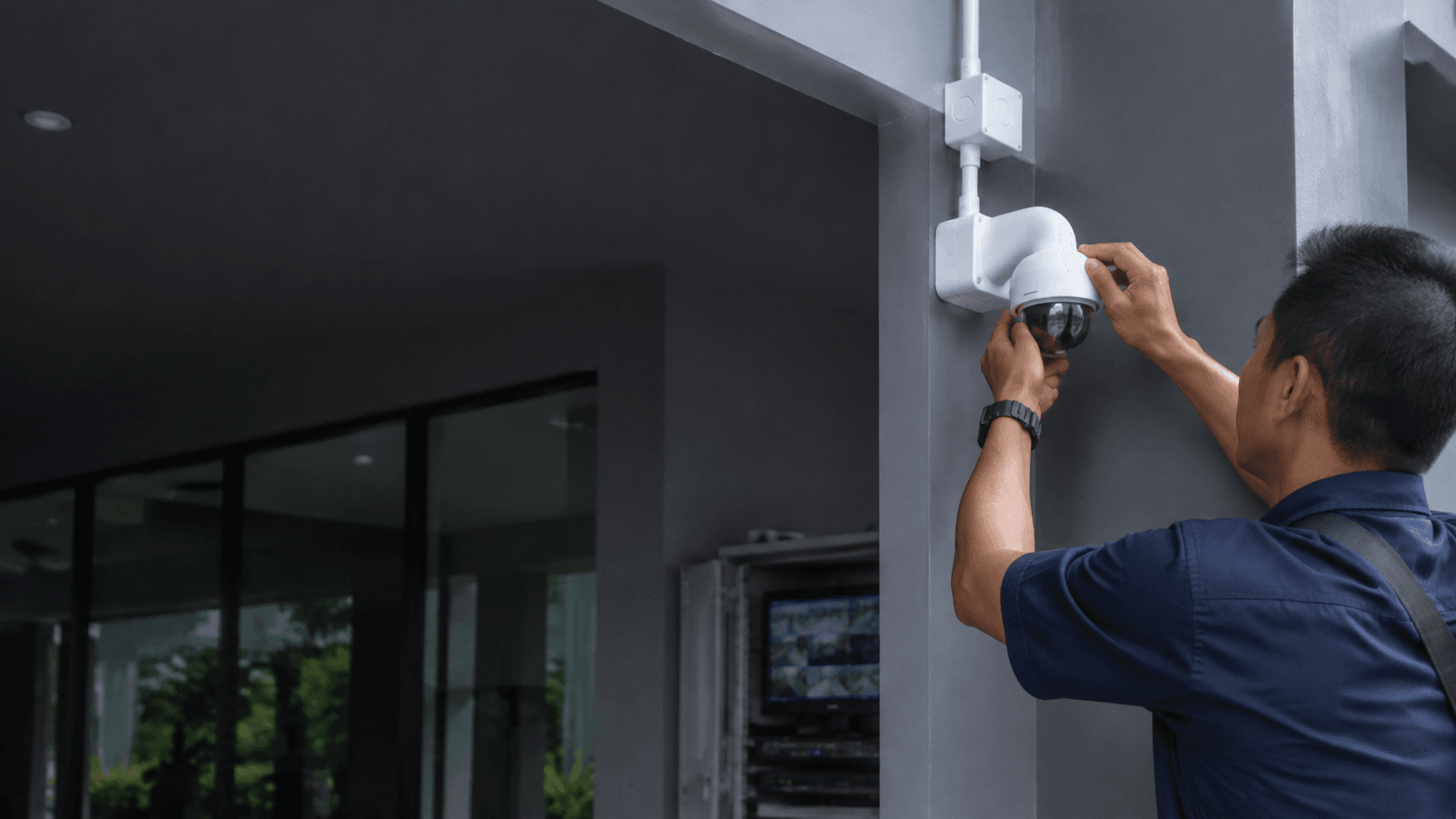
The exact-match query "360 outdoor camera" describes a category rather than a single product. Buyers in Malaysia usually arrive with one of two jobs in mind: watch a wide open area with as few devices as possible, or follow movement across a large compound. Those two jobs pull toward different hardware, and the choice affects cabling, recording load, and how much of the scene stays sharp.
360 Outdoor Camera: What Matters Before You Choose
Coverage shape is the first decision. A fisheye lens bends a very wide field onto one sensor, so a single unit can watch a room or a yard corner without a second camera. A pan-tilt-zoom unit rotates and zooms, so it can follow a subject but cannot watch every direction at the same moment.
Both designs sit inside the wider family of 360-degree fisheye and panoramic IP security cameras, alongside dual-head and multisensor models that stitch several views together. The practical difference is not the number printed on the box. It is whether the scene needs constant total coverage or active tracking.
Resolution spreads across the field of view. A very wide image divided across one sensor leaves fewer pixels per metre at the edges, so a face or plate near the frame boundary can be softer than the same subject in the centre. That trade-off is the main reason a wide camera sometimes needs a second, narrower camera beside it.
Choosing the Right 360 Outdoor Camera
A short sequence keeps the decision grounded in the site rather than the catalogue.
- Define the area to watch and note where the boundary, gate, or entry point sits.
- Decide whether the scene needs constant total coverage or active tracking of movement.
- Check the real lighting at the mounting point across a full day, including the hours after dark.
- Confirm power and network reach, since a wide camera still needs a cable or a stable wireless link.
- Match recording capacity to the resolution and frame rate the wide view will actually run at.
- Confirm the mounting height and angle, because a fisheye view changes shape with height.
- Test the live view and playback before handover, including remote access from a phone.
Eyonic's CCTV installation process follows site survey, system proposal, installation, and handover, which places the survey before any hardware is fixed. That order matters for wide cameras because the mounting point decides how much of the scene is usable.
What is 360 outdoor camera coverage in practice?
Coverage means the area the lens can resolve, not the area it can technically see. A wide view that reaches a far fence line may still not identify a person at that distance. Useful coverage is the zone where detail holds up under the lighting that exists at night.
Fisheye or pan-tilt-zoom
A fisheye panoramic camera holds one fixed wide view and never misses a direction inside its field. A pan-tilt-zoom camera moves, so it can zoom into a detail but leaves the rest of the scene unmonitored while it is pointed elsewhere. Sites that need both usually combine a wide fixed unit with a narrower or movable one.
360-Degree Fisheye And Panoramic IP Security Cameras
Fisheye and panoramic cameras are network devices, so they stream over IP and record to a recorder or a storage platform. The wide image is often dewarped in software, which flattens the curve into a normal-looking view or splits it into several panels.
Dewarping costs processing. A recorder handling several wide streams at high resolution needs enough throughput, and storage fills faster when the image carries more pixels. Multi-sensor models reduce the distortion problem by using several lenses and stitching their views, at the cost of a larger housing and more cabling.
Outdoor use adds housing and sealing requirements. A camera rated for outdoor mounting still needs a sheltered angle where rain does not sit on the lens and where direct low sun does not wash out the view at the same hour every day.
Are panoramic security cameras suitable for outdoor and indoor use?
Yes, panoramic security cameras are suitable for both outdoor and indoor use. The same wide view that watches a yard corner also covers an office floor or a shop aisle, provided the housing suits the location and the lighting is checked at the actual mounting point.
Placement rules that hold up
Height changes the shape of a fisheye view. Mounting too low pushes the useful detail toward the ceiling or sky, while mounting very high compresses the ground plane. Corners and ceiling centres are common because they put the widest part of the view across the area that matters.
Lighting is the other constraint. Eyonic recommends checking actual lighting conditions before confirming placement for ColorVu-style cameras, and the same discipline applies to any wide outdoor unit, because a view that looks clean at midday can lose detail after dark.
Practical Considerations for Projects
Bandwidth and storage are the quiet costs. A wide high-resolution stream produces more data than a narrow one at the same settings, so the recorder, the network link, and the retention period all need to match the chosen resolution.
Power and connectivity decide where the camera can go. Wired network cameras need a cable run to the mounting point, while wireless units depend on signal strength at that exact spot. A wide camera placed for coverage but reached by a weak link will drop frames rather than improve the view.
Maintenance is modest but real. The dome or lens needs cleaning, the dewarped view needs checking after any firmware change, and the recording schedule needs confirming so the retention period still covers the site's needs.
Where a wide camera fits well
Open compounds, shop floors, warehouse aisles, office reception areas, and building corners suit a wide view because the scene is broad and the important activity is spread across it. A single wide unit can replace several narrow cameras in those spaces and reduce the number of cable runs.
Where it fits poorly
Long narrow corridors, distant gate lines, and number-plate capture are weak matches. Those scenes need reach and detail rather than breadth, so a narrow or zoomed camera does the work better. A wide camera can still cover the approach while a second unit handles identification.
Making an Informed Choice About Hardware
The decision usually comes down to whether the site needs total coverage or targeted detail. A wide fixed camera answers the first need with fewer devices. A movable camera answers the second but leaves gaps while it moves. Many sites end up with both, which is a design choice rather than a compromise.
Budget planning benefits from treating the camera as one line among several. Cabling, recorder capacity, mounting hardware, and installation time all scale with the site, and a wide camera can reduce camera count while increasing the resolution and storage demand per device.
Eyonic's published package pricing lists a Hikvision CCTV package at RM 1,599 covering camera supply and setup, basic recording configuration, and mobile viewing handover. That figure describes a package scope rather than a wide-camera project, so it is a starting reference rather than a quotation for a specific site.
Completed work gives a sense of how these projects are scoped. Eyonic supported the Kuching Immigration Office with a focus on arrival flow, staff areas, visitor movement, and dependable daily operation, and supported KTA Sarawak Sdn Bhd with an office setup covering staff movement, visitor handling, tidy cabling, and clearer daily site control. Both are public-office and consultancy environments where coverage and cable discipline mattered more than a single dramatic camera.
For sites in Sarawak, the practical next step is a survey that fixes the mounting points, checks the lighting at those points, and confirms power and network reach before any hardware is ordered. Sharing the location, property type, and required system with Eyonic on WhatsApp at +60 11-5111 7959 gives the survey a starting brief.
Common questions
Does a 360 outdoor camera really see everything? It sees everything inside its field of view, but detail falls away with distance and at the edges of a very wide image. Blind spots can still exist directly below the housing or behind an obstruction.
Is one wide camera cheaper than several narrow ones? Often the camera count falls, but resolution, recorder capacity, and storage per device rise. The net cost depends on how much detail the site needs at the far edges of the view.
Can a wide camera work at night? It can, provided the lighting at the mounting point is checked first. Wide views spread available light across more of the frame, so the night result depends on the scene rather than the specification alone.
Does a wide view replace a recorder? No. The camera produces the image, and a recorder or storage platform holds it. Retention length and playback depend on that recording layer.