
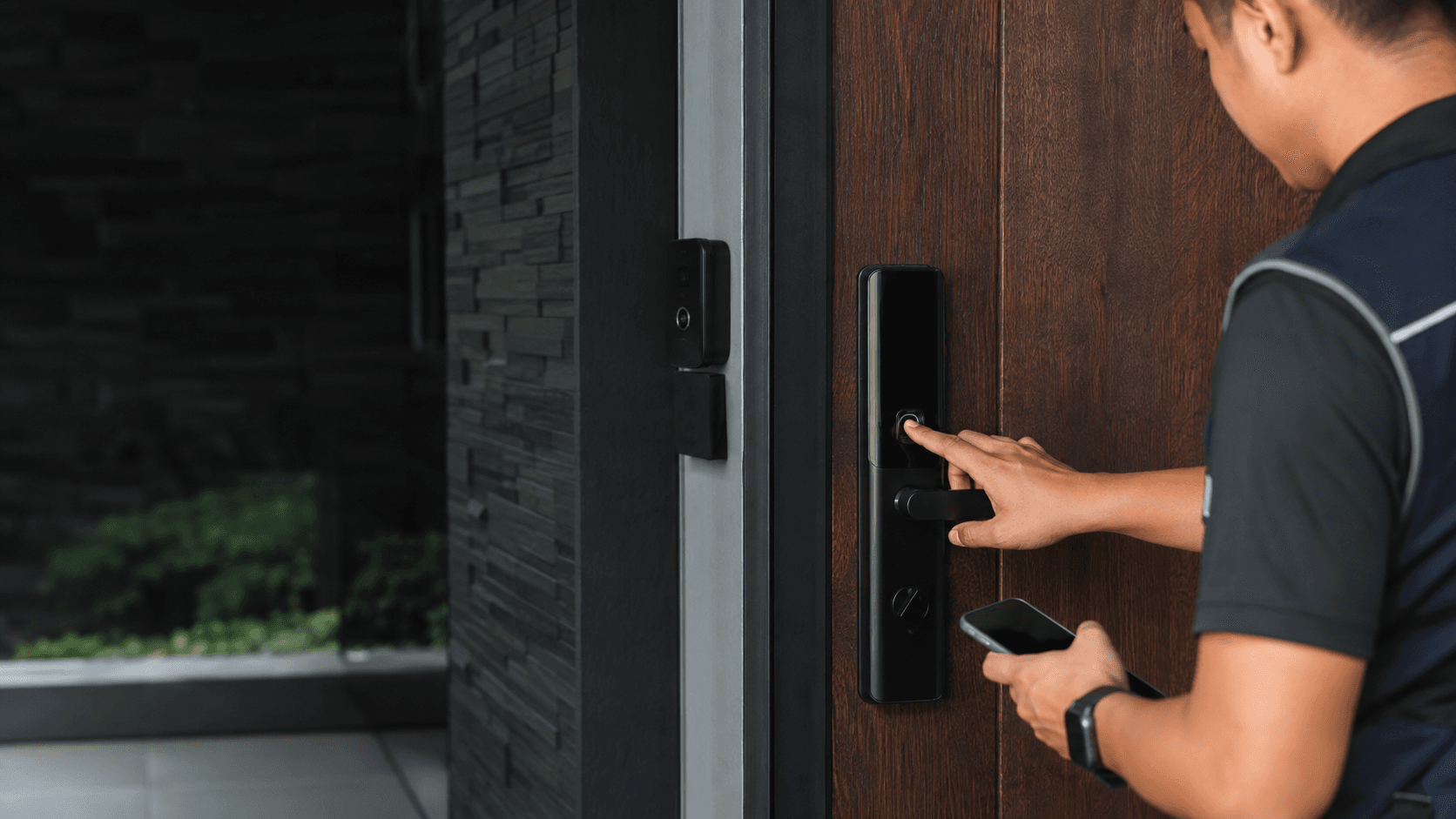
The exact-match query "fingerprint door entry" is the subject here, and the useful question is not whether the technology exists but whether it suits a specific door, a specific group of users and a specific failure plan. Across nine competitor pages analysed for this topic, none used the complete query in the H1 and none carried the main entity in the body at the measured counts, so the phrase is effectively unclaimed. That leaves room for a grounded explanation rather than another product listing.
Fingerprint Door Entry. What to Check Before You Install
Most failed installations are not reader failures. They are door, user or backup failures that were never checked before the hardware was ordered. A short pre-installation review catches them.
- Confirm the door type, thickness and existing cutout, because a lock body that does not match the door cannot be forced into service.
- List who needs entry and what each person is allowed to reach, since staff, visitors and contractors rarely share one permission level.
- Decide the backup entry method before installation, not after the first lockout.
- Agree what happens during a power or battery failure, including whether the door fails open or stays closed.
- Confirm who handles handover, user enrolment and ongoing support after the installer leaves.
Eyonic's own installation process follows site survey, system proposal, installation and handover, which is the same sequence that suits access-control work. The survey stage is where door condition and user roles get settled.
How Fingerprint Door Entry Reads a Finger and Releases the Door
A fingerprint reader captures an image of the ridge pattern, converts it into a mathematical template, and compares that template against stored records. When the comparison passes the threshold set by the manufacturer, the reader sends a release signal to the locking hardware.
The locking hardware is the part most buyers overlook. A standalone smart lock contains both the reader and the lock body in one unit, so the release signal stays inside the door. A wider access control setup separates the reader from a control panel and an electric lock, which allows one system to manage several doors and one set of user records.
That separation is the main architectural difference between consumer hardware and building access control. It also explains why a reader that works perfectly on a single office door may not be the right choice for a site with multiple entry points and shared user lists.
Why wet or dirty fingers matter
Optical and capacitive readers depend on a readable ridge pattern. Moisture, oil, dust and abrasion reduce the quality of that pattern, and a reader that cannot capture a usable image cannot complete a match. This is a real operating condition in Malaysia rather than a theoretical edge case, particularly for outdoor gates, workshops and food-handling areas.
The practical response is to plan a second credential from the start. A keypad code, a card or a mechanical key gives a person a way in when the finger will not read, without requiring anyone to bypass the door.
Fingerprint Door Entry Compared With Keypad, Card and Key Access
Each credential type trades convenience against control in a different way, and the right answer often combines two of them on the same door.
A mechanical key cannot be revoked once copied and leaves no record of who entered. A keypad code can be changed when someone leaves, but codes get shared and observed. A card or fob is fast and easy to issue, but it can be lent or lost. A fingerprint cannot be handed to another person, which is its main advantage for staff and contractor access.
The trade-off is that a fingerprint is not replaceable. If a finger is injured, bandaged or temporarily unreadable, the person needs another way in. That is why backup entry is a design requirement rather than an optional extra, and why a mixed-credential door usually outperforms a single-method door in daily use.
Standalone smart lock or access control panel
Eyonic's own product guidance notes that smart locks work best when door condition, user roles and backup method are reviewed before installation, and that for business use the usual check is whether a standalone smart lock or an access-control panel is more appropriate.
A standalone smart lock suits a single door with a small, stable user group: a home, a small office, a shop back door. An access control panel suits multiple doors, changing user lists, shared records and a need to review who entered where. Choosing the panel route for one door adds cost and complexity without adding control. Choosing the standalone route for a busy multi-door site creates separate user lists that nobody can reconcile.
Door Condition, User Roles and Backup Entry Before Any Fingerprint Door Entry Decision
Door condition decides whether the hardware can be fitted at all. Frame alignment, existing bore holes, door thickness and the presence of a closer all affect which lock body will work. A door that does not close cleanly will not become reliable because a reader was added to it.
User roles decide how the system is configured. A home needs a handful of permanent users. An office needs staff with full access, cleaners with time-limited access and visitors with escorted entry. A shop needs staff access plus a way to let deliveries in without leaving a door unlocked. A site with contractors needs credentials that can be issued and revoked on a schedule.
Backup entry decides what happens on the worst day. The plan should name the method, the person who holds it and where it is stored. A backup key locked inside the room it opens is not a backup.
Power and battery failure behaviour
Battery-powered locks depend on the battery, and mains-powered locks depend on the supply. Either way, the failure mode should be agreed in advance: whether the door releases or stays secured when power is lost, and who can open it manually.
For a home, a lock that stays secured during an outage is usually acceptable because someone is present. For a shop or an office with staff arriving at a fixed time, a door that cannot be opened during an outage disrupts the working day. For a fire escape route, the requirement is different again, and it should be confirmed against the applicable building requirement rather than assumed from a product listing.
in Malaysian Homes Offices Shops and Industrial Sites
Malaysia's climate shapes the hardware decision more than most buyers expect. Humidity, heat and direct rain exposure affect both the reader and the lock body, and an outdoor gate reader faces conditions that an internal office door never sees.
For a home, the usual pattern is a single main door with a small user group and a mechanical key as backup. For an office, the pattern shifts toward staff and visitor separation, which is where a panel-based setup starts to make sense. For a shop, the priority is staff access plus controlled delivery entry without leaving the premises open. For an industrial site, the priority is durable hardware, clear user records and a backup method that works when a worker's hands are dirty.
Eyonic's completed work in Sarawak includes the Kuching Immigration Office, where the focus was arrival flow, staff areas, visitor movement and dependable daily operation, and the KTA Sarawak Sdn Bhd project, which needed a practical office setup in Kuching to support staff movement, visitor handling, tidy cabling and clearer daily site control. Both are examples of access decisions being driven by how people actually move through a building rather than by the credential technology alone.
Planning and Installation Support in Sarawak
Local support matters because access hardware needs someone to configure users, adjust the door and respond when something stops working. A lock bought online and fitted by a general contractor often ends up with no one responsible for the user list.
Eyonic Sdn Bhd is a security system supplier in Sarawak working across CCTV and ELV systems, with planning, supply and installation for homes, offices, shops and industrial sites. The founder, Eric Yong, has more than 10 years in the industry and is experienced in technical installation of digital security solutions for commercial businesses in Sarawak.
Where a fingerprint door entry decision sits inside a wider security plan, it usually connects to other systems on the same site. Eyonic's published packages cover Hikvision CCTV at RM 1,599, a Hikvision alarm system at RM 1,599 and an autogate package at RM 1,599, each including supply, setup and handover. Those packages cover different systems from fingerprint door entry, so they are useful as a reference for how Eyonic scopes and hands over work rather than as a price for access hardware.
For a property in Kuching or elsewhere in Sarawak, the practical next step is to share the location, property type and required system with Eyonic on WhatsApp at +60 11-5111 7959 so the door condition and user roles can be reviewed before any hardware is specified.