
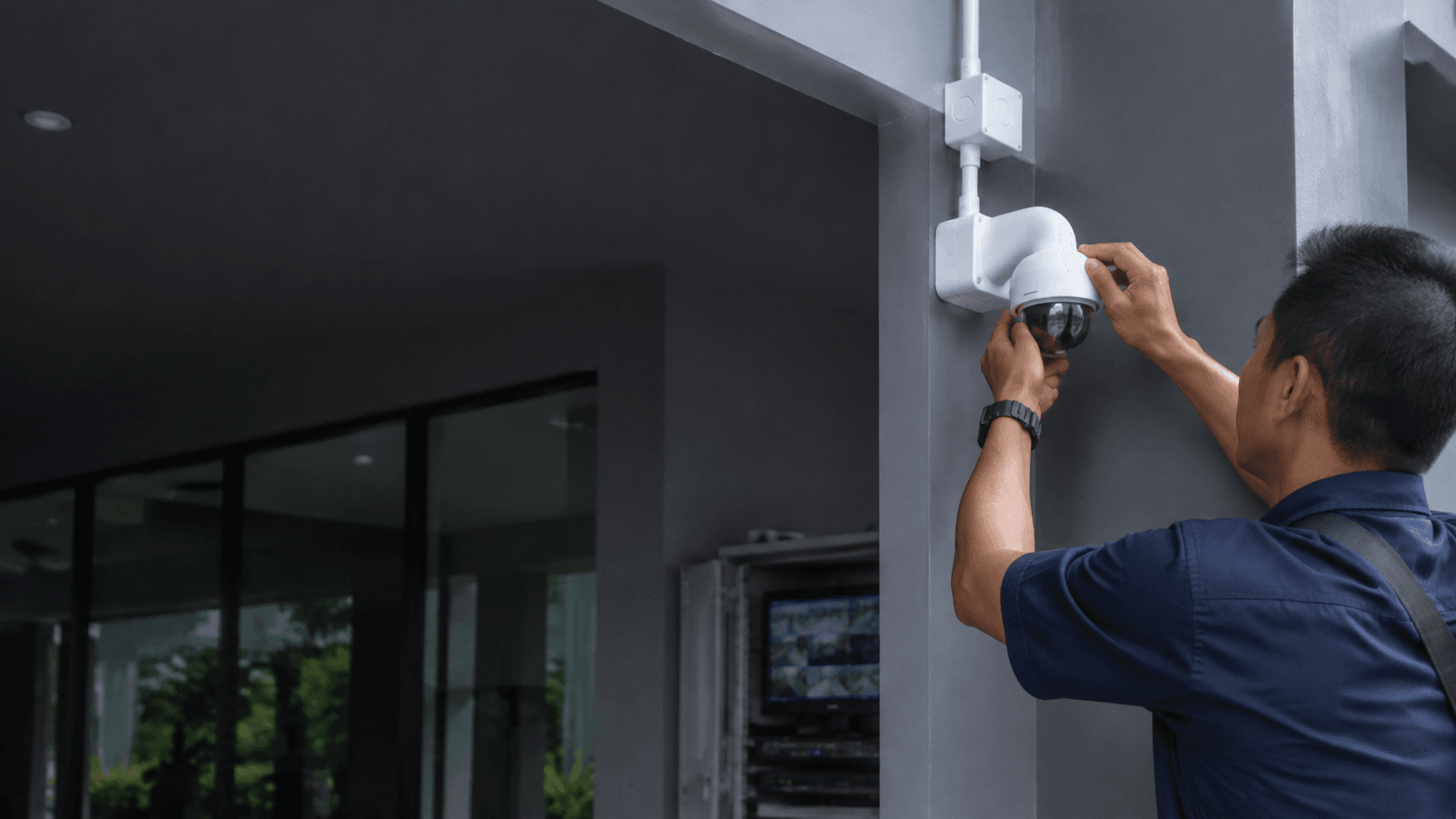
The term covers a lot of ground, and the buying decision usually comes down to how the property is laid out rather than which camera looks best in a listing. Eyonic Sdn Bhd, a security system supplier in Sarawak, plans, supplies, and installs monitoring systems with camera placement, recording, and remote viewing for homes, offices, shops, and industrial sites.
Wireless Camera System. What the Term Covers in Practice
In practice, the phrase describes a camera setup where the video signal travels without a dedicated video cable run back to a recorder. That is the part buyers care about, because cable runs through walls, ceilings, and attics are the slowest and messiest part of a conventional installation.
What the term does not settle is power. A camera still needs electricity, whether from a nearby outlet, a battery, or a solar panel, and that decision shapes where the camera can physically go. The supplied evidence does not include transmission range, frequency band, latency, or how signals behave through Malaysian wall and ceiling materials, so those specifics should be confirmed against the actual product documentation for whichever model is being considered.
The practical distinction that matters most is between a camera that records to a local recorder and one that depends on a cloud service. Local recording keeps footage on site and does not depend on an internet connection to store video. Cloud recording trades that for remote access convenience. The supplied evidence does not state storage capacity, retention periods, or subscription terms for any specific model, so those are questions to raise before committing.
How a Wireless Camera System Is Planned Before Installation
Planning starts with a site survey, not a product list. Eyonic's CCTV installation process runs through site survey, system proposal, installation, and handover, and the same sequence applies when the cameras connect wirelessly.
- Site survey. the property is walked through to identify entry points, blind spots, existing power outlets, and where a recorder can sit.
- System proposal. the survey findings are turned into a recommended camera count, placement plan, and recording setup.
- Installation. cameras are mounted, power is connected, and the recorder and network are configured.
- Handover. the system is tested and the people who will use it are shown how to view footage and check the system.
The survey is where most of the value sits. A camera pointed at a gate that is already covered by another camera adds cost without adding coverage. A camera mounted where no power reaches it forces either a cable run or a battery decision that changes the maintenance picture. Walking the property first turns those into decisions rather than surprises.
For commercial sites, the planning conversation usually widens. The Kuching Immigration Office project focused on arrival flow, staff areas, visitor movement, and dependable daily operation, which is a different brief from covering a single house entrance. A public office needs coverage that holds up through a full working day, and the camera positions follow the movement patterns of the people using the building.
What the survey should establish
The survey should confirm where power is available, which areas genuinely need coverage, how many cameras that implies, where the recorder will live, and how the property's internet connection will support remote viewing. It should also confirm who will use the system day to day, because a system designed for one person checking a phone is not the same as one designed for a front desk that needs to review an incident.
Wireless Camera System Placement and Lighting Checks
Placement is a lighting question as much as a coverage question. Eyonic recommends checking actual lighting conditions before confirming placement for ColorVu-style cameras, because a position that looks fine in daylight can behave differently once the site's real night-time lighting is taken into account.
That check is worth doing on site rather than from a floor plan. Street lighting, security lights, and neighbouring buildings all change what a camera actually sees after dark. A position that captures a clear face during the day may capture a silhouette at night if the light source sits behind the subject.
Coverage overlaps matter too. Two cameras covering the same doorway from different angles give a better chance of a usable image than two cameras covering separate areas with a gap between them. The gap is where incidents happen.
Placement questions worth settling early
Which direction does the main light come from at night? Is there a position that captures faces rather than backs as people approach? Does the camera angle include the area where a vehicle would park? Is there a second angle on the most important entry point? These are the questions that separate a system that produces usable footage from one that produces footage nobody can act on.
Recording, Remote Viewing, and Daily Operation
Recording and remote viewing are the two functions people actually use after installation. Recording determines what can be reviewed later. Remote viewing determines whether anyone can check the property without being there.
NVR setup is part of the installation scope, and it is the piece that ties the cameras to the recording and viewing functions. A recorder that is configured properly means footage is being written and can be found again. A recorder that is not means the cameras are running but the footage is not usable when it is needed.
Remote viewing depends on the property's internet connection and on the viewing app being set up correctly on the devices that will use it. Handover is where that gets tested, because a viewing setup that has never been opened on the actual phone or tablet is not finished.
Daily operation is usually simpler than buyers expect. The routine is checking that the system is recording, confirming the cameras are online, and reviewing footage when something needs attention. The complexity sits in the setup, not the daily use.
What handover should cover
Handover should include a working demonstration of live viewing and playback, confirmation that recording is active, and a walkthrough of how to find footage from a specific time. It should also cover what to do if a camera goes offline, since that is the most common day-to-day issue with any camera system.
What a Costs in Malaysia
Cost depends on camera count, recorder, storage, and how much installation work the property needs. Eyonic's published package pricing starts at RM 1,599 for a Hikvision CCTV package covering camera supply and setup, basic recording configuration, and mobile viewing handover. The same RM 1,599 starting figure applies to the Hikvision alarm system and the autogate package.
Larger projects sit well above that. The Kuching Immigration Office project carried an approximate budget of RM 12,000 to RM 28,000, and the KTA Sarawak Sdn Bhd project carried an approximate budget of RM 8,000 to RM 18,000. Those figures reflect multi-camera commercial installations with broader coverage requirements, not a single-camera home setup.
The supplied evidence does not include pricing for a wireless camera system as a distinct package, so the RM 1,599 figure should be read as the entry point for Eyonic's installed security packages rather than a quoted price for a wireless configuration. Camera count, recorder choice, and site conditions all move the number.
What drives the cost up
More cameras, a larger recorder, longer recording retention, and difficult mounting positions all add cost. Commercial sites with multiple entry points and staff areas need more coverage than a single residential entrance. Sites where power is not available at the desired camera position add either a cable run or a battery decision, and both affect the final figure.
Installation and Handover
Installation follows the plan agreed at the proposal stage. Cameras are mounted at the surveyed positions, power is connected, the recorder is configured, and remote viewing is set up on the devices that will use it.
The handover step is what makes the system usable. It is also where the limits of the installation should be stated plainly. If a camera position has a coverage gap, that is worth saying at handover rather than leaving it to be discovered later. If the property's internet connection limits remote viewing quality, that is worth confirming before the system is signed off.
Eric Yong, founder of Eyonic Security Systems, has worked in the industry for more than 10 years and is experienced in technical installation of digital security solutions for commercial businesses in Sarawak. That experience shows up most in the survey and placement decisions, where the difference between a workable system and an awkward one is usually settled before any hardware is mounted.
For properties in Sarawak, the practical next step is a site survey. Share the location, property type, and required system with Eyonic on WhatsApp at +60 11-5111 7959.