
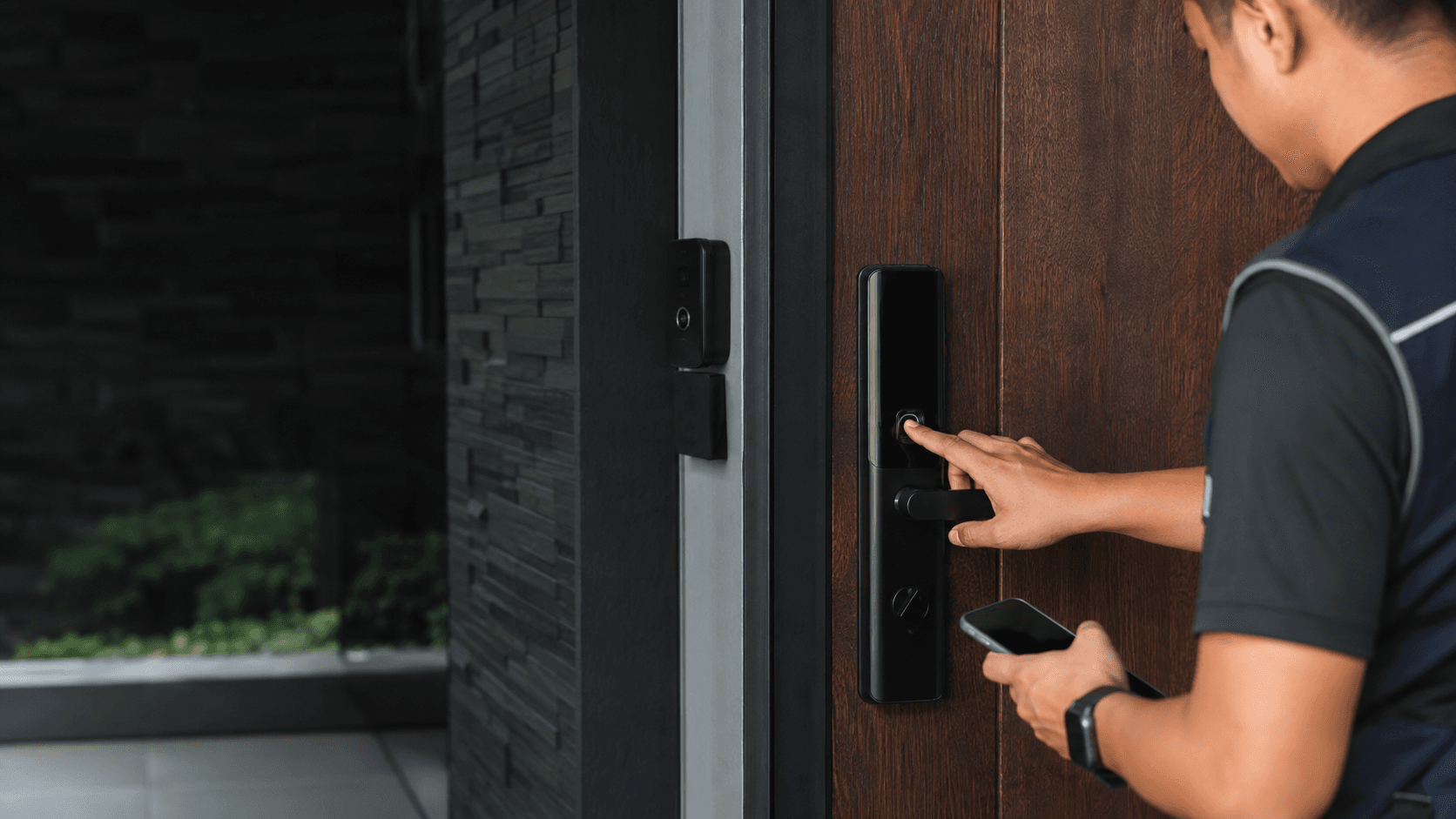
Rental doors are usually the landlord's property, so the practical question is not which lock is newest but which change can be undone. A retrofit smart lock keeps the existing deadbolt body in place and adds a controllable outside section, which means the door is not permanently altered. That single decision shapes permission, cost, and what happens at handover.
Eyonic reviews smart lock door access and treats it as good for controlled convenience when user permissions and backup entry are planned properly. The same review notes that smart locks work best when the door condition, user roles and backup method are reviewed before installation, and that for business use Eyonic usually checks whether a standalone smart lock or an access-control panel is more appropriate.
What a smart lock for renters changes about daily entry
Daily entry changes in three ways: the key stops being the only way in, entry can be time-limited for other people, and a record of who entered becomes possible. None of those require replacing the door.
A retrofit unit sits over the interior side of an existing deadbolt and turns the thumbturn. The outside of the door keeps its original key cylinder, so the landlord's key still works and the unit can be removed later. A full deadbolt replacement removes the existing lock body and installs a new one, which is a permanent change to the door.
For a rented unit, the retrofit route usually matters more than the feature list. Access methods such as a keypad code, a phone app, or a temporary code for a cleaner or a family member can all be issued and revoked without cutting a new key. When the tenancy ends, the codes stop existing and the hardware comes off.
Where the daily benefit is smallest
A single-occupant rental with one door and no visitors gains little from remote access. The benefit appears when several people need entry at different times, when keys are repeatedly lost, or when the tenant travels and needs someone else to enter.
Retrofit adapters versus full deadbolt replacement on a rented door
The two options differ mainly in reversibility. A retrofit adapter leaves the existing deadbolt in place; a full replacement substitutes it. On a rented door, reversibility is the deciding factor because the landlord's original hardware has to go back.
| Consideration | Retrofit adapter lock | Full deadbolt replacement |
|---|---|---|
| Reversibility | Removes and restores the original deadbolt | Original deadbolt is taken off the door |
| Landlord approval | Still required, but easier to justify | Required, and harder to reverse |
| Door modification | Typically none beyond the existing deadbolt | Depends on whether the new body matches the existing bore |
| Backup entry | Original key cylinder usually remains usable | Backup depends on the new lock's own key or power |
| Suitability for a rented unit | Better fit where the deadbolt is sound | Better fit where the existing deadbolt is failing |
The trade-off is not only about damage. A retrofit unit depends on the existing deadbolt working smoothly, because it is turning that mechanism rather than replacing it. A stiff or misaligned deadbolt will make any retrofit unit unreliable, and no amount of app configuration fixes a mechanical problem.
A full replacement can be the better answer when the existing deadbolt is worn, when the door has already been modified, or when the landlord agrees to the change in writing. In that case the original hardware should be labelled and stored so it can be reinstalled.
Permission, reversibility and move-out condition
Permission should be obtained in writing before any hardware is touched, and the message should describe the change, the reversibility, and who holds a physical key. A landlord who understands that the original deadbolt goes back is more likely to agree than one who hears only that a lock is being replaced.
Reversibility has two parts. the hardware must be removable, and the door must be left in the condition it was found. Photographs taken before installation are the simplest record. They also settle any dispute about existing scratches, paint, or a door that was already misaligned.
Move-out condition is where most rental lock problems surface. The practical sequence at the end of a tenancy is:
- Remove all temporary and permanent user codes from the lock and the app.
- Delete the tenant's account access and any shared guest access.
- Take the retrofit unit off the door and refit the original deadbolt.
- Test the original key from outside and the thumbturn from inside.
- Photograph the reinstalled hardware and the door edge.
- Hand the physical keys back and confirm the handover in writing.
If the original deadbolt was damaged or lost, that is a repair cost rather than a restoration. Keeping the removed hardware in a labelled bag from day one avoids that outcome.
Who pays
Cost responsibility depends on the tenancy agreement and on whether the change benefits the property or only the tenant. A retrofit unit bought by the tenant and removed at the end is normally the tenant's cost. A replacement deadbolt that stays with the property is a different conversation, and the agreement should say who owns it before installation rather than after.
Access methods, backup entry and battery behaviour
Every smart lock for renters needs at least one entry method that does not depend on the lock's electronics. A keypad code, a phone app, and a physical key are three separate paths, and losing all three at once is the failure case worth designing against.
Access methods commonly available on retrofit and replacement locks include a keypad code, a phone app, a physical key, and in some models a fingerprint reader or card. The useful distinction for a rental is between methods that can be revoked remotely and methods that cannot. A code can be deleted in seconds; a copied physical key cannot.
User permissions matter more in a rental than in an owner-occupied home, because the people who need entry change. A cleaner, a family member, or a contractor should have a code that expires, not a key that persists. Eyonic's review of smart lock door access notes that user permissions and backup entry need to be planned properly, which is the same point from the installation side.
Battery behaviour is the constraint that catches people out. A lock that runs on batteries will eventually stop responding, and the failure usually happens at the least convenient moment. The practical safeguards are a low-battery warning that is actually noticed, a spare set of batteries kept in the unit, and a physical key stored somewhere outside the home. A key locked inside the unit is not a backup.
Where a lock supports remote access, that access depends on the lock's own connectivity and on the building's network. A rental with unreliable Wi-Fi or no hub should not rely on app-only entry.
Door condition checks before any is confirmed
Door condition decides whether a retrofit is viable at all. The checks below are the ones that determine fit, and they should be done before a unit is chosen rather than after it arrives.
- Confirm the tenancy agreement allows the change, and get written consent from the landlord.
- Photograph the existing deadbolt, the door edge, and the frame before anything is removed.
- Measure the door thickness and the backset, which is the distance from the door edge to the centre of the deadbolt.
- Confirm the existing deadbolt is removable or adaptable, and that it turns smoothly by hand.
- Agree in writing who holds a physical backup key and where it is kept.
- Record the original hardware, including any screws and trim, for reinstatement at move-out.
A deadbolt that sticks, a door that has swollen with damp, or a frame that has shifted will all affect how a retrofit unit performs. These are mechanical issues, and they are worth resolving before the lock is fitted. The same principle applies to placement decisions elsewhere in a property: Eyonic recommends checking actual conditions before confirming placement rather than assuming a standard position will work.
For a rental, the door is also shared infrastructure. A main entrance used by several units, or a door in a managed building, may fall under rules that the tenant does not control. That is a question for the landlord or the management office, not something to settle by reading a product page.
When a smart lock is the wrong choice
A smart lock is a poor fit when the landlord refuses any change, when the existing deadbolt is failing and the landlord will not replace it, when the door is a fire door with specific hardware requirements, or when the tenant cannot guarantee a backup key stays accessible. In those cases a keyed solution or a portable door alarm addresses the same concern without touching the door.
Practical next step with Eyonic
Eyonic Sdn Bhd is a security system supplier in Sarawak, Malaysia, working across CCTV and ELV systems for homes, offices, shops and industrial sites. The company's installation work follows a site survey, system proposal, installation and handover sequence, and its project record includes the Kuching Immigration Office, where the focus was arrival flow, staff areas, visitor movement and dependable daily operation.
Smart lock door access sits alongside that work as a controlled-convenience option rather than a standalone product line. Because the review process starts with door condition, user roles and backup method, the useful information to bring is the door type, the existing deadbolt, who needs entry, and whether the landlord has agreed in writing.
Eyonic's published packages cover CCTV, alarm and autogate at RM 1,599 each. Smart lock supply and installation is not listed among those packages, so scope and pricing for a lock job need to be confirmed directly rather than assumed from the package figures.
Share your location, property type and required system with Eyonic on WhatsApp at +60 11-5111 7959 for the next practical step.