
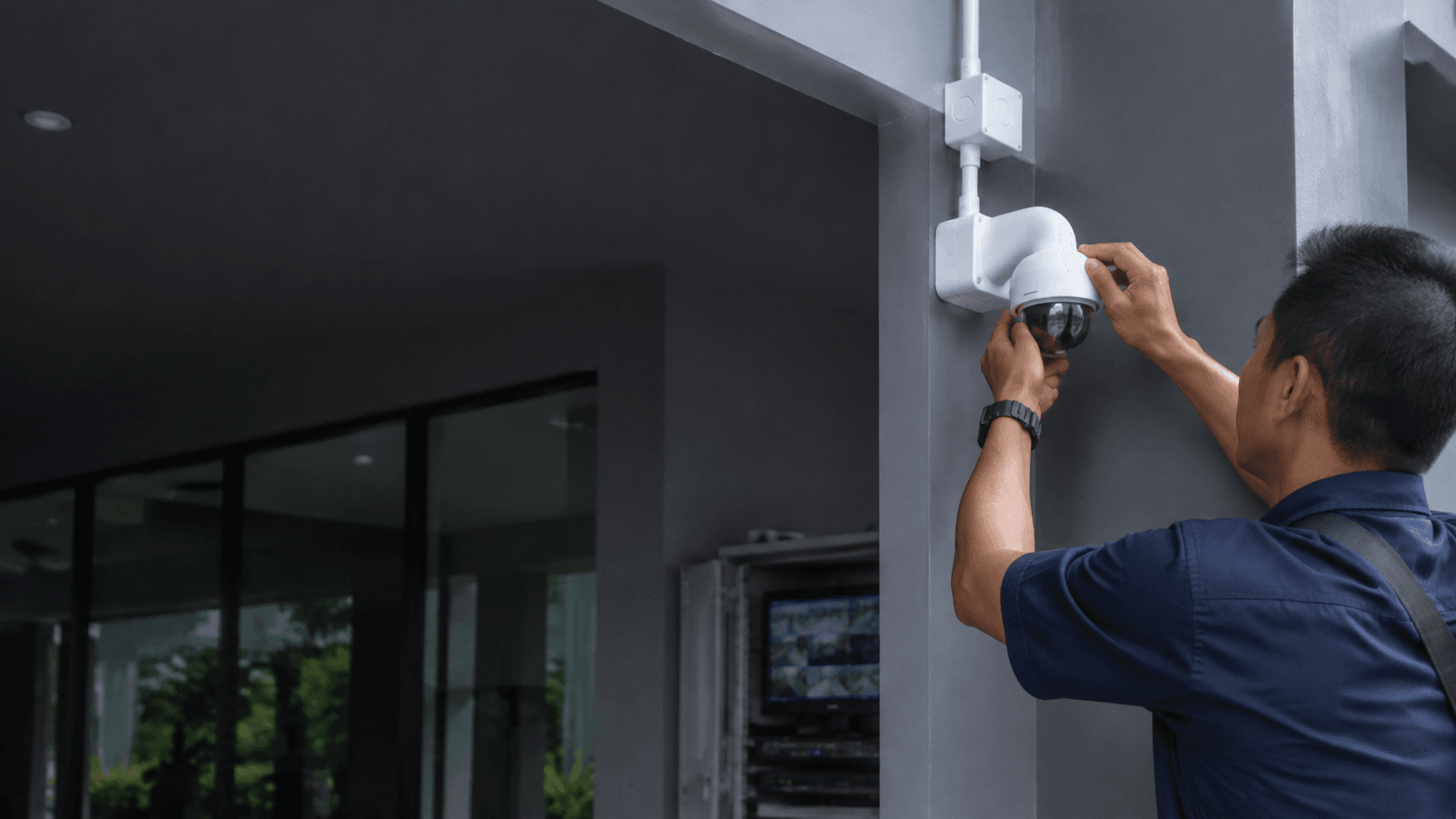
Home cctv work in Malaysia usually starts with the same question: what does the property actually need watched, and where can a camera see it properly? Eyonic Sdn Bhd, a security system supplier based in Sarawak, handles that question through planning, supply, and installation for homes, offices, shops, and industrial sites.
The sections below cover what a practical setup includes, how the Eyonic process runs, what placement and lighting checks matter, what the published packages cost, and the questions that come up before installation.
Home Cctv. What a Practical Setup Includes
A working home cctv system is four connected parts, not just cameras on a wall. Each part has to be decided before the next one makes sense.
- Camera placement — where each camera sits, what it covers, and what it cannot see.
- Recording — how footage is stored and how long it stays available.
- NVR setup — the recorder configuration that ties the cameras together.
- Remote viewing — the phone or computer access handed over at the end of the job.
Eyonic describes its CCTV work as planning, supplying, and installing monitoring systems with camera placement, recording, and remote viewing for homes, offices, shops, and industrial sites. Those four elements are the same whether the property is a single-storey terrace house or a shoplot with a back lane.
The practical difference between a system that gets used and one that gets ignored usually comes down to placement and handover. A camera aimed at a blank wall records nothing useful. A recorder nobody can operate from a phone gets checked twice and then forgotten.
How Eyonic Plans a Home Cctv Installation
Eyonic's published installation process runs in four stages: site survey, system proposal, installation, and handover. The order matters because each stage removes guesswork from the next.
- Site survey — the property is reviewed on site before any equipment is proposed.
- System proposal — the recommended setup is put in writing for review.
- Installation — cameras, cabling, and the recorder are installed and configured.
- Handover — recording and remote viewing are explained and tested with the user.
The survey stage is where coverage decisions get made. A surveyor looks at entry points, boundaries, parking, and the routes someone would actually take across the property. That is also when existing cabling, power points, and the router location get checked, because those constrain where a recorder can sit and how cameras connect.
The proposal stage turns those observations into a defined scope. Because Eyonic supplies and installs rather than only installing, the proposal can name the equipment being used instead of leaving the brand open.
Handover is the stage most often skipped by cheaper work. It is also the stage that decides whether the system is usable six months later, when someone needs to find footage from a specific night.
What the Kuching Immigration Office Project Shows
Eyonic completed a project for the Kuching Immigration Office, focused on arrival flow, staff areas, visitor movement, and dependable daily operation. The approximate budget for that type of work was RM 12,000 to RM 28,000.
That project is a public office rather than a house, so it is not a direct price comparison for a residential job. What it does show is the planning approach: coverage was organised around how people move through the building, not around filling a fixed camera count. The same logic applies at home, where the front gate, car porch, and side passage usually matter more than a camera in every room.
Eyonic has also completed work for KTA Sarawak Sdn Bhd, an engineering consultancy, covering staff movement, visitor handling, tidy cabling, and clearer daily site control, with an approximate budget of RM 8,000 to RM 18,000 for that type of work.
Home Cctv Placement and Lighting Checks
Placement is the single decision that most affects whether recorded footage is useful. Two cameras in the right positions outperform six in convenient ones.
Eyonic recommends checking actual lighting conditions before confirming placement for ColorVu-style cameras. ColorVu is a camera type built around low-light colour imaging, and its performance depends on what light is actually present at the camera position at night. A position that looks bright during a daytime survey can be almost dark at 2am.
That check is worth doing on site rather than from a plan. Street lighting, porch lights, neighbouring lights, and whether a light is left on overnight all change what a camera sees. Where a position is genuinely dark, the placement may need to move closer to an existing light source, or the lighting itself may need to change.
Other placement constraints that come up in Malaysian homes:
- Roof overhangs and awnings can block the top of a camera's view or catch rain splash on the lens.
- Direct afternoon sun on a camera facing west can wash out images at the worst time of day.
- Trees and foliage grow into a camera's view over a year or two, so a small gap now can close later.
- Height trades identification against coverage. A camera high enough to be out of reach often records faces at an angle rather than straight on.
- Cable routes decide where the recorder can sit, which in turn decides how far cable runs need to go.
Privacy is a real constraint too. A camera that overlooks a neighbour's window or a shared corridor creates a problem that is easier to avoid at survey stage than to fix afterwards.
Home Cctv Packages and Project Budgets
Eyonic publishes three packages at RM 1,599 each. They cover different systems rather than different sizes of the same system.
- Hikvision CCTV Package — RM 1,599. Camera supply and setup, basic recording configuration, and mobile viewing handover.
- Hikvision Alarm System — RM 1,599. Control panel and sensors, siren and zone setup, and user testing and handover.
- Autogate Package — RM 1,599. Motor recommendation, remote-control setup, and safety testing and handover.
The CCTV package is the entry point for a home cctv setup. It covers camera supply and setup, basic recording configuration, and mobile viewing handover, which maps directly onto the four parts of a working system described earlier.
Larger or more complex properties sit above the package price. The two completed projects with published budget ranges give a sense of where that sits: RM 8,000 to RM 18,000 for the KTA Sarawak office work, and RM 12,000 to RM 28,000 for the Kuching Immigration Office work. Both were commercial or public-sector sites with more coverage points and more cabling than a typical house, so they are an upper reference rather than a residential quote.
What moves a home job above the package price is usually camera count, cable distance, and whether additional systems are involved. A single-storey house with four cameras and a short cable run is a different job from a two-storey house with cameras at the gate, porch, side passage, and rear, plus an alarm and autogate on the same visit.
Combining systems in one installation is often cheaper than three separate visits, because the survey, cabling routes, and handover are shared. The alarm and autogate packages are priced separately, so the total depends on how many are taken together.
Home Cctv Questions Homeowners Ask Before Installing
These are the questions that come up most often during a survey, with the answers that apply in practice.
How many cameras does a house need
It depends on the number of entry and approach points, not on floor area. A typical terrace house has a front gate or car porch, a main door, and a rear or side access. Each of those is a separate coverage decision. Adding cameras beyond the entry points usually adds footage nobody reviews.
Can footage be viewed from a phone
Yes. Remote viewing is part of the Eyonic CCTV service, and mobile viewing handover is included in the Hikvision CCTV Package. The handover stage is where that access is set up and tested rather than left for the owner to configure.
What happens if the internet goes down
Recording and remote viewing are separate functions. Recording runs through the NVR setup on the local network, so footage continues to be captured when the internet connection drops. Remote viewing from outside the property is the part that depends on the connection.
Does the recorder need its own space
The NVR needs a position with power, a cable route back to the cameras, and enough ventilation. It is usually placed somewhere out of casual reach rather than in a living area, which is a decision made at survey stage because it affects cable routing.
Can a system be added to later
Adding cameras later is easier when the recorder and cabling were planned with spare capacity from the start. That is one reason the survey covers the whole property rather than only the positions being installed immediately.
What about lighting at night
This is the check Eyonic recommends before confirming placement for ColorVu-style cameras. The camera position should be assessed under the lighting that will actually be present at night, not under daytime conditions.
Next Step With Eyonic
The practical next step is a site survey, because placement, cabling, and recorder position all depend on the property itself. A survey produces the information needed for a system proposal, and the proposal defines what gets installed.
Eyonic Sdn Bhd works across Sarawak, supplying and installing CCTV and ELV systems for homes, offices, shops, and industrial sites. The founder, Eric Yong, has been in the industry for more than 10 years, with experience in technical installation of digital security solutions for commercial businesses in Sarawak.
To move forward, share the property location, the property type, and the system required with Eyonic on WhatsApp at +60 11-5111 7959. Those three details are enough to arrange a survey and prepare a proposal.