
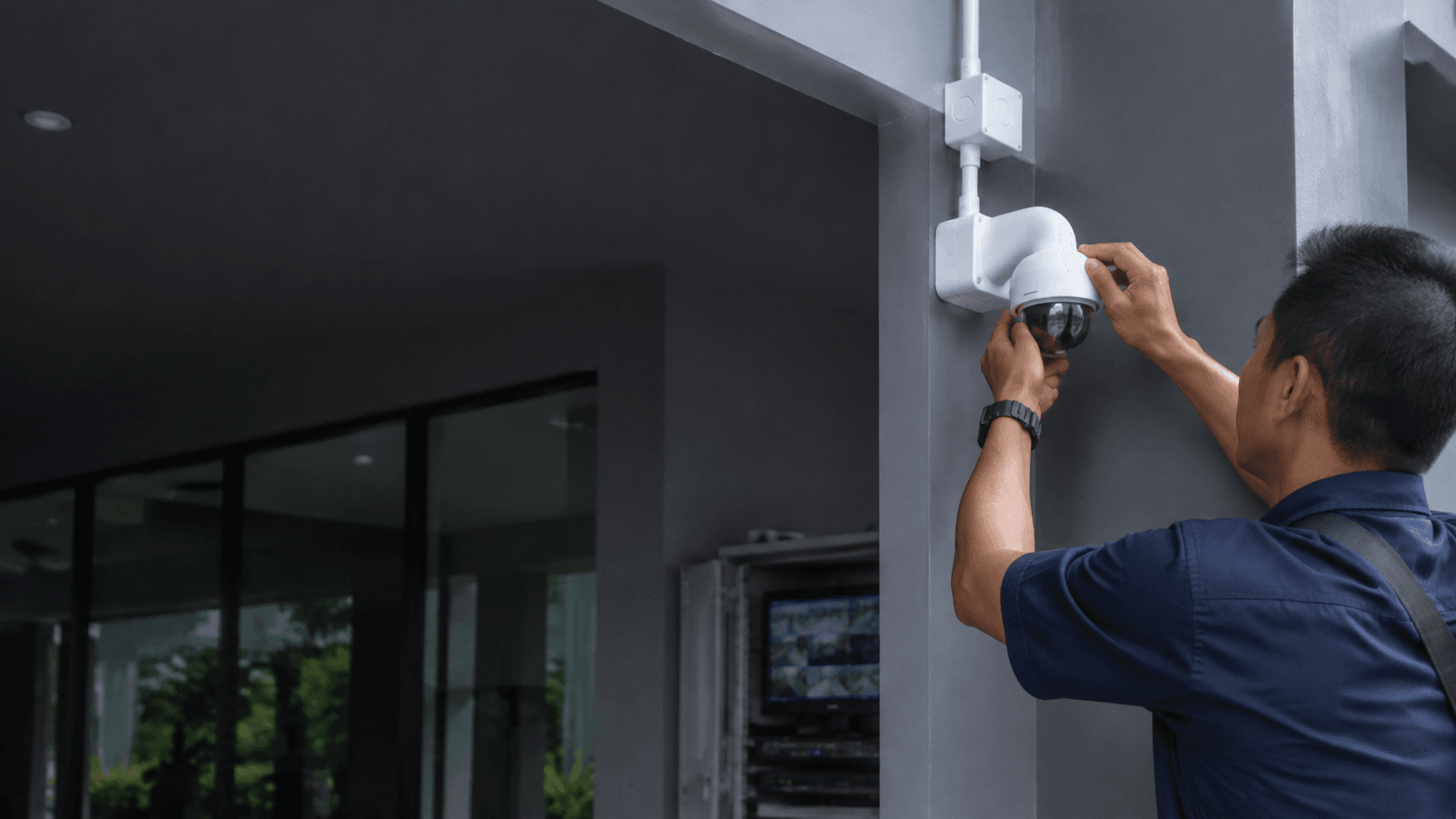
The exact-match query arlo cctv camera describes a product family rather than a single model. Arlo builds cameras around two power approaches, battery and plug-in, and the choice between them shapes where a camera can go, how often it needs attention, and whether recording depends on a subscription. That structure matters in Malaysia, where a buyer is often weighing a self-managed camera against a locally installed system with recording hardware on site.
What an Arlo CCTV Camera Is Built For
An Arlo CCTV camera is designed around flexible placement rather than fixed cabling. The wire-free models run on battery power, which removes the need to run a cable to each mounting point. Plug-in models stay tethered to a power source but avoid battery changes. Both approaches appear across the Arlo lineup, and the trade-off is straightforward: battery models trade maintenance for placement freedom, while plug-in models trade placement freedom for continuous power.
Two features recur across the range and shape how the system behaves day to day. Motion detection triggers recording rather than continuous capture, which conserves battery on wire-free units. Night vision extends usable coverage into low-light hours, though the quality of that coverage depends on the actual lighting at the mounting point rather than the camera alone.
Recording and viewing are the part buyers most often overlook. Arlo cameras typically pair with an app for remote viewing, and cloud storage is commonly tied to a subscription plan. Local storage options exist through companion hardware, but the specific tiers, storage limits and plan pricing are not confirmed in the evidence available here, so those details should be checked against an official Arlo source before any purchase decision.
Wire-Free Battery Power Versus Plug-In Power
The power decision usually comes down to three practical questions: how far the mounting point sits from an outlet, how often someone can physically reach the camera, and how much recording activity the location generates.
A battery-powered camera suits a gate, a back lane, a perimeter wall or any point where running cable is awkward or expensive. The cost is maintenance. Frequent motion events drain a battery faster, and a camera mounted high on a wall is inconvenient to recharge. A plug-in camera suits a fixed position near power, such as under a porch or above a shop entrance, where continuous power removes the recharge cycle entirely.
There is a middle case worth naming. A location with heavy foot traffic and no nearby outlet is the hardest fit for either approach, because battery life suffers and cabling is impractical. That scenario often pushes buyers toward a wired system with a fixed recording unit instead.
Where an Arlo CCTV Camera Fits in Malaysia
Malaysia's climate and building stock shape which camera approach works. Outdoor units face heavy rain and direct sun, so weather resistance and mounting position matter as much as the camera itself. Shophouses, terrace homes and commercial lots often have awkward cable routes, which is where a wire-free camera has a genuine advantage.
The harder question for Malaysian buyers is support. Local availability, warranty terms, authorised dealer status and pricing for Arlo hardware are not confirmed in the evidence available here. A buyer comparing options should verify those points directly with a supplier before committing, because a camera that cannot be serviced locally carries a different risk profile than one bought through an established channel.
Eyonic Sdn Bhd is a security system supplier based in Sarawak that plans, supplies and installs monitoring systems with camera placement, recording and remote viewing for homes, offices, shops and industrial sites. The company's published packages include a Hikvision CCTV package at RM 1,599, covering camera supply and setup, basic recording configuration and mobile viewing handover. That figure is a useful reference point when comparing a self-managed camera purchase against an installed system.
For buyers who want a locally installed and supported setup, Eyonic's CCTV installation process follows a defined sequence.
- Site survey to assess the property, sightlines and existing infrastructure.
- System proposal covering camera placement, recording and viewing.
- Installation of cameras, recording hardware and cabling.
- Handover covering configuration, mobile viewing and user testing.
That sequence applies to installed systems rather than to self-purchased Arlo hardware. Whether Eyonic supplies, installs or supports Arlo products specifically is not confirmed in the available evidence, so that question belongs in a direct conversation with the supplier.
Camera Placement and Lighting Checks Before Installation
Placement decides whether a camera is useful or decorative. A camera pointed at a blank wall records nothing of value, and a camera mounted too high captures the tops of heads rather than faces. The practical checks are sightline, coverage overlap and whether the target area is actually within the camera's field of view from the proposed angle.
Lighting deserves its own check. Eyonic recommends verifying actual lighting conditions before confirming placement for ColorVu-style cameras, and the same discipline applies to any camera relying on night vision. A mounting point that looks adequate in daylight can be too dark at night, and a point facing a bright streetlight can produce glare that washes out the image. Testing the location under real night-time conditions, rather than assuming from a specification, avoids a camera that only works during the day.
Power and network reach complete the placement picture. A wire-free camera still needs sufficient Wi-Fi signal at the mounting point, and a plug-in camera needs a usable outlet. Both constraints are easier to resolve during a site survey than after installation.
Comparing an Arlo CCTV Camera With an Installed CCTV System
The comparison comes down to who manages the system and where the recording lives. An Arlo CCTV camera is largely self-managed: the owner handles placement, battery or power, app setup and any subscription. An installed system is supplier-managed: a site survey determines placement, recording hardware sits on site, and handover covers configuration and mobile viewing.
Recording location is the sharpest difference. Installed systems typically record to a local recorder, which keeps footage on the premises and avoids an ongoing subscription for storage. Arlo's model commonly leans on cloud storage tied to a plan, though local storage options exist through companion hardware. Buyers who want footage to stay on site, or who want to avoid recurring costs, tend to favour the installed approach. Buyers who want flexible placement and minimal cabling tend to favour the wire-free approach.
Scale changes the answer too. A single camera covering a gate is a reasonable wire-free job. A shop, office or industrial site with multiple entry points, staff areas and visitor movement needs coordinated coverage, which is where a surveyed and installed system performs better. Eyonic's work for the Kuching Immigration Office focused on arrival flow, staff areas, visitor movement and dependable daily operation, and the company's project work for KTA Sarawak Sdn Bhd covered staff movement, visitor handling and tidy cabling in an office setting. Both illustrate the kind of multi-zone requirement that a single wire-free camera does not address.
Budget expectations differ as well. Eyonic's published Hikvision CCTV package sits at RM 1,599, and larger project work has carried approximate budgets in the RM 8,000 to RM 18,000 range for an office setup and RM 12,000 to RM 28,000 for a public office. Those figures describe installed project work, not Arlo hardware, and they are useful mainly as a scale reference.
Which Approach Suits Which Property
A rented property or a home where drilling and cabling are undesirable fits a wire-free camera, because nothing needs to be run through walls. A shop entrance with a nearby outlet fits a plug-in camera, which avoids battery maintenance on a high-traffic door. A multi-zone office, factory or government site fits a surveyed installed system, because coverage, recording and handover all need coordination.
The edge case worth flagging is a property with poor Wi-Fi reach and no practical cable route. Neither a wire-free nor a plug-in camera performs well there without first solving connectivity, and that problem is usually cheaper to fix before buying cameras than after.
For buyers who want to move forward on an installed system, sharing the location, property type and required system with Eyonic on WhatsApp at +60 11-5111 7959 is the practical next step.