
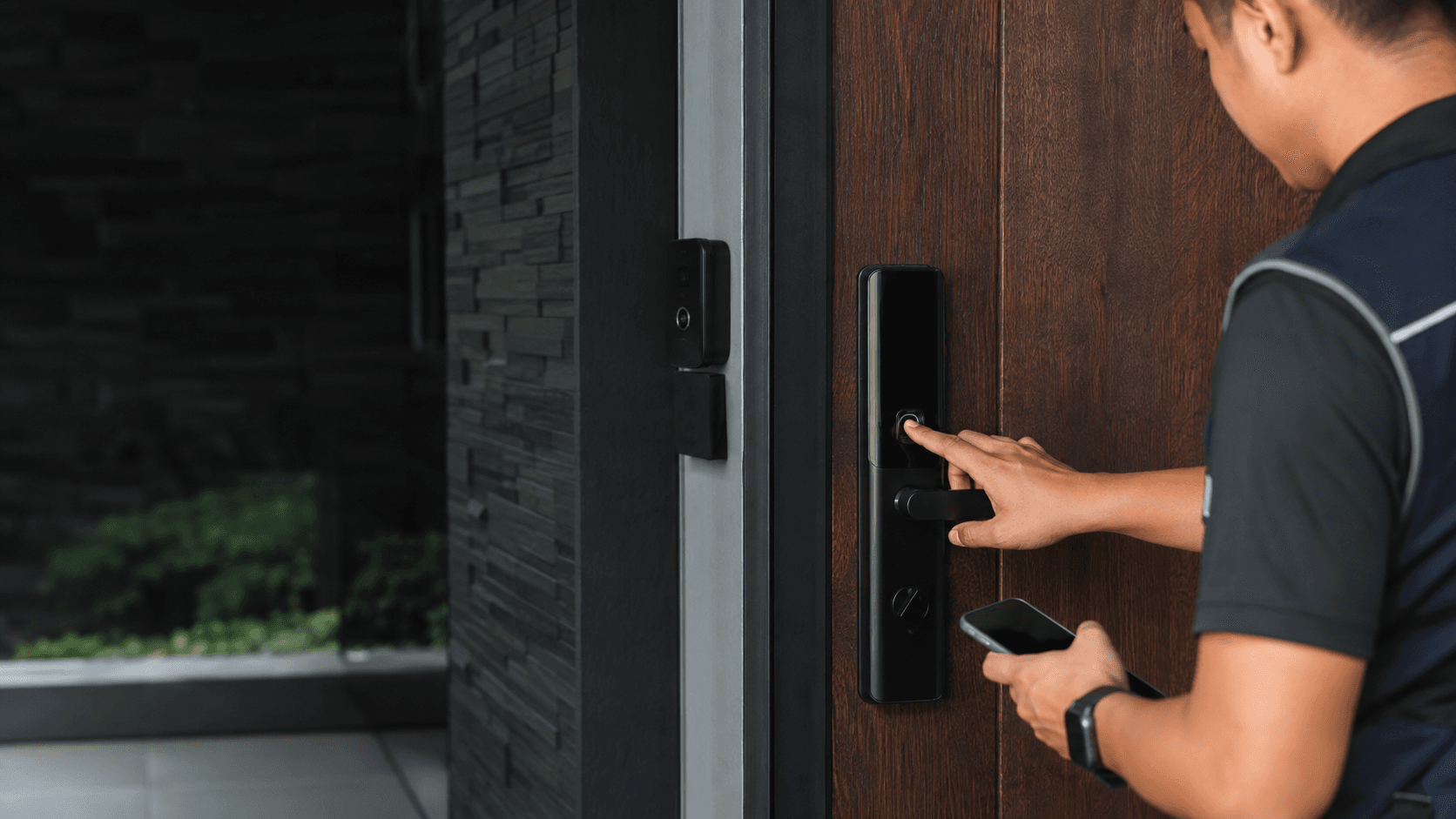
Lockly Secure Plus Latch Edition sits in a specific niche: homes and offices where the door uses a latch rather than a deadbolt, and where keyless entry is wanted without rebuilding the door. The product is documented by Lockly under model PGD628F, with a user manual and an installation guide published on the Lockly support desk. Eyonic Sdn Bhd, a security system supplier in Sarawak, lists smart lock door access among its product reviews and notes that smart locks work best when door condition, user roles and a backup entry method are reviewed before installation.
Lockly Secure Plus Latch Edition: What Matters Before Choosing
The first question is mechanical, not digital. A latch lock replaces the existing latch hardware on the door. A deadbolt lock replaces a deadbolt. These are different openings, and the wrong edition will not fit no matter how good the electronics are.
Lockly documents both a Latch Edition and a Deadbolt Edition of the Secure Plus line, and the support desk publishes separate installation material for the latch version. That separation exists because the mounting, the bore and the strike differ. Checking the door edge before ordering avoids the most common return reason for this category.
The second question is how the lock will be used day to day. A household with a few regular users has different needs from an office where staff, cleaners and visitors come and go. Lockly's Secure Plus line supports fingerprint access, the PIN Genie keypad, app-based control and offline access codes, and the wider Lockly ecosystem includes a Secure Link Wi-Fi Hub for remote features. Which of those matter depends on whether anyone needs to open the door without being physically present.
Choosing the Right Lockly Secure Plus Latch Edition
A short sequence keeps the decision grounded in the door and the people using it.
- Confirm the door uses latch hardware, not a deadbolt, and note the door thickness and edge bore.
- Decide who needs entry. household members, staff, tenants, cleaners or short-stay guests.
- Choose the entry methods that match those users, such as fingerprint, keypad code or app access.
- Decide whether remote control and status reporting are needed, which affects whether a Wi-Fi hub is required.
- Agree on a backup entry method before installation, so a flat battery or a lost phone does not lock anyone out.
- Check the door closes and latches cleanly before fitting the lock, since alignment problems show up as lock problems later.
Step four deserves emphasis. Community discussion around this model centres on whether the Lockly Secure Link hub is needed for full lock status and door open/close reporting in a smart home platform. That is a hub question, not a lock question, and it changes the budget and the setup work.
What is lockly secure plus latch edition?
It is the latch-mounted version of the Lockly Secure Plus smart lock, sold under model PGD628F. Lockly publishes a dedicated user manual and installation guide for it, and retailers list it as the Lockly Secure Plus Latch Edition (PGD628F). The core access methods are a biometric fingerprint sensor and the PIN Genie keypad, which shuffles the position of the digits so a bystander cannot learn a code from finger placement.
The distinction from the Special Edition with card access is the credential set. The card-access variant adds RFID cards for users who prefer a tap over a code or a fingerprint. The Latch Edition is the version to look at when the door hardware is the constraint and the access method is the variable.
Peek-Proof Smart Lock | Lockly Secure Plus | Lockly®
Peek-proof is the phrase Lockly uses for the PIN Genie keypad, and it describes a real mechanism rather than a marketing flourish. A conventional keypad shows ten fixed positions, so wear marks and shoulder-surfing both leak information. PIN Genie displays the digits across a small set of buttons and reshuffles them, so the same code is entered in different physical positions each time.
That matters most in shared or semi-public entrances: a shop front, a clinic door, a rental unit, an office corridor. In a private home with a single entrance, the benefit is smaller but not zero, because delivery staff, contractors and visitors all stand at the same door.
The fingerprint sensor covers the speed case. A registered finger opens the door without a code, which suits the person who arrives with full hands. The keypad covers the case where a finger is wet, dirty or unavailable, and offline access codes cover the case where the lock has no network connection at that moment.
Practical Considerations for Lockly Secure Plus Latch Edition
Several constraints decide whether this lock is a good fit, and they are worth stating plainly.
Door condition comes first. Eyonic's own product review guidance notes that smart locks work best when door condition, user roles and backup method are reviewed before installation. A door that does not close cleanly, or a frame that has shifted, will cause more trouble than any software setting.
Business use needs a different question. For commercial premises, Eyonic checks whether a standalone smart lock or a full access-control panel is more appropriate. A single latch lock suits a small office with one controlled entrance. A site with multiple doors, staff shifts and audit requirements usually needs a panel-based system instead.
Remote features depend on the hub. App control from outside the home, status reporting and integration with smart home platforms generally rely on the Secure Link Wi-Fi Hub. Without it, the lock still works at the door, but the remote layer is thinner.
Backup entry is not optional. Every smart lock needs a plan for a depleted battery or a lost phone. That plan should be agreed before installation, not discovered afterwards.
Installation is a real task. Lockly publishes an installation guide, and the work involves removing existing hardware, fitting the new latch assembly and aligning the strike. A door that has been painted over or has an oversized bore adds time.
How Lockly Secure Plus Latch Edition compares with related models
| Model | Mounting | Notable access method | Best fit |
|---|---|---|---|
| Lockly Secure Plus Latch Edition (PGD628F) | Latch | Fingerprint and PIN Genie keypad | Latch-style doors needing keyless entry |
| Lockly Secure Plus Special Edition with Card Access | Latch and deadbolt variants | RFID card access alongside fingerprint and keypad | Sites where some users prefer a card over a code |
| Lockly Secure Pro | Deadbolt | Wi-Fi enabled with app monitoring | Doors with a deadbolt and a need for remote visibility |
The table is a fit guide, not a ranking. The right column depends on the door in front of the installer, and the mounting row is the one that cannot be worked around.
Making an Informed Choice About
The decision usually comes down to three checks. Does the door take a latch lock? Do the people who need entry have credentials that suit fingerprint, keypad or app access? Is a hub needed for the remote features that are actually going to be used?
If all three answers line up, the Lockly Secure Plus Latch Edition is a straightforward fit. If the door takes a deadbolt, the Secure Pro or a deadbolt edition is the correct starting point instead. If the site has several controlled doors and staff who change regularly, a panel-based access control system will serve better than a single smart lock, and that is a conversation worth having before any hardware is ordered.
For readers in Sarawak, Eyonic Sdn Bhd supplies and installs security and ELV systems, including smart lock door access, and has completed projects such as the Kuching Immigration Office and KTA Sarawak Sdn Bhd. Share your location, property type and required system with Eyonic on WhatsApp at +60 11-5111 7959 for the next practical step.