
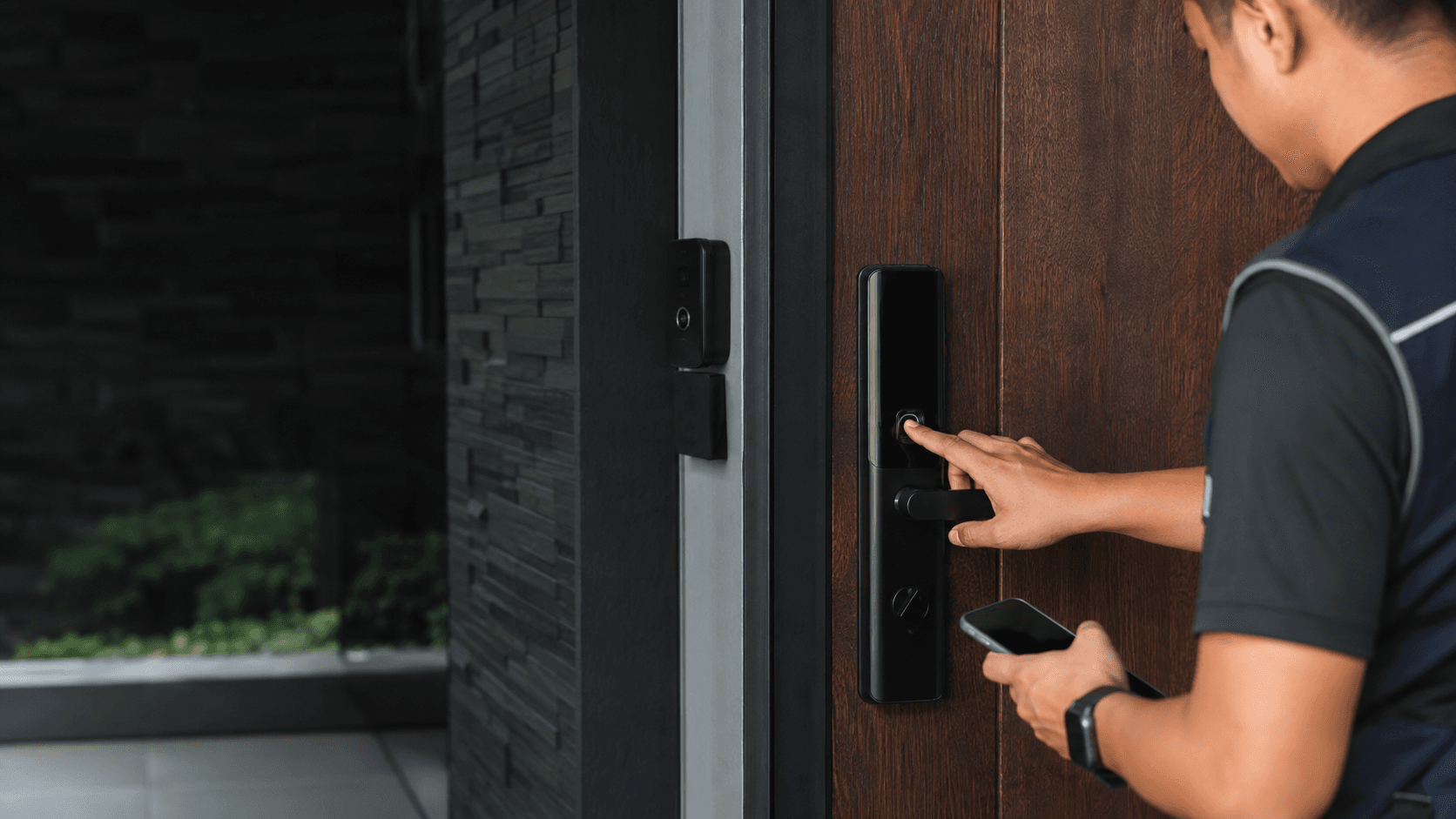
Bosch Smart Door Lock. What Matters Before Choosing
The Bosch Smart Door Lock sits in a crowded category where the brand name carries weight, but the actual buying decision turns on door condition, user roles and what happens when the battery dies or the network drops. Bosch smart lock listings in Malaysia and Singapore cover several distinct families, and they are not interchangeable.
Observed competitor pages group the range into handle locks, full-panel digital locks and gate locks. The EL600 and EL600V appear as full-panel digital door locks with fingerprint, PIN, RFID card, mechanical key and app access. The EL800A appears as a higher-tier model with a similar access mix. The ID40, ID60 and ID60C sit in a different design family. The FU6 Plus, FU8 Plus, T15 and T15 Plus appear as digital gate locks rather than door locks.
That split matters because a gate lock and a door lock solve different problems. A gate lock usually needs weather tolerance and a different mounting approach. A door lock usually needs to fit an existing mortise cutout or a specific door thickness. Choosing the wrong family means the hardware may not fit at all, regardless of how good the electronics are.
What the evidence actually supports
Published Bosch smart lock material describes fingerprint, password, NFC card and dual verification as access methods on the ID60. Competitor listings for the EL600V describe a 3.97-inch screen, a 160-degree night vision camera, two-way video calls and real-time alerts. Those are product-level claims from reseller pages, not from a single authoritative specification sheet, so they should be verified against the specific model before purchase.
One documented constraint appears repeatedly in Bosch lock documentation: the lock should not be exposed to rain, sunlight or outdoor environments. That single line rules out mounting a standard Bosch door lock on an exposed exterior gate or an unsheltered doorway. Any outdoor installation needs a model explicitly rated for it, or a sheltered position.
Choosing the Right Bosch Smart Door Lock
The practical sequence below reflects how a security installer would approach the decision. It is not a product ranking.
- Confirm the door type and thickness. Full-panel digital locks need a compatible mortise cutout and a door thickness within the model's stated range.
- Decide whether the door is sheltered. Bosch documentation warns against rain, sunlight and outdoor exposure, so an exposed gate needs a different product family.
- List who needs entry and how often. Households with regular visitors, domestic helpers or short-stay guests need temporary or time-limited credentials.
- Choose the access methods that match those users. Fingerprint suits frequent users; PIN suits occasional visitors; cards suit staff; a mechanical key is the fallback.
- Plan the backup entry method before installation, not after. A dead battery or a failed reader should never leave a property with no way in.
- Check whether a standalone lock or a managed access-control panel fits better. For business premises with multiple doors and staff roles, a panel is often the more appropriate choice.
- Confirm the power source and expected battery type, then set a replacement routine.
Eyonic's own product guidance makes the same point in different words: smart locks work best when door condition, user roles and backup method are reviewed before installation, and for business use the choice between a standalone smart lock and an access-control panel should be checked first.
Bosch Smartlock models and what separates them
The Bosch Smartlock range observed across competitor pages includes the ID40, ID60, ID60C, EL600, EL600F, EL600VF, EL800VF, FU6 Plus, FU8 Plus, T15 and T15 Plus. The naming is not self-explanatory, and the differences are not limited to finish.
Door locks and gate locks are the first split. The EL and ID families are door locks. The FU and T15 families are described as digital gate locks. A buyer searching for a lock for a front gate and a buyer searching for a lock for a main door are looking at different product lines, even though both appear under the same brand.
The second split is access method. Some models lean on fingerprint and PIN. Others add facial recognition, as the EL600B listing does. The EL600V adds video and a screen. More access methods mean more convenience, but also more configuration and more ways for a user to be locked out if permissions are not set up carefully.
What is bosch smart door lock?
A Bosch Smart Door Lock is a battery-powered electronic lock that replaces or augments a mechanical door lock and grants entry through fingerprint, PIN code, RFID card, mobile app or a physical key, depending on the model. It is a product category rather than a single device.
The category exists because mechanical keys have two persistent problems: they can be copied, and they cannot be revoked. An electronic lock lets an owner add or remove a user without changing the cylinder. That is the core functional difference, and it is the reason the category appeals to landlords, offices and households with changing occupants.
The trade-off is dependency. An electronic lock depends on battery power, and often on a reader or a network connection. A mechanical lock depends only on the key and the mechanism. Most Bosch smart lock models keep a mechanical key as a fallback precisely because of this.
Bosch Smartlock access methods in practice
Fingerprint access is the fastest method for people who use the same door every day. It fails when fingers are wet, dirty or injured, which is why a PIN or card backup matters in kitchens, workshops and outdoor-adjacent doors.
PIN codes suit visitors and short-term users because they can be shared verbally and changed afterwards. The weakness is that a shared code can be observed or passed on.
RFID cards suit staff and family members who want a physical token without carrying a key. Cards can be lost, so a card-based system needs a way to disable a missing card.
App access and video features, where supported, add remote visibility and temporary credential issuing. They also add a dependency on the app, the phone and the network, so they work best as an addition to a local access method rather than a replacement.
Practical Considerations for Installation
Installation is where most smart lock projects succeed or fail. The electronics are usually the easy part. The door is the hard part.
Door thickness, mortise dimensions and existing cutouts determine whether a full-panel lock fits without modification. A door that has been cut for a different lock may need patching, re-cutting or replacement. That work is carpentry, not electronics, and it should be assessed before the lock is ordered.
Shelter is the second constraint. Bosch documentation states the lock should not be exposed to rain, sunlight and outdoor environments. A covered porch or a recessed doorway is different from an exposed gate post. Where a door is exposed, the realistic options are a sheltered mounting position, a weather-rated model from a different family, or a different access-control approach entirely.
Power is the third. Battery-powered locks need a replacement routine, and the routine should be tied to something memorable rather than to a failure. A lock that dies while the property is empty is an inconvenience; a lock that dies while a tenant is locked out is a problem.
User management is the fourth. A lock with ten users and no record of who holds which credential is harder to manage than a mechanical lock. Naming users, assigning roles and removing credentials when people leave is the part that keeps the system useful.
Where a smart lock fits and where it does not
A single-door home with a sheltered entrance and a small household is a straightforward fit. The lock replaces a keyed cylinder, the household uses fingerprint or PIN daily, and the mechanical key stays in a safe place.
A rental property with changing tenants is also a reasonable fit, provided the owner can manage credentials remotely or on site and can revoke access between tenancies.
An office with multiple doors, staff shifts and visitor traffic is a weaker fit for a standalone lock. The same convenience that helps a household becomes a management burden across many doors and many people. In that setting, a managed access-control panel is usually the more appropriate choice, which is consistent with Eyonic's own guidance on business use.
An exposed gate is the clearest mismatch. Bosch documentation warns against outdoor exposure, so a standard door lock is the wrong product for that position regardless of price or features.
Making an Informed Choice About
The decision comes down to four checks: does the lock fit the door, is the door sheltered, can every user get in reliably, and is there a backup method that does not depend on power or network. If all four are satisfied, the model choice is mostly about access methods and finish.
Where the checks fail, the answer is usually a different product family or a different approach rather than a different brand. A gate needs a gate lock. A multi-door office needs a panel. An exposed doorway needs shelter or a weather-rated device.
Eyonic Sdn Bhd supplies and installs security and ELV systems in Sarawak, including smart lock door access, CCTV, alarm systems, autogate systems, keyphone intercom and Starlink internet installation. The company's project work includes the Kuching Immigration Office, where the focus was arrival flow, staff areas, visitor movement and dependable daily operation, and KTA Sarawak Sdn Bhd, where the focus was staff movement, visitor handling, tidy cabling and clearer daily site control. Those projects illustrate the same principle that applies to a smart lock: the hardware matters less than whether the layout, the users and the daily routine actually work together.
For a single door, the practical next step is to confirm the door type, thickness and shelter, then match those facts to a specific model. For a property with several entry points, the more useful first step is to map who needs access where, and then decide how many of those points a smart lock should cover.
Share the location, property type and required system with Eyonic on WhatsApp at +60 11-5111 7959 for the next practical step.